

What to Look Out for When Negotiating with ERP Providers like Oracle & SAP


Do you know how to protect yourself and stay in the driver’s seat during contract negotiations so that you won’t be held ransom by your ERP provider?
In this article, we’re going to outline the top things you need to take into consideration when negotiating contracts with Oracle, SAP, and any other ERP system.
We’re going to share with you the key terms to clarify in your contracts to avoid extra costs and substantial frustrations down the road.
What to Look for in an ERP
While no company has a crystal ball to know exactly what the future will look like, you do need to identify how you’d like your business to function over the next 10 years.
Why 10 years?
Typical business roadmaps project as far as 3-5 years in the future. Most ERP systems relationships last a minimum of 10 years. You need to know how your business will function in order to know what you’d even need an ERP for and what it would need to do.
You need to be risk-averse in your contract negotiation in order to cover your bases for what could happen.
Once you have your future vision in place, you’ll look at the supplier landscape. Compare what each of the top ERP systems providers offers and how it’ll meet your needs outlined above. Create a Supplier Decision Matrix and stack each contender against it to determine which is the best for your corporation.
Once you know which ERP software is right for your corporation, you’ll need to dig deep to really figure out the total ownership cost. This is the tricky part and is best handled through careful contract negotiation, financial analysis, and service management.
Key Things to Consider When Negotiating an ERP Software Contract
The contract is the most important factor when determining the total cost of ownership of the ERP and there are generally only two triggers for renegotiation once a contract is in place.
These triggers are: mergers & acquisition activity and contract renewals.
Providers know that you don’t read ERP contracts every day. They design contracts in complex and ambiguous ways, which leads to more revenue for them - and more fees for you.
Each of the following points needs to be specifically addressed and outlined in your contract to prevent your ERP from holding you ransom at various times over the course of your relationship.
Pay Attention to Intellectual Property Ownership
Many ERP contracts will state that any systems or processes developed while using the ERP are now Intellectual Property (IP) owned by the ERP provider.
We worked with a customer recently in the manufacturing industry. They had developed a process for creating their materials more efficiently going through the production line. According to their contract with their ERP provider, it shows that any process that you develop using the ERP software can be considered ERP owned IP. As such, we needed to carefully negotiate the situation with the ERP provider so as to not cannibalize the newly found process improvement which led to millions in positive P&L impact (new revenue and cost savings).
In a contract, you need to be very clear who owns the rights of process improvements as far as when it may directly or indirectly utilize an ERP system.
Your ERP is the backbone of your business. As such, if properly set-up and integrated throughout your organization, it touches most if not all aspects of your business. Naturally, this complicates any opportunity to disentangle from that ERP.
If Oracle, SAP or any other provider wanted to play hardball, they could say any process improvement that utilizes an ERP system could be co-owned or sole-owned by that ERP. If this is the case, the provider could take that process and then go sell it.
In fact, one of our recent clients had this happen to them based on not properly reading the contract years ago. They needed to retain our expertise and a major law firm to seek litigation with that specific provider.
Make it very clear who owns what when negotiating your own contract. It needs to be clear that the client owns all IP that are developed for the benefit of their company.
Be Smart About Your License Cost Model
Everyone knows ERPs cost a lot. New contracts with smaller providers will often undercut themselves for the first year or two but will see a massive uptick in years 3-8 because the ERP knows it’s incredibly difficult to leave an ERP once you’re integrated into it.
The cost models of ERPs vary depending on the makeup of the customer’s business and what will be the most profitable for the provider.
Some of the pricing models include:
- Seat-based: Typically the number of humans who log in to the system. These licenses can be either Perpetual or SaaS based.
- Site-based: Number of physical locations, etc.
- Consumption Based: Number of processes, inputs, etc., into the tool.
- Value Based: The newest model within the marketplace and yet the scariest of all. A cost associated with the perceived value of using the platform within your business.
Generally speaking, seat-based pricing is the most cost-effective for companies looking at ERPs, but this depends greatly on what your 5-10 year plan looks like to know which would be the most beneficial to you.
In addition to your unit cost, there could also be annual maintenance expenses. This acts like an annual expense and is generally a percentage of your perpetual license fee/net spend with the ERP.
There are 2 ways to host an ERP system:
- On-premise: Software that is loaded on the servers you’re in control of.
- Software as a Service (SaaS): Software is hosted in the cloud by the provider.
Either way, you need to be careful how you license a product because if you don’t have control of consumption and volume-based metrics, it can skyrocket your costs.
Know Your Audit Rights
This is one that gets people in trouble a lot. Generally speaking, Oracle and SAP will not proactively limit access or connectivity to your ERP. This almost always is the responsibility of their customer, based on their unique needs.
As such, these providers will contractually allow themselves unfettered access to your ERP environment with the intent of auditing the usage of their software.
The most common areas of audit risk are:
- License compliance (Using more seats/volume/etc than you are paying for)
- Architecture compliance (Too many API connections, etc.)
- M&A compliance (Acquisitions, divestiture, subsidiary utilization)
Depending on your unique situation, you may be subject to all three (or more) risk areas. It’s important to know there is intentional ambiguity by the software providers in how one could interpret contract language related to permissible use.
Furthermore, we find that clients have no intention of noncompliance within any area but find it most difficult to monitor and govern the area of architecture compliance. A common example of routine noncompliance when a client links their ERP system to both development and production environments.
Similarly, if an ERP is connected (in anyway) to a client’s CRM system it may also trigger a non-compliance event for both architecture and license compliance due to the fact that a client almost always has more active users within a CRM environment. Those CRM users may be somehow benefiting from the ERP and well, we’ll leave it to your imagination based on what you’ve already learned from this article.
Over the last 10 years, large ERP providers like Oracle and SAP have been focused on audit rights within a client's environment. Specifically, when an ERP is living within a client’s infrastructure (on-premise) it’s technically infeasible for the provider to proactively monitor license compliance.
As such, these providers are inserting audit right language within to client’s contracts (both new and old) providing the legal authority to conduct random audits of a client’s environment. The providers deploy both human and technical based tools. The technical tools include running scripts that “listen” to your environment.
These scripts are developed by the provider themselves and are programmed in a way to identify every single endpoint. The output of the script’s analysis is a single report that identifies ways in which the client is potentially non-compliant. This automatically places the client in a defensive position leading them to try and disprove any sort of non-compliance allegations.
These guys make huge revenue by running these audits and identifying non-compliance. Architecture based non-compliance is most often the most profitable audit for a provider. In addition to what we’ve already stated, another risk area is when your ERP is connected to other systems outside of your current infrastructure.
In a nutshell, every time you make a connection between your ERP and another outside platform (often done through APIs), the ERP provider may identify this as a missed charge and will charge you retroactively since the connection was initiated. This can easily develop into millions of dollars of new revenue for the ERP providers (with very healthy sales commissions).
Not only with the ERP provider monetize the API connection with an API charge but will also try and push value-based pricing.
For example, a client is connecting different systems together (using APIs) - this is the backbone of how their systems work. It is going to help them go to market faster.
The ERP provider is arguing the fact that “you are going to get an extra 20% increase in value from the system now vs what we quoted you. As a result, we are going to increase your fee by 20%.”
Value-based pricing is risky because these providers can charge for new API connections, new acquisitions, product launches, and/or the output of the tool and how it can help you run your business. It’s based on potential and not necessarily even realized revenue!
Don’t let a provider run a script inside your environment. If they don’t have access to your information, you’re in control of it and you remain in the driver’s seat.
Have Clear Merger & Acquisition Language
Put specific clauses in the contract that make it very clear what happens if you are acquired or if you acquire someone else.
More often, it is the provider who offers this language. These companies will put in very loose language to say ‘if this happens, we will talk about it’ which leaves a lot of area for ambiguity.
To best prepare yourself for any situation, we recommend you place specific and measures or language in your contract that outlines the cause and effect for the most common situations.
Specifically, you’ll want to identify what happens if you are acquired or if you acquire a separate entity. Within any of these situations it’s important to have clear legal language regarding the rights of your company. From a commercial perspective this means having specific pricing thresholds.
Simply put, If you are acquired, you take the better of two prices. You take the best price of both until you, as the newly combined customer, want to renegotiate.
If you are acquiring a company, it’s important to insert legal language allowing you to renegotiate the contract immediately or rather simply adding the newly acquired entity into your existing contract with only a reasonable increase in fees. From a commercial perspective it’s important that you outline what (if any) additionally fees would be subject to the transaction.
You want to eliminate ambiguity. From a pricing standpoint, you want to make this as clear as possible.
Set Expectations About Subsidiaries
You also want to know the specific parties of the agreement. A common hiccup for companies is that they don’t have subsidiary language in their ERP contracts. A company like Coca-Cola, where each product line acts as its own subsidiary, could be in default of the contract by letting that subsidiary use your system without proper language.
This is something people don’t think about until your provider comes to you and says, ‘Hey, by the way, your other subsidiaries are using this ERP software. Happy you are doing it, but that is not part of your contract so here is a bill for another million dollars.’
Third parties—suppliers, vendors, non-employees—need to be defined in the contract as well. If third parties are allowed to act on your behalf, there shouldn’t be any additional fees for them to use your system.
Be Sure to Outline Price Protection
Another thing you need to consider when negotiating your contract is price protection. Generally speaking, companies don’t write in any sort of price protection year-over-year.
What that means is that over the contract term, your ERP provider could change the price points of your unit costs at any given time.
It is not just about being clear about locking in your price at contract term, it is also putting a cap on the amount of increase that can happen at the next contract renewal, which needs to be aligned to the Consumer Price Index (CPI).
A general rule of thumb is that the increase shouldn't exceed 3-5% at renewal.
Include Clear Terms Around Your Service Level Agreement (SLA)
An ERP is a critical piece of software for any corporation and yet we often don’t negotiate Service Level Agreements (SLAs). If ERP systems go down, it can shut down governments and grids. It is a critical software within companies for good reason.
Make sure that you have the best service level agreements and governance agreements by specifically outlining them in your contract. Including these will ensure that your provider keeps their service at 99.99% performance.
In addition, there needs to be penalties for an ERP provider not meeting or exceeding their Service Levels that you agreed upon in your contract.
Most contracts will put in language about penalties but most companies don’t catch ERP providers when they are starting to fail. There are hundreds of thousands of dollars left out there because no one said “Hey your service was down over the weekend. That creates a $200k payment because it has been down for X hours.”
If a big company hires an IT governance professional to monitor that, that professional will likely be ROI positive. You pay them $130k salary and then get $250k-400k in fees coming back from the ERP provider.
Along with keeping an eye on the service levels internally, you need to put the ownership on the ERP provider to send you reports of the performance versus making you have to monitor if it was working correctly. You should put the onus on the ERP provider versus on your employees.
The big providers won’t allow this very often but the smaller ones will. Make it the obligation of the ERP provider to know that there has been a breach in the SLA.
The big ones, like SAP and Oracle, will send automated reports and humans have to look into them to see if there is an issue.
Don’t Forget Cybersecurity and Intrusion Detection
You need to be careful that if you get hacked, you don’t owe your ERP provider or are legally obligated in any other way to pay a hacking fee. This is called indemnification.
In matters of cybersecurity and hacking, your contract should stipulate that the ERP provider should be accountable, if possible. There should be financial and legal obligations, and your ERP software provider should be responsible for any sort of intrusion into the system—especially if it’s located in the cloud.
The concept being that if someone hacks your environment, the source code from the ERP could be opened to the black market for rip off and resell.
People don’t look out for this enough and hackers are getting more sophisticated every day.
Know the Rules About Implementation Partners
Implementation partners are third parties that will help develop custom code on top of the ERP system for your business.
Most of the time, your contract states that any implementation partners have to be registered as “Preferred Providers” for your specific ERP software.
You can’t have just anyone build custom code on top of an ERP system, it has to be an approved vendor.
It is a contractual risk to your company if your contractors are not certified by your ERP provider.
Your E-Commerce System Needs to Play Nice
If your company is in eCommerce, you need to make sure that there is an active and working connection between your ERP provider and your eCommerce provider.
Many ERPs will tell you “Don’t worry, we will make a connection.”
What they won’t tell you is that the connection they make will cost YOU more money. Your contract needs to dictate who is accountable for paying for any connections that are required for your eCommerce platform and your ERP system to play nicely together.
We always make the new piece of software that is connected to the ERP system pay for the API. It is the third party’s cost.
We just had a client that we saved about $500k for this very point!
They have an ERP system and they were working on getting set up with an eCommerce platform.
There was one sentence in the contract that made it ambiguous on who pays for the cost of being able to have different systems to talk to one another.
The ERP software provider was planning to charge it back to the client and the client didn’t even assume that would be their cost.
That basic API connection should not be your cost to maintain and pay for - stipulate in the contract who is responsible (ideally the third party) ahead of time so you aren’t stuck with a huge bill.
Make Sure You Have Coterminous Contracts
Another big thing to look out for is coterminous contracts. In most large companies, each department will have separate contracts with an ERP provider and these contracts won’t align on the same termination date.
If you have multiple business units in a company, the provider will often split out their budget and license fees per business unit.
This is the biggest trick in the book and the largest companies in the world forget to do this step.
It creates massive chaos because you can’t get everyone on the same page. This situation forces the client to align internally at multiple times throughout the year in the interest of representing the entire company. Clients typically lose 10 - 20% when they are in a non-coterminous environment. .
If you you are subject to an non-coterminous environment, then the ERP provider is in the driver’s seat. They will divide and conquer you. This is called a split requirement and they will negotiate with each department individually.
In other words, the ERP software provider negotiates at a business unit level versus an enterprise level. At enterprise level, you have volume and leverage to get better terms which typically drives an additional 10-20% in value.
In Conclusion
Whether you’re negotiating an initial contract or a renewal, make sure you develop and maintain a total cost of ownership view.
First, make sure you understand how your business will be growing over the next 10 years.
Then, dissect the contract so that you better understand the unit cost and connection fees.
In the contract, layout all potential possibilities early as opposed to being forced to react to them as they come along. The more prepared you are, the better you’ll be able to handle surprises, pivots, and conflicts.
Make sure that in the contract, each of the specific points outlined above are detailed with zero ambiguity. Hit all these points as a minimum.
The truth of the situation is that the sales representatives at these ERP providers know you aren’t negotiating an ERP contract everyday. While we’re not saying that every ERP sales representative leverages this face in a malicious manner, it’s important to understand how to protect your company.
As you can see, there is a lot to take into consideration when negotiating contracts with ERP providers. Keeping these points in mind will help you to protect yourself and your company. If you need help implementing any of the above, we have the experience and know-how to protect you from being held ransom now and 10 years down the line. Reach out to us, we’re here to help you with negotiating contracts with your ERP provider.
More resources
From Fortune 500 giants to fast-growing innovators, TNG has helped clients save 20% – 40%+ on enterprise software contracts — even when they thought it was impossible

The Difference Between Gartner & The Negotiator Guru
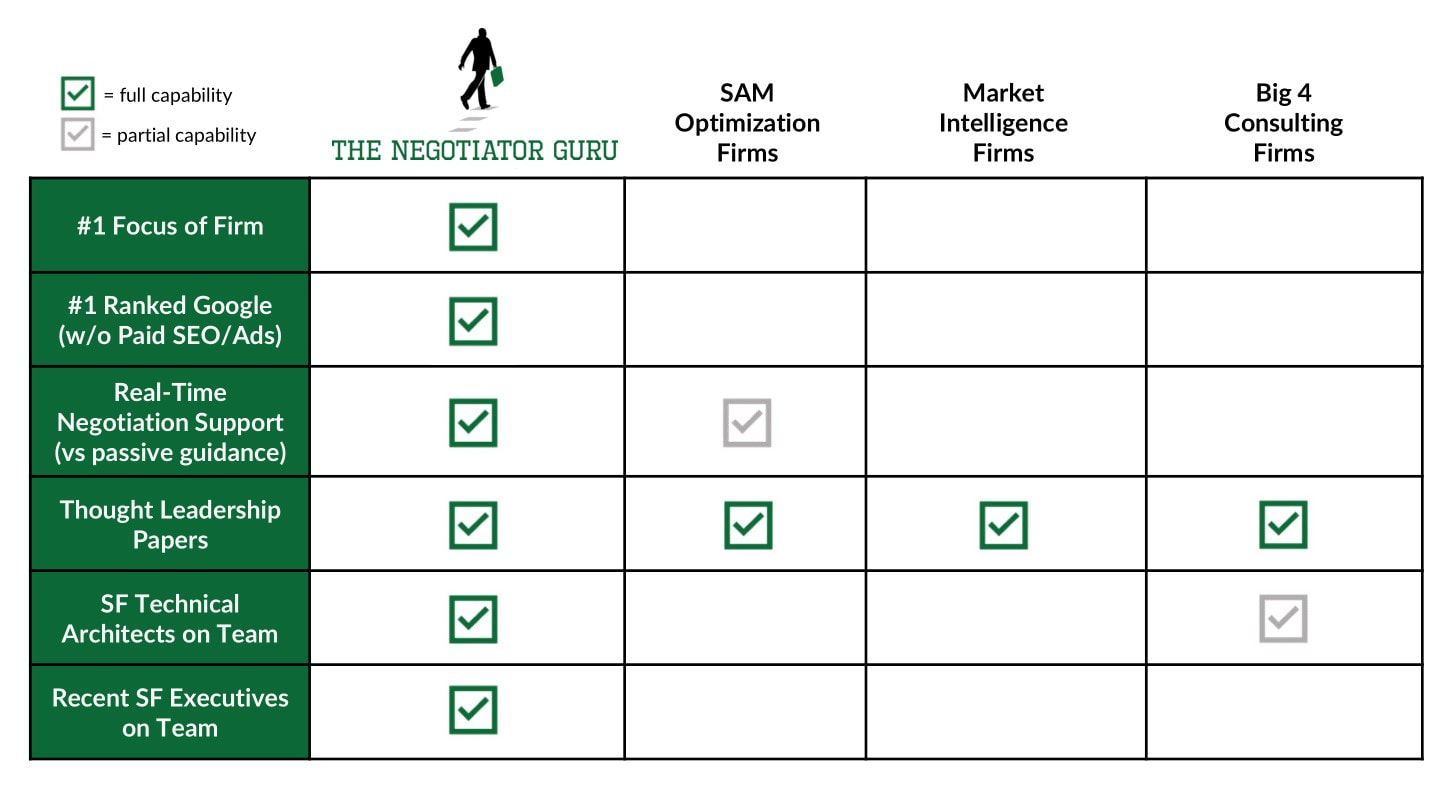
Gartner, at its core, is a market intelligence firm. It uses a wide-angle lens to give you a big-picture view of market and industry trends. You can use their data as general negotiation guidance and add their toolkits to your own.
There is absolutely value in this broad-stroke model but it can be limiting when it comes to looking for data and resources that more specifically mirror the size and needs of your organization.
In this article, I want to outline the similarities and differences between a simple market intelligence firm approach and a niche service provider approach. There are many reasons you might want to research best practices from a 30,000-foot view as well as dive deeper at a 5,000-foot view.
Many of my clients will use both Gartner’s and The Negotiator Guru’s (TNG) services to achieve the best results for their companies.
The graphic below gives a basic overview of the similarities and differences between our companies and we’ll break each one down in this article.
There Are Some Similarities Between Gartner & The Negotiator Guru
Both Gartner and TNG provide information on market and industry trends as well as general guidance on IT Cost Optimization. We have each developed our own toolkits to strategically approach each client’s needs. We overlap when it comes to providing general guidance to CIO’s.
Our companies also both provide rate benchmark data although, as you’ll read below, we go about this in different ways. Gartner has quite a bit of data they provide in aggregated terms which is useful but, without isolating the information by industry or annual spend or similar categories, it can be difficult for CIOs and their supporting functions to narrow down actionable intelligence that is defensible and realistic.
There Are Many Differences Between Gartner & The Negotiator Guru
The keyword I would use to describe the services Gartner and TNG have in common is ‘general.’ Gartner is a great resource for general information across a wide array of topics but rarely provides niche depth that our customers are longing to consume.
In contrast, TNG has a deep and disciplined focus within the IT Software vertical which enables our team to share actionable insights that are localized, specific, and highly relevant to our clients. In fact, it was our early clients that helped shaped this disciplined focus as they made their niche needs clearly known to our team. Due to our outstanding client family, TNG has been on a journey to fill our clients’ market intelligence needs for specific supplier relationships. This has organically driven our firm to be the worldwide leader in Salesforce Contract Negotiation Advisory Services which typically is 80% of our work portfolio at any given time.
With the average cost of a Gartner subscription being $30,000 per seat, plus additional consulting costs in order to receive personalized advisory services, it’s worth your while to be informed on what they can and cannot help you achieve.
Because we provide specialized data and consulting services, we’re able to dig deeper into our clients’ businesses and tailor our process to better achieve the results they’re looking for.
The following are a few of the specific areas The Negotiator Guru differs from Gartner in terms of what services and results we can offer our clients.
Right Size
While Gartner has a wealth of industry data and information, it can be nearly impossible for a client to look at the data and isolate a specific instance to best compare themselves to their peers. This leaves clients feeling informed but uncomfortable about how this information is applicable, and more importantly defensible, within their environment.
In certain circumstances, Gartner will provide “best in class” rates for a specific digital capability or service portfolio. One would argue that this provides directionally correct price targets to use as a market intelligence within their supplier negotiation. We generally agree, however, it’s important to note that your software sales executive (or worse yet your internal colleagues) will very quickly share with you that you don’t fit the profile of those rates for XYZ reason. We know this because we’ve been in these conversations on countless occasions.
In the rare case that you obtain “best in class” rate information for your specific topic of interest, you are still missing a critical piece of knowledge which we call our “Right Size” guidance. Using conservative figures, there is a 15-20% value-capture opportunity just by applying Right Size practices to your research and internal analysis before entering into any IT contract negotiation
Our supplier-specific expertise is one of the biggest contributors to this Right Sizing approach.
Within our Discovery Phase, we take an inventory of your current products and licenses and match them against your actual business needs. Almost always, we find that our clients are over licensed and have shelfware within their environment. This is an example of Right Sizing.
From a Right Pricing standpoint, not only do we understand “best in class” rates, we localize price targets based on industry, client size, and contract value. This enables our clients to feel 100% confident about the market intelligence as we’re benchmarking their rates against that of their likesize industry peers.
To expand upon this difference, we’ll use our expertise in Salesforce as an example.
As raised and validated by leading consulting and intelligence firms, TNG has the most comprehensive database of Salesforce rates in the world. This capability allows our team to quickly and easily perform a price benchmarking exercise for our clients. In many instances, we’ll inform prospective clients that their rates are within an acceptable margin of their “Right Price” benchmark and that the only real opportunity (if any) is to pursue “Right Sizing” inside of their environment. At TNG, our culture and client centric values direct our work and guide us to only accept prospective clients where we know with certainty there is a strong potential to drive huge impact.
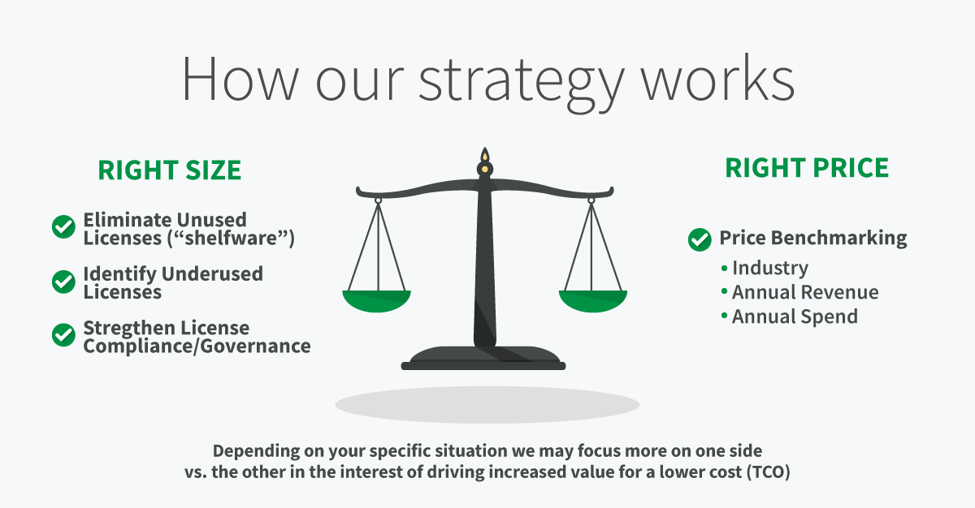
Being able to combine Right Price and Right Size analysis will have a significant impact on the effectiveness of your supplier negotiation strategies.
Contract Language Risks
As a result of our deep supplier-specific expertise, our team on average analyzes 5 - 15 software contracts per day. As a result, we know what’s “normal” with all of the large enterprise software platforms and any common risks that are inserted unbeknownst to our clients. By doing this every single day, our team is easily able to identify commonly-used, ambiguous language that always favors the supplier.
Large software companies know their customers rarely spend time analyzing terms and conditions within their contracts. Furthermore, the widely accepted principle of Software-as-a-Service (SaaS) leads clients to believe the terms are standard and unchangeable.
Unfortunately, this simply isn’t true. As part of our Contract Execution Phase, we conduct a deep dive assessment of our client’s supplier contract as part of our standard service (another major difference from Gartner). To put the impact of this added service into context, our team identifies a unique contractual risk within SaaS contracts alone 33% of the time. If the contract we are analyzing is not a SaaS contract, contractual risks are identified, on average, 85% of the time. Knowing what to look for in each supplier’s contract language helps our clients avoid common pitfalls and supplier-centric renegotiation strategies.
Sales Playbook Coaching
Another key difference between taking a general approach on market intelligence (Gartner) vs. a software specific deep niche (TNG) is the ability to learn and leverage the sales playbook(s) for these large enterprise suppliers. It may not surprise you that within the most successful software sales organizations are repeatable and prescriptive sales playbooks that guide the near robotic actions of their sales representatives.
As a result of learning these sales playbooks we are literally able to tell our clients the moves their suppliers are going to take next. This intelligence allows us to be one step ahead within the negotiation process while leveraging the interests of both parties.
While the art of negotiation is an art and not a science, arming yourself with this intelligence allows you to deploy counterintelligence strategies inside of your organization (to counteract common supplier tactics such as divide and conquer) while also proactively preparing counterpoints to their foreseeable arguments. As a result, our clients commonly tell us that they were the most prepared they have ever been before, during, and after a negotiation.
Advisory and Execution Services
We don’t just tell you what is possible. We help you achieve it.
The biggest criticism most companies have of typical market intelligence and/or management consulting firms is that they’ll tell you what “best in class” looks like but will leave you to figure out how to achieve it within your organization. If they do offer advisory services that help you implement their “best in class” then it will be for additional fees that eat away at the cost savings potential, etc.
We’re a full, beginning-to-end provider who will help you all the way through to the execution of the contract..
At TNG, we not only share a “best in class” picture but also create a realistic future state localized for your business. We help you implement that future state while also limiting risks to your organization long after our engagement ends. This is all part of our standard duty of care for our clients.
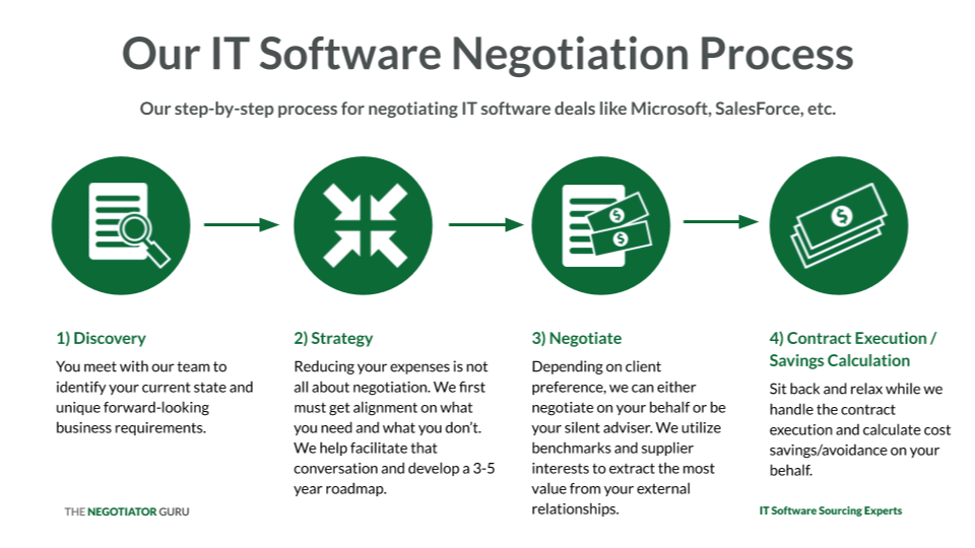
4-Step Negotiation Process
Our proprietary 4-step negotiation process allows us to deliver a clear and consistent service to our clients. In the interest of brevity we won’t go into detail of what each step entails, however, please know that within the Discovery and Strategy steps you will walk away with a forward looking roadmap as part of the overall engagement. If even offered, this would be an extra advisory fee from Gartner and/or any other market intelligence and/or management consulting firm.
The graphic below quickly outlines our negotiation process:
Compensation & Fees
Our compensation for these services is also entirely different from Gartner’s method.
As mentioned above, Gartner’s average subscription rate is $30,000 per person plus any additional consulting fees.
With this package, you have access to their standard publications, toolkits, and potentially a limited number of “analyst calls” which are quick conversations with the author of the publications. Any additional advisory assistance, if even possible, comes as an upcharge. Even with this additional cost, you will be on your own from an execution standpoint.
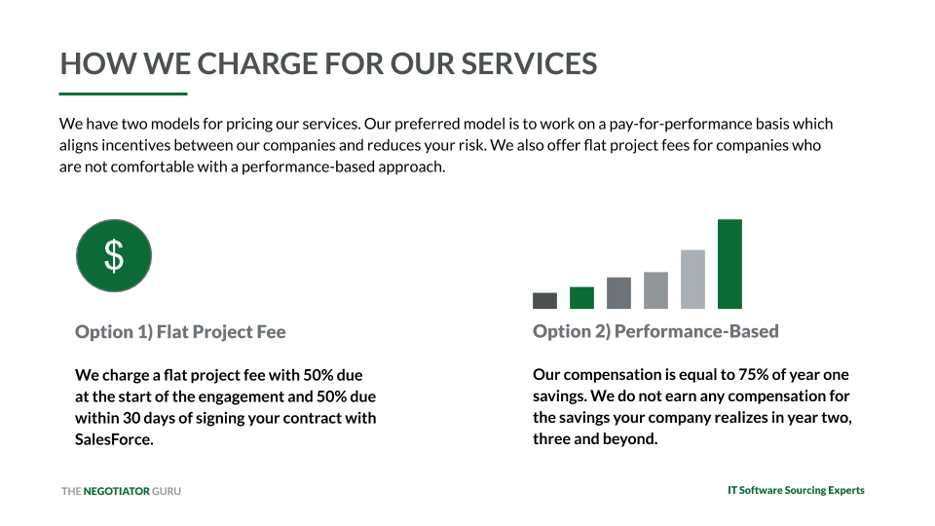
We charge either an Advisory Fee based on annual contract value or we offer a Pay Per Performance option with a simple baseline calculation.
We don’t charge based on a subscription service to our articles, we provide all this information for free.
Our rates contain no hidden charges or surprise upsells. On top of that, we’ll help you execute the strategies we develop with you.
We’re incredibly transparent with how we price our services and our clients never question the value they achieved from engaging with TNG.
Combining a Broad Overview Approach with a Specialized, Niche Consulting Firm is a Winning Equation
One of the questions we hear frequently is whether someone can/should work with both Gartner AND The Negotiator Guru.
The answer is yes!
Gartner provides a lot of good, general information. TNG helps you zoom in on the information that is most relevant to your organization so you can determine which key findings are critical for driving cost savings/avoidance while lowering your contractual risk.
Gartner is a market intelligence research firm that has a very limited advisory component separate from their articles. They do not generally provide execution services.
TNG provides information without a subscription fee and our advisory and execution services are provided in the same package.
Bringing in TNG to help you pinpoint your specific needs, value capture opportunities, and execution strategies will provide immediate and long-term intrinsic value for your organization. Remember, TNG will only accept you as a client if there is clear and distinct net positive impact potential… well, we can’t speak for the other guys.

Quid Pro Quo: Salesforce & Salesforce Consulting Partners
We commonly get asked the following questions in varying forms:
- Is The Negotiator Guru (TNG) a Salesforce Partner? Are you on the AppExchange?
- What are the differences between TNG and a Salesforce Partner?
- Why can’t my Salesforce Partner advise me on the best possible rates/products for my Salesforce environment?
Before we get into the specific answers to the above questions, let us share a brilliant unsolicited quote from one of our recent multinational clients regarding the motivational differences between TNG and a Salesforce Partner:
Expecting a registered Salesforce Partner listed on the AppExchange to give you completely impartial advice on Salesforce pricing is like expecting a court room prosecutor to share their notes with the defense before every trial.
Why, you might ask?
The answer is simple: All Salesforce Consulting Partners have an unavoidable conflict of interest with their clients. Why? Because of the inherent need for these “Partners” to make both their client and Salesforce happy.
In this article we’re going to cover this conflict of interest and why TNG is different.
Salesforce Partners Always Have Two Clients (and one isn’t you)
Salesforce Partners have two customers:
- You the client; and,
- Your Salesforce account management team (hereby collectively referred to as “Salesforce”)
The fact of the matter is that your Salesforce Partner is, by design, incentivized to keep both its client and Salesforce happy. The difficult truth is that you, the customer, are the least important of the two clients. Yes indeed, more often than not, your Salesforce Partner has a greater long-term interest in keeping Salesforce happy. Yes, we know this sounds horrible, but we hope you appreciate our directness here.
Let’s dig into two key, but interrelated, reasons:
1. Business Relationships
Your Salesforce Partner focuses heavily on keeping a strong business relationship with Salesforce. Why? Because Salesforce is their single most effective sales channel to acquire new business. When Salesforce identifies a new or existing client that needs custom development work, they have the entire Salesforce Partner community to consider when providing a recommendation to their customer. Naturally, those Salesforce Partners that are “supportive” to their sales process will be referred more and more business.
2. Money
More referrals = more business = more money.
Back in the 18th century Edmund Burke once said “…never bite the hands that feed you.”
Presenting this differently, if you were a Salesforce Account Executive and you had a Salesforce Partner repeatedly suggest changes to an account that materially decreased your sales compensation revenue, would you continue using that Partner when you have others options available?
To be clear; we are not saying that all Salesforce Account Executives are unethical in how they conduct business. However, we are stating that there is an inherent fundamental conflict of interest for the Salesforce Partner who commercially needs to appease both parties.
The unfortunate situation is that while a Salesforce Partner may know a customer is being sold more products and/or services than they actually need, they rarely speak up for the reasons above. We’ve even been told there is an informal blacklist inside of Salesforce that keeps track of these Partners that raise cost avoidance opportunities during the sales process.
We don’t like writing about this topic but we know every customer wants the truth.
Why TNG is different
Quite simply we are only focused on keeping you, the client, happy. When the firm was founded we only included a “pay for performance” compensation option to ensure our incentives were aligned with the client. Over the years, we added an “advisory fixed fee” option purely based on repeated client requests.
TNG’s Right Size & Right Price Process
Part of our secret sauce is a deep focus and understanding on 1) how Salesforce works, 2) you as a customer, and 3) best practices on how to quickly drive savings in your environment. While strategic negotiation is an art, our Right Size & Right Price process is more of a science based on its repeatability across all industries.
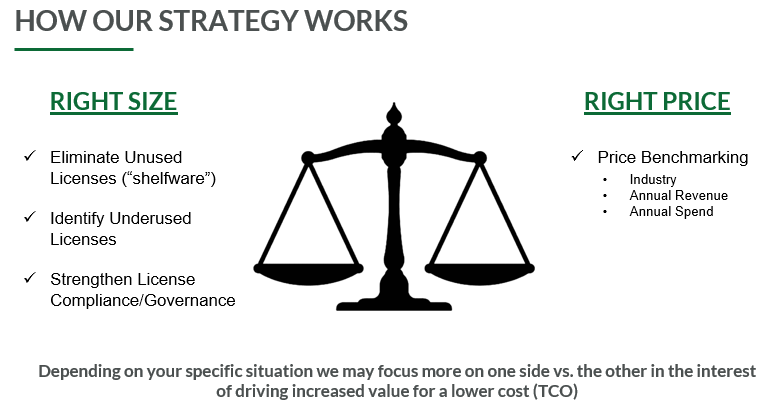
The Right Size process
focuses on identifying consumption based savings opportunities within your organization.
Our three most commonly identified opportunities within this process are:
- “shelfware” elimination
- license optimization
- governance enhancement. On average, we identify 24% savings opportunity within this process alone.
The Right Price process purely focuses on your product and service price points within your specific Salesforce contract. The vast majority of our clients reach out to us for this service alone. Specifically, they want to know how their prices compare to their peers and if they’re getting a “good deal.”
We have the largest database of Salesforce rates in the world and can quite easily identify if there is a price optimization opportunity within your various SKUs. Unlike other large market intelligence firms, we are able to isolate your realistic “should cost” price points based on your industry, annual revenue, and annual contract value. The others simply will share a “best in class” rate which is ambiguous and often self-serving.
On average, we identify a 22% savings opportunity here but your specific opportunity could be as high as 305% (yes, this was a real client).
Fit-for-Purpose Engagement Style
The Founder of TNG, Dan Kelly, feels strongly about providing our clients options on how they engage our firm depending on each individual client’s needs. Some clients want a “negotiation-as-a-service” approach while others simply want the output of our Right Price process to identify target price benchmarks to use within their own negotiations. We welcome you to start a conversation with our firm to determine how we can most effectively and efficiently support you.
Summary
To recap, here are the basic points of what we’ve covered in this article:
- Your Salesforce Partner has motivation to keep both you and Salesforce happy;
- They aren’t able to easily share cost savings opportunities with you in fear of losing future opportunities with other Salesforce customers;
- The Negotiator Guru is only focused on driving cost savings for you by negotiating with Salesforce, the client;
- We have a proprietary negotiation process that includes both the art of negotiation and the science of opportunity creation inside of your Salesforce organization,
- On average, we save clients 20-50% on their Salesforce annual expenses through our Right Size and Right Price process; and,
- On SELA Agreements (Salesforce Enterprise License Agreement), we typically generate a 41.3% savings for our clients.
- We only accept clients within our full negotiation service where we know we can make a huge impact.

A 3-Step Process to Reduce Your IT Spend 25% Or More
In the latest meeting with your company’s executives, the ultimate goal was the same as ever - increase revenue, decrease spend.
Do more, with less.
Your directive is to find a 10% cost savings in the next year and you are looking for some quick, streamlined ways to achieve that goal.
Have you taken a good look at your current contract situation? Where can you find savings in the software and products you’re already paying for?In this article, I’m going to share how you can create a system to manage and optimize your current (and future) IT contracts. By taking these steps, you'll achieve the best cost savings (often upwards of 25%) for your company.
How do you manage & optimize your current IT contracts?
To optimize your IT spending, you need to get organized. Tons of contracts are flying around and you have to know where you’re starting from today to be able to optimize for the future.
You have multiple contracts with each supplier you work with. Each product you buy from them throughout the year has its own legal commitments: Master Service Agreements (MSA), Statements of Work (SOW), order forms, etc.
Each supplier has a number of IT contracts they use with their clients.
Any of these types of contractual documents probably have different commercial language.
And they all add up to time and money obligations for you.
The worst part? Almost none of these contracts will be co-termed. Regardless of the company they’re with, each contract will have a different term period. Some of them will be for six months, a year, eighteen months, what have you.
This creates mass chaos and it’s all by design.
In order to get out of that chaos, you need to get above it - get a bird’s eye view of the landscape of your IT contracts. This can be a very arduous process but the payoff is huge. Take the time to align each of the contracts so you can properly optimize around them.
Step 1: Create an Asset Inventory List
If you don’t have a contract management system - and most companies don’t, even the biggest ones out there - you need to create an Asset Inventory List.
Basically, list out all your suppliers and all the IT contracts. You need to be clear on what contracts you have with a specific supplier.
You can do this with a fancy Excel spreadsheet like the one I’ve created below. You can download this template for your own use.
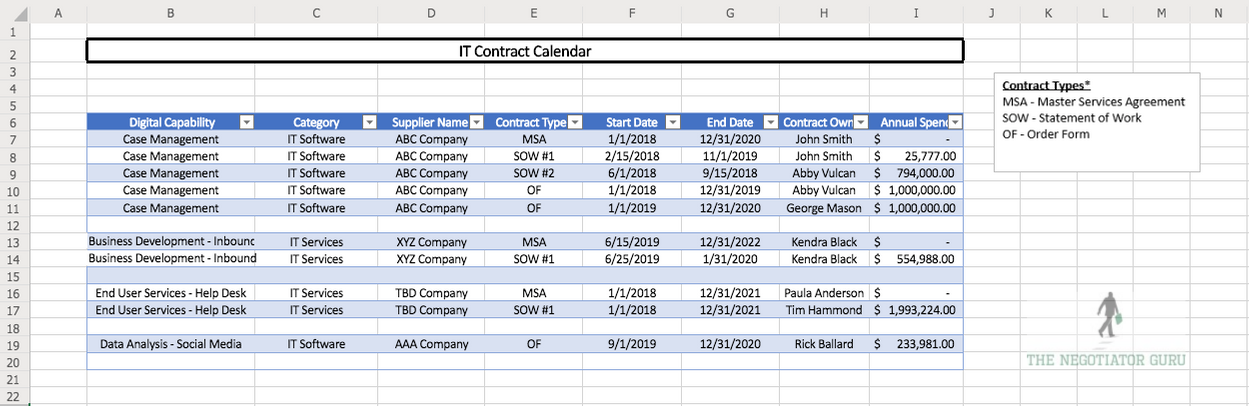
Essentially, this list will have the vendor name, contract type, contract term, and price. Consultant groups charge millions for this fancy spreadsheet but you can create one yourself from my free template.
Through this process, you’ll identify 2 things:
- How much you’re spending every year.
- How many IT contracts you have with each supplier.
With this information, you can tackle the next step. You now know what contracts are coming up for renewal and when. You know the negotiation period and can bring in extra help in advance to work through that process. And finally, you can now work on co-terming all the order forms and SOWs.
hese adjustments create more administrative ease versus the chaotic burden they’re designed to be.
Once you’ve got a survey on your IT contract landscape, you can move on to Step 2.
Step 2: Analyze Each Supplier Against a Right Size/Right Price Matrix
Start with the suppliers that are your biggest spend items. These will most likely be your ERP provider, your Microsoft Office contract, and your CRM software. Do an internal assessment of these suppliers and determine:
- How much you’re spending;
- When you’re going to renew; and,
- What you’re planning to do in the future.
This will help you determine that you are, in fact, only paying for the items that you need versus those that you don’t. All too often companies are paying for products that they aren’t even using because they don’t have a handle on their contracts.
The second thing you’ll be able to keep an eye out for is whether you’re paying for the right license types or not. Challenge your company to look at ways you can downgrade your subscriptions.
The third piece of knowledge you’ll gain from this process is figuring out which business capabilities each supplier is supporting. You’ll be able to see which suppliers are overlapping functionalities.
This overlap is common in decentralized organizations. Each business stakeholder wants to use the software they’re familiar with even though three other companies provide the same capabilities. Your corporation is likely spending way too much on overlapping suppliers that provide the same digital capability.
Paying for software you’re not using is called shelfware. Don’t make the mistake of paying for shelfware.
You need to start this internal assessment process six months before your next contract renewal. If you don’t, you’re going to be playing catch up to these large suppliers because they know more about you than you do.
Step 3: Preparing for negotiation
Create your negotiation team
Your negotiation team should consist of 3 different roles: a business stakeholder, an IT stakeholder, and a negotiator. Sometimes this last role is procurement and sometimes it involves an outside advisor.
Gather benchmark data
In addition to your negotiation team, you’ll need some hard-to-find information. One of the biggest pieces of leverage you can get is benchmark data. This data gives you the prices other firms are paying for the same service. There’s no way your company can know what other businesses are paying unless you bring in an external advisor like The Negotiator Guru.
Create an opportunity analysis
You can analyze your rates against the benchmark to find out how competitive your prices are compared to your industry peers. Similarly, you can analyze your supplier performance metrics, Service Level Agreements, governance process (etc.) against benchmark data to find out how well your suppliers are performing.
And finally, you can analyze your Innovation Quadrant against the benchmark.
How is the supplier driving new ideas, new concepts, process improvements, etc? How are they incentivized to drive cost savings for YOUR company through their relationship with you?
For example:
If you’re using a company like Accenture to run your help desk, there should be a clause in the contract for a 10% target cost savings over the contract term for the services they provide. They do this through process improvements and through automation.
This ensures they are actively working toward providing your company with cost savings to make your business more efficient.
Create a Roadmap of Initiatives
This roadmap has the intent of prioritizing your initiatives to ensure you’re targeting the greatest impact that will take you the least amount of time. Of course, not all initiatives will be easy to achieve but taking a systematic approach to what you work on first is paramount to your success.
To assist with this approach, we suggest categorizing your initiatives so that you can easily sort and isolate the opportunities in front of you. Categories you might consider using include “Quick Win, Strategic Sourcing, and Business Transformational.” Naturally, the progression of cost savings usually increases in scope and impact as you move from Quick Win opportunities to that of Business Transformation.
After you perform your opportunity analysis, get your benchmarks, and create your roadmap of initiatives, you can then pull together a Heat Map. This entails creating a visual graph that clearly identifies the sequencing opportunities.
Here is an example of one of these Heat Maps:
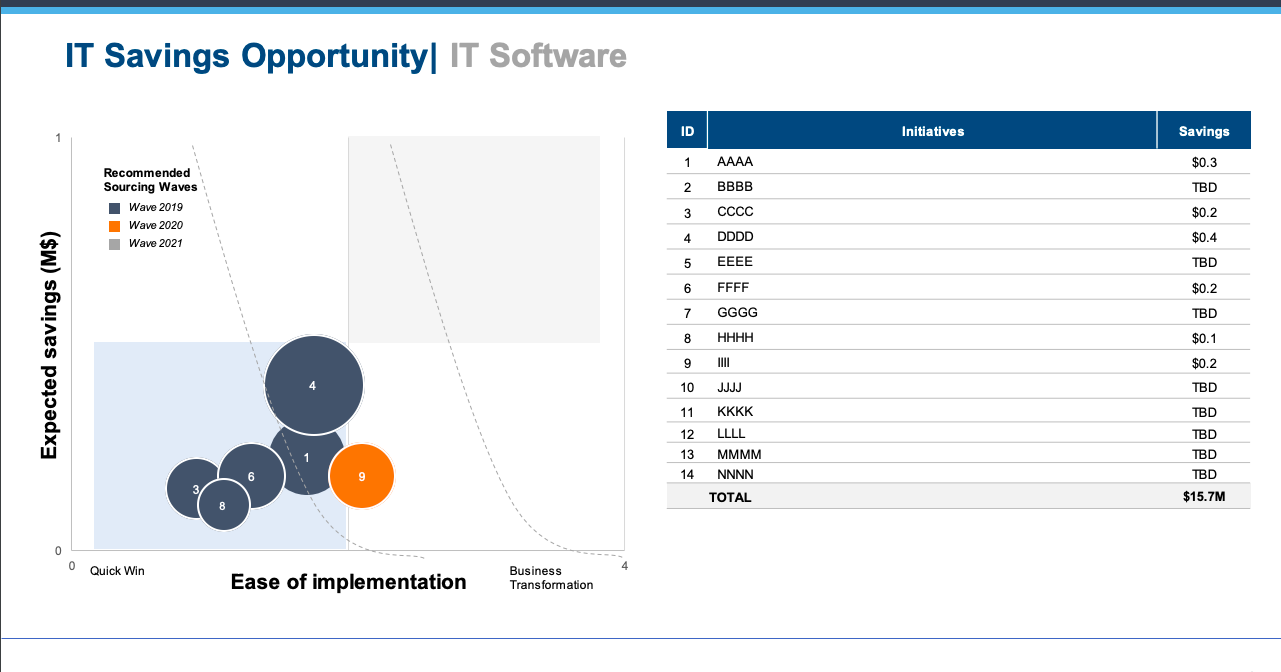
Being proactive with IT contracts can save 25% annually
A stellar negotiation team together with your benchmark data and forward-looking road map will give you a clear direction during the renegotiation process.
Centralizing, and subsequently renegotiating, your contracts with this approach generates on an average 25% P/L cost savings for your company (industry agnostic).
A decentralized company can cost you extra money
If a company has multiple business units and/or sites that are responsible for their own procurement you will undoubtedly have an unstructured supply base. The downstream effects of this situation is that you will have overlap in your supply base, duplicative digital capabilities, and a rats nest of contracts causing incredible inefficiencies and unleveraged spend.
For example, if one branch is using DocuSign for e-signatures and another is using Panda, this is a digital capability overlap that can easily be eliminated.
After your company streamlines your digital capabilities, your company should be able to easily consolidate spend, processes, and contracts. Once you remove the redundancy and get everyone on the same software, you can also negotiate a single contract for your company that drives immediate cost savings and long-term cost avoidance.
IT Contracts create both opportunity and risk in Merger & Acquisition transactions
When combining companies, it’s important to do both a top-down and bottoms-up approach to identifying synergy opportunities within your IT spend.
Top-down approaches involve a lot of financial synergy assumptions based on similar transactions within your industry. These approaches largely identify duplicative roles, processes, etc. and identify a financial target for savings. This approach naturally takes a high-level approach but doesn’t consider the unique needs of your business. To accurately forecast synergy opportunities it should not be the only synergy view to consider.
Bottoms-up approaches, on the other hand, allow you to co-create opportunities with your l business stakeholders that consider business risk, culture, and ease to achieve.
I’ll provide more insight on how to properly prepare for a merger in a future article.
Wrapping It All Up
Follow these steps to properly optimize your current contracts:
- Identify your current state situation.
- Identify your high-spend suppliers.
- Gather benchmark data to see how your contracts stack up.
- Run an Opportunity Analysis to determine overlap and shelfware.
- Create a negotiation team.
- Optimize each contract as its renewal period approaches.
Start with a CIA.
That’s a Client Intake Assessment.
Upload your contract data or schedule a discovery call. If we can’t identify at least a 10%+ from a TNG Right Pricing™ opportunity, we won’t take your money (but we will offer you some free advice!)
