

Quid Pro Quo: Salesforce & Salesforce Consulting Partners


We commonly get asked the following questions in varying forms:
- Is The Negotiator Guru (TNG) a Salesforce Partner? Are you on the AppExchange?
- What are the differences between TNG and a Salesforce Partner?
- Why can’t my Salesforce Partner advise me on the best possible rates/products for my Salesforce environment?
Before we get into the specific answers to the above questions, let us share a brilliant unsolicited quote from one of our recent multinational clients regarding the motivational differences between TNG and a Salesforce Partner:
Expecting a registered Salesforce Partner listed on the AppExchange to give you completely impartial advice on Salesforce pricing is like expecting a court room prosecutor to share their notes with the defense before every trial.
Why, you might ask?
The answer is simple: All Salesforce Consulting Partners have an unavoidable conflict of interest with their clients. Why? Because of the inherent need for these “Partners” to make both their client and Salesforce happy.
In this article we’re going to cover this conflict of interest and why TNG is different.
Salesforce Partners Always Have Two Clients (and one isn’t you)
Salesforce Partners have two customers:
- You the client; and,
- Your Salesforce account management team (hereby collectively referred to as “Salesforce”)
The fact of the matter is that your Salesforce Partner is, by design, incentivized to keep both its client and Salesforce happy. The difficult truth is that you, the customer, are the least important of the two clients. Yes indeed, more often than not, your Salesforce Partner has a greater long-term interest in keeping Salesforce happy. Yes, we know this sounds horrible, but we hope you appreciate our directness here.
Let’s dig into two key, but interrelated, reasons:
1. Business Relationships
Your Salesforce Partner focuses heavily on keeping a strong business relationship with Salesforce. Why? Because Salesforce is their single most effective sales channel to acquire new business. When Salesforce identifies a new or existing client that needs custom development work, they have the entire Salesforce Partner community to consider when providing a recommendation to their customer. Naturally, those Salesforce Partners that are “supportive” to their sales process will be referred more and more business.
2. Money
More referrals = more business = more money.
Back in the 18th century Edmund Burke once said “…never bite the hands that feed you.”
Presenting this differently, if you were a Salesforce Account Executive and you had a Salesforce Partner repeatedly suggest changes to an account that materially decreased your sales compensation revenue, would you continue using that Partner when you have others options available?
To be clear; we are not saying that all Salesforce Account Executives are unethical in how they conduct business. However, we are stating that there is an inherent fundamental conflict of interest for the Salesforce Partner who commercially needs to appease both parties.
The unfortunate situation is that while a Salesforce Partner may know a customer is being sold more products and/or services than they actually need, they rarely speak up for the reasons above. We’ve even been told there is an informal blacklist inside of Salesforce that keeps track of these Partners that raise cost avoidance opportunities during the sales process.
We don’t like writing about this topic but we know every customer wants the truth.
Why TNG is different
Quite simply we are only focused on keeping you, the client, happy. When the firm was founded we only included a “pay for performance” compensation option to ensure our incentives were aligned with the client. Over the years, we added an “advisory fixed fee” option purely based on repeated client requests.
TNG’s Right Size & Right Price Process
Part of our secret sauce is a deep focus and understanding on 1) how Salesforce works, 2) you as a customer, and 3) best practices on how to quickly drive savings in your environment. While strategic negotiation is an art, our Right Size & Right Price process is more of a science based on its repeatability across all industries.
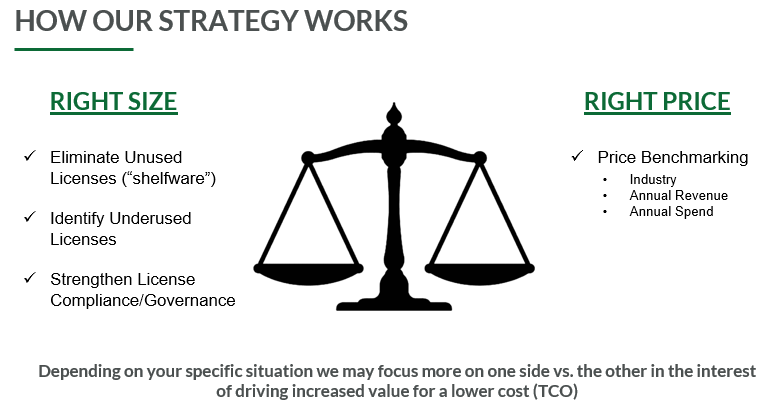
The Right Size process
focuses on identifying consumption based savings opportunities within your organization.
Our three most commonly identified opportunities within this process are:
- “shelfware” elimination
- license optimization
- governance enhancement. On average, we identify 24% savings opportunity within this process alone.
The Right Price process purely focuses on your product and service price points within your specific Salesforce contract. The vast majority of our clients reach out to us for this service alone. Specifically, they want to know how their prices compare to their peers and if they’re getting a “good deal.”
We have the largest database of Salesforce rates in the world and can quite easily identify if there is a price optimization opportunity within your various SKUs. Unlike other large market intelligence firms, we are able to isolate your realistic “should cost” price points based on your industry, annual revenue, and annual contract value. The others simply will share a “best in class” rate which is ambiguous and often self-serving.
On average, we identify a 22% savings opportunity here but your specific opportunity could be as high as 305% (yes, this was a real client).
Fit-for-Purpose Engagement Style
The Founder of TNG, Dan Kelly, feels strongly about providing our clients options on how they engage our firm depending on each individual client’s needs. Some clients want a “negotiation-as-a-service” approach while others simply want the output of our Right Price process to identify target price benchmarks to use within their own negotiations. We welcome you to start a conversation with our firm to determine how we can most effectively and efficiently support you.
Summary
To recap, here are the basic points of what we’ve covered in this article:
- Your Salesforce Partner has motivation to keep both you and Salesforce happy;
- They aren’t able to easily share cost savings opportunities with you in fear of losing future opportunities with other Salesforce customers;
- The Negotiator Guru is only focused on driving cost savings for you by negotiating with Salesforce, the client;
- We have a proprietary negotiation process that includes both the art of negotiation and the science of opportunity creation inside of your Salesforce organization,
- On average, we save clients 20-50% on their Salesforce annual expenses through our Right Size and Right Price process; and,
- On SELA Agreements (Salesforce Enterprise License Agreement), we typically generate a 41.3% savings for our clients.
- We only accept clients within our full negotiation service where we know we can make a huge impact.
More resources
From Fortune 500 giants to fast-growing innovators, TNG has helped clients save 20% – 40%+ on enterprise software contracts — even when they thought it was impossible

5 Tips for Negotiating a Salesforce Extension
In this article we will discuss how to successfully extend your current Salesforce contract in order to create additional time to successfully prepare and negotiate your renewal agreement. For more detail, read our guide on negotiating with Salesforce.
An extension is commonly needed whenever our clients engage us too late (i.e. too close to their contract renewal) and we need time to successfully complete the Discovery and Strategy Phases of our proprietary 4-Step Negotiation Plan.
Tip #1: Be Confident
We find that most of our clients have either rarely or never requested a contract extension with either Salesforce or any other IT Supplier. As such, this very basic concept becomes daunting for the average IT or Procurement leader as they don’t have either the experience, or past playbook, to execute with natural confidence. This sentiment is augmented by the fact that Salesforce will automatically inform you that they never allow extensions. If you’ve read our previous articles, then you’ll know this is yet another canned answer out of their sales playbook. Please know that extensions are granted all the time as long as you know how to ask for them…as such, they are considered the exception vs. the rule.
Tip #2: Focus on the Facts
Share only what is necessary with Salesforce without going into too much detail. You don’t want to expend all of your negotiation equity during this process or you’ll end up hurting yourself down the road. Keep in mind that Salesforce will try and obtain as much information as possible during this stage so they can decide 1) whether or not to grant the extension and 2) to determine how prepared you are as an organization.
Tip #3: Establish the Why
Like any human scenario, it’s always easier to influence people if they understand the intent and context behind any request. This scenario is no different as you’ll want to answer in a way that is authentic to your organization but intentionally vague in material content. Typical responses we find most effective are the following:
- Active interest in exploring new digital capabilities and need time to make internal decisions;
- Internally restructuring the Salesforce relationship accountability;
- Aligning multiple stakeholders within your organization to accurately capture the wants and needs over the next 5 years;
- In the process of obtaining end user feedback and need some additional time to finalize, analyze, and make decisions, etc.
Tip #4: Create a Timeline with Milestones
Salesforce will be far more willing to accept an extension request if they understand the timeline in which you plan on making decisions. This in a sense shows a partnership mentality which is both real and healthy. Develop a basic timeline of when you plan on making internal and external decisions that provides a good amount of cushion in favor of your organization.
Tip #5: Keep your Promises
Constant and honest communication is key. All too often we find individuals/companies making the mistake of playing the power client position. In other words, the client exemplifies a lack of empathy or care for the sales process and holds all information back thinking that they are protecting their position. After years of research and proven experience we have repeatedly disproven that hypothesis. Instead, we find providing regular milestone updates to Salesforce (or any IT supplier) shows a level of commitment to the relationship and will pay dividends at the final negotiated deal. Summary It’s important to recognize that each client scenario offers its unique challenges and opportunity. That being said, the guiding principles laid out above will prove effective no matter your situation. Be confident in your request, focus on the facts of your specific situation, build credibility with Salesforce by providing context into the request, set expectations via timeline with milestones, and deliver on your promises. We use these same effective tactics every day and hope you find them useful in your future endeavors.
Summary
It’s important to recognize that each client scenario offers its unique challenges and opportunity. That being said, the guiding principles laid out above will prove effective no matter your situation. Be confident in your request, focus on the facts of your specific situation, build credibility with Salesforce by providing context into the request, set expectations via timeline with milestones, and deliver on your promises. We use these same effective tactics every day and hope you find them useful in your future endeavors.

Key Points to Remember When Negotiating Your Salesforce Master Subscription
Customer Relationship Management (CRM) has become one of the most expensive IT investments for organizations around the world according to the annual “IT Trends Study” conducted by the Society of Information Management.
This IT investment growth is being fueled by two primary industry drivers:
- Large organizations are both replacing homegrown systems as well as utilizing their CRM platform to further connect their internal and external stakeholders, processes, and communication strategies; and,
- Small to medium-sized organizations are rapidly acquiring this technology to make a positive step-change in their customer interactions and client prospecting.
While there are many Software-as-a-Service (SaaS) CRM platforms to choose from in the marketplace today, Salesforce continues to dominate the space. Subsequently, if you are looking at CRM solutions in the marketplace, you’re likely considering Salesforce as an option.
Why is Salesforce (SFDC) the market leader and what makes it different than the others?
While this article is not intended to be a tactical comparison of CRM solutions available today, our vast experience and focus on Salesforce naturally has revealed a few key points:
- SFDC has been, and continues to be, very strong in outbound and inbound marketing tactics;
- SFDC arguably was the first mover in defining a SaaS CRM solution that is decoupled from any other large enterprise agreement (ex: Microsoft, Oracle, etc.) making it easier to obtain;
- SFDC developed a buying channel that is direct to a business end-user vs. going through a channel partner/value added reseller (VAR);
- SFDC was founded with the intent of truly being a platform where vertical applications could easily connect and integrate (like the Apple App Store); and,
- SFDC has perfected the sales process inside of organizations in a way that their divide and conquer sales tactics commonly identifies continues growth opportunities across the organization.
Why is negotiating a Salesforce agreement so difficult?
The funny thing is that the entire go-to-market model of SFDC makes it very easy to acquire licenses as needed. This is in fact one of the many elements that make negotiating with SFDC difficult. In other words, very often our clients come to us after they have identified SFDC has spread throughout their organization without their knowledge and/or with very little governance. Our clients often describe this situation similar to an “internal virus” (their words, not ours) that spreads organically at a very fast pace. The result of this unmanaged growth can lead to the following (by no means comprehensive):
- Little to no license asset management leading to “shelfware” (acquisition of more licenses than are being used);
- Incorrect license purchase creating higher costs than needed;
- Different monthly subscription fees for the same license type;
- Lack of an enterprise agreement leading to contractual risk (etc.);
- No defined growth or utilization strategy; and;
- A platform that is very difficult to disengage which drastically increases the internal cost of
- change.
CIOs and IT Procurement leaders often find it difficult to negotiate a more favorable agreement when renewing their SFDC agreement.
We find the following to be the primary drivers:
- Like other very well-known and established software companies, SFDC has developed a sales process that is very difficult to crack if you don’t deal with them every day (like we do); Find out more about this here.
- The standard SFDC SaaS contract allows for SFDC to introduce price adjustments at any time;
- If a client is reducing their license count, SFDC’s standard contracts permit higher per unit pricing;
- SFDC sales leadership and staff are highly motivated to continuously drive revenue growth at existing clients;
- To be explicitly clear about this, if a client’s contract is renewed with flat revenue, this is a very negative reflection on your account management team;
- SFDC licenses are constantly changing; and,
- SFDC account management changes (by design) every 6 – 18 months which naturally negates knowledge continuity, etc.

4 Key Steps to Successfully Prepare for a Salesforce Negotiation
Here are a few quick steps to prepare for your Salesforce negotiation:
1. Assemble a best-in-class negotiation team
Including an expert negotiator in your team can help you acquire the most reasonable Salesforce subscription agreement. As discussed in previous articles, Salesforce is an expert at “divide and conquer” sales tactics.
As such, they will be looking to speak with different stakeholders at all levels of your business with the intent of gaining as much intelligence about your needs as possible. To properly prepare for, and counter, these tactics we recommend establishing a negotiation team 6 months prior to any planned contract renewal/execution. Within this team you should include business, souring, and legal stakeholders that have decision-making authority on behalf of your organization.
As part of the planning process, the negotiation team should create a working group of business stakeholders that can provide inputs into the needs and wants of the organization.
2. Perform a thorough review of the current contract prior to renewal
Part of our standard client onboarding process is a meticulous review of their current contract. While this may seem like common sense, it’s amazing how many prospective clients we speak with that never think of conducting this initial due diligence. Since our entire team originated from large organizations, we actually understand why this happens…initiative overload!
Before we accept a new client, we ask them whether or not they have reviewed their current contract to determine if they actually received the products/services that were under contract within the current term. On average, only about 35% actually completed this step prior to engaging our firm. After we conduct the analysis, we on average find that 60% of our clients do not actually receive/activate the products/services that they pre-paid for as part of their original contract negotiation.
Subsequently, we suggest you review all special contract terms that are part of your expiring agreement that may impact your contract renewal (i.e. price protection, etc.).
3. Prepare for a Proactive Negotiation
A proactive negotiation can enhance your leverage with Salesforce. As stated earlier, we recommend a 6-month runway to ensure the most leverage. If you are a renewing customer, Salesforce will generally start engaging your business stakeholders 3-4 months prior to your natural renewal date. Getting ahead of this stakeholder engagement will only help your organization. To ensure organization, we suggest developing a communication plan that directly advises each level of the organization what to expect, what to say, and when to say it.
4. Negotiate a 3-year TCO
Our clients commonly come to us asking about what price they should be paying for a specific product or service. Through years of experience, we advise clients to focus on the Total Cost of Ownership (TCO) for the entire contract instead of becoming fixated on a specific line item on the proposal. Like many other major software companies, Salesforce incentivizes its sales reps differently depending on the product or service. Instead of becoming fixated on a specific price point for a Sales Cloud license we suggest focusing on the net contract value. In other words, identify a TCO that you are comfortable with from a price-to-value standpoint and focus on driving the most value for your needs within that spectrum.
We commonly obtain a 10 – 15% value increase by negotiating a net TCO vs. that of a line item rate basis. This, of course, is easier said than done but we wanted to share this facts-based article for you to consider as you embark on your Salesforce negotiation.
Start with a CIA.
That’s a Client Intake Assessment.
Upload your contract data or schedule a discovery call. If we can’t identify at least a 10%+ from a TNG Right Pricing™ opportunity, we won’t take your money (but we will offer you some free advice!)
