

How to Negotiate with Salesforce: A Step-by-Step Playbook for Enterprise Leaders


For enterprise leaders managing multi-million-dollar technology budgets, few vendor renewals carry the complexity, pressure, and financial weight of a Salesforce Enterprise License Agreement (SELA) or Master Subscription Agreement (MSA). Whether you lead an IT organization as a CIO, oversee financial strategy as a CFO, or direct sourcing operations as a Procurement Leader, approaching a Salesforce renewal without a rigorous playbook is a recipe for inflated costs and rigid contract terms.
At The Negotiator Guru, we have helped global enterprises navigate high-stakes enterprise contract renewals, achieving a cumulative $1.05 billion in total cost impact globally with an average savings of 37% per deal. Unlike traditional brokerages or vendor referral partners, we operate with absolute impartiality. We sit strictly on your side of the table, backed by our 10% savings guarantee: if we don't secure at least 10% in hard savings, we don't take the fee.
This comprehensive, step-by-step playbook is designed for Fortune 500 decision-makers looking to master salesforce contract negotiation, eliminate shelfware, leverage precise market intelligence, and execute a winning renewal strategy.
Step 1: Pre-Renewal Groundwork : Timing and Internal Data Gathering
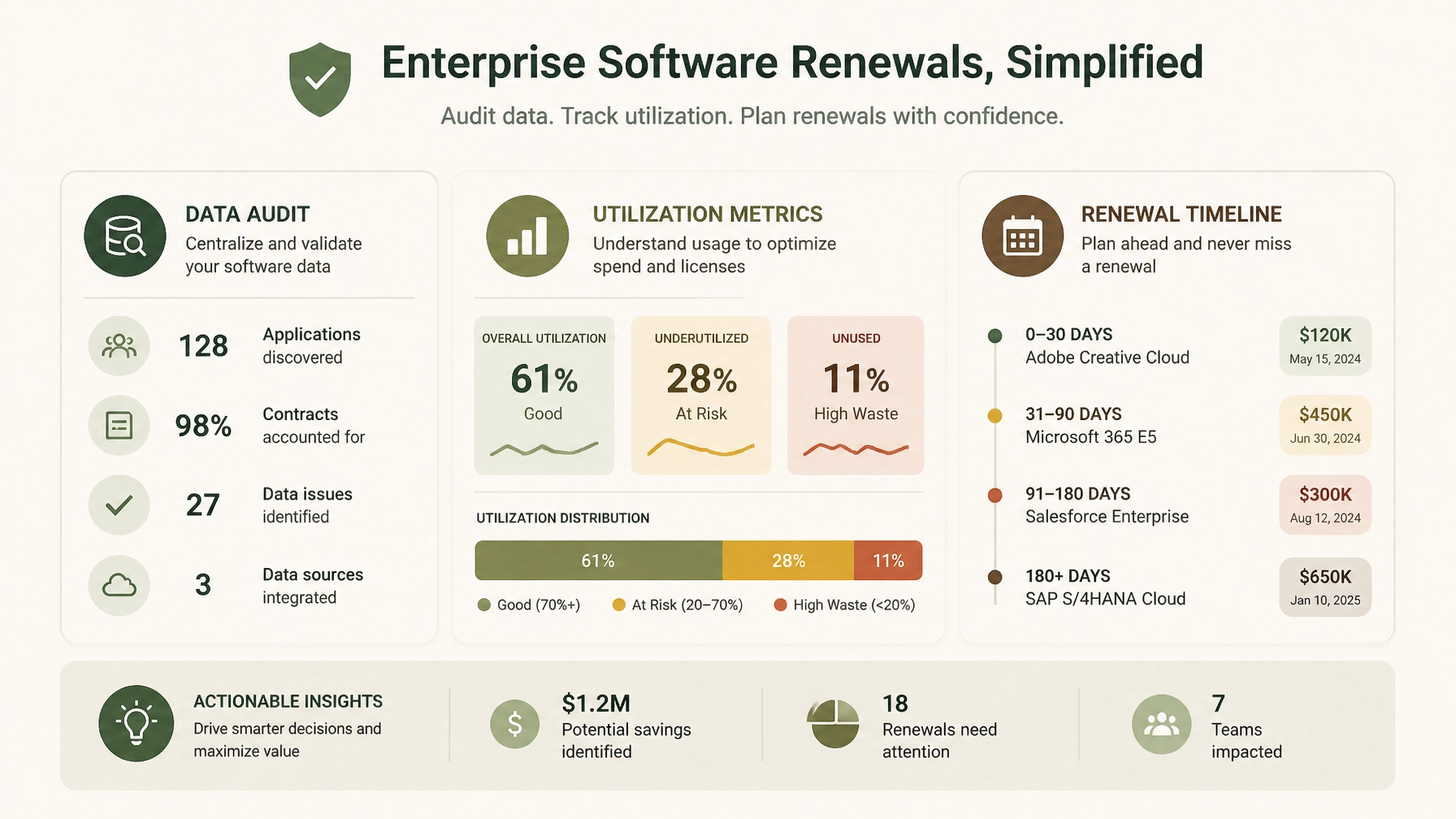
Successful salesforce renewal negotiations are won long before you ever step into a meeting room with your Salesforce account executive. In enterprise vendor negotiations, 75% of your success is determined during preparation, while only 25% occurs at the bargaining table.
Establish the Right Timeline
Salesforce sales teams operate on strict quarterly and annual fiscal cycles (typically ending January 31st). They rely on urgency to push enterprise buyers into rushed decisions. To neutralize this pressure:
- Start 6 months out: For SELA-scale agreements ($5M to $15M+ annual spend), your internal preparation must begin at least 6 months before expiration.
- Review notice periods: Check your contract for required non-renewal notice windows. Timely notification preserves your right to walk away or renegotiate from a position of strength, preventing automatic rollovers into unfavorable terms.
Conduct a Rigorous Utilization Audit
Salesforce will push you to expand your user counts and add-on suites based on historical licensing rather than actual consumption. Ninety days prior to renewal, execute a comprehensive internal audit across all clouds (Sales Cloud, Service Cloud, Marketing Cloud, Data Cloud, Einstein/AI add-ons, and MuleSoft):
- Active vs. Licensed Users: Compare active logins against provisioned licenses. Identify dormant, departed, or under-utilized users (shelfware).
- Feature Adoption: Audit which specialized features and add-ons are actively driving business outcomes versus those gathering digital dust.
- Departmental Silos: Consolidate usage data across business units. Fragmented buying often hides enterprise-wide redundancy.
By aligning with CIOs & IT Leaders and CFOs & Finance Leaders, you can eliminate waste before Salesforce ever evaluates your baseline.
Step 2: Mastering Salesforce SKU and License Benchmarking
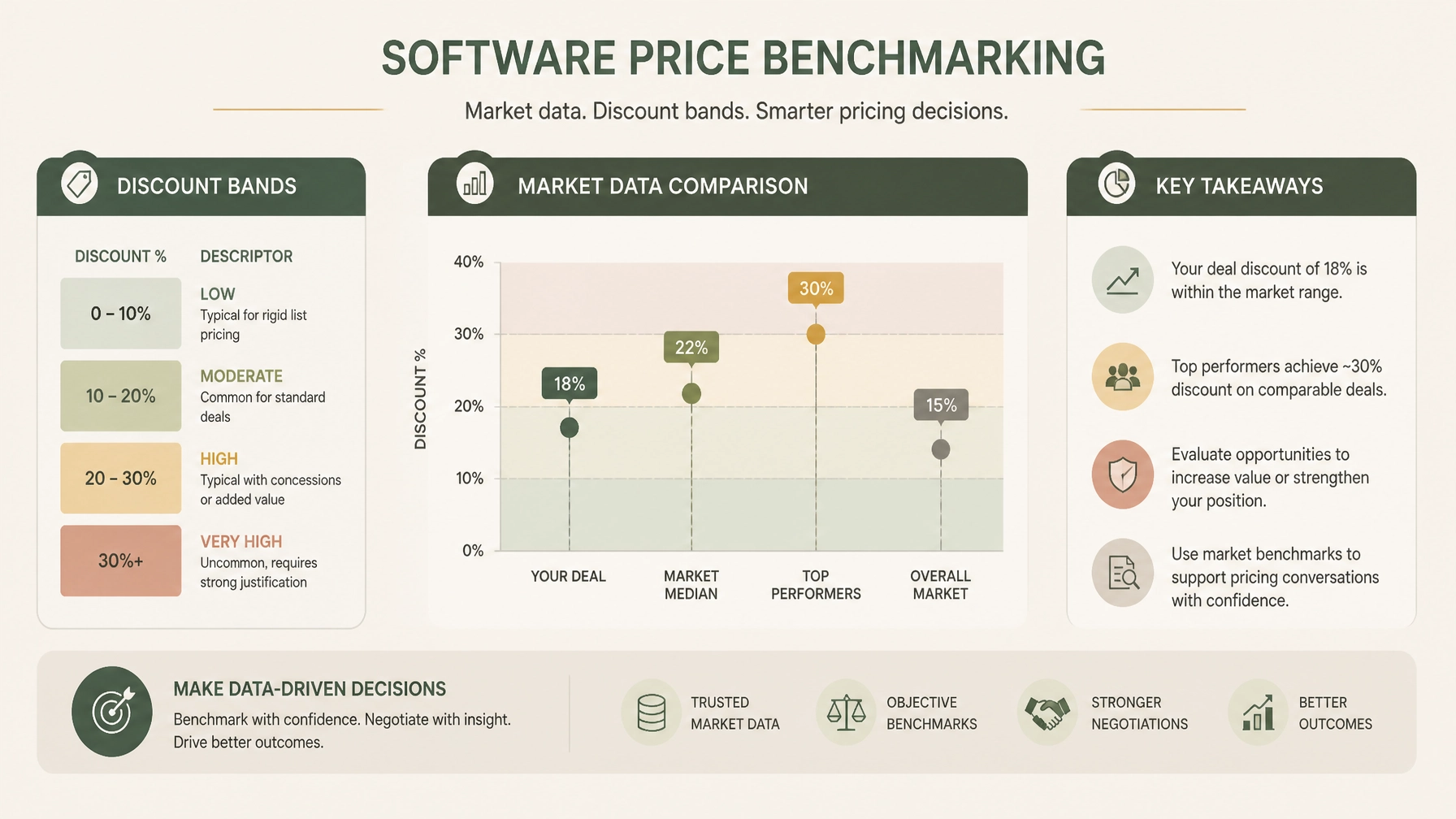
Salesforce’s list prices are designed to act as artificial anchors. Vendor sales reps will often present a proposed discount that looks generous on paper, but when compared against actual enterprise market data, you may still be paying significantly above peer averages. This is where salesforce benchmarking becomes your primary lever.
Moving Beyond List Price
Enterprise buyers must replace Salesforce list prices with empirical market data. Through our specialized Right Price Benchmarking™ service, we map every SKU, license tier, and volume break against recent Fortune 500 deal points:
- Discount Bands by Annual Contract Value (ACV): Enterprise discount percentages scale with ACV. For instance, at $1.5M–$5M ACV, robust negotiations typically yield 26–38% on Sales Cloud and 28–40% on Service Cloud, while $5M–$15M ACV deals command even deeper tiering.
- Net Price per User: Break down the cost per active user by product rather than accepting bundled pricing obfuscation.
- Add-On Unit Economics: Scrutinize high-margin add-ons such as Data Cloud data volume consumption, Marketing Cloud contact tiers, and API call allowances.
When you present data showing that your net pricing sits outside upper-quartile peer benchmarks, you dismantle Salesforce's narrative that "this is our best possible price."
Step 3: Recognizing and Countering Salesforce Negotiating Tactics
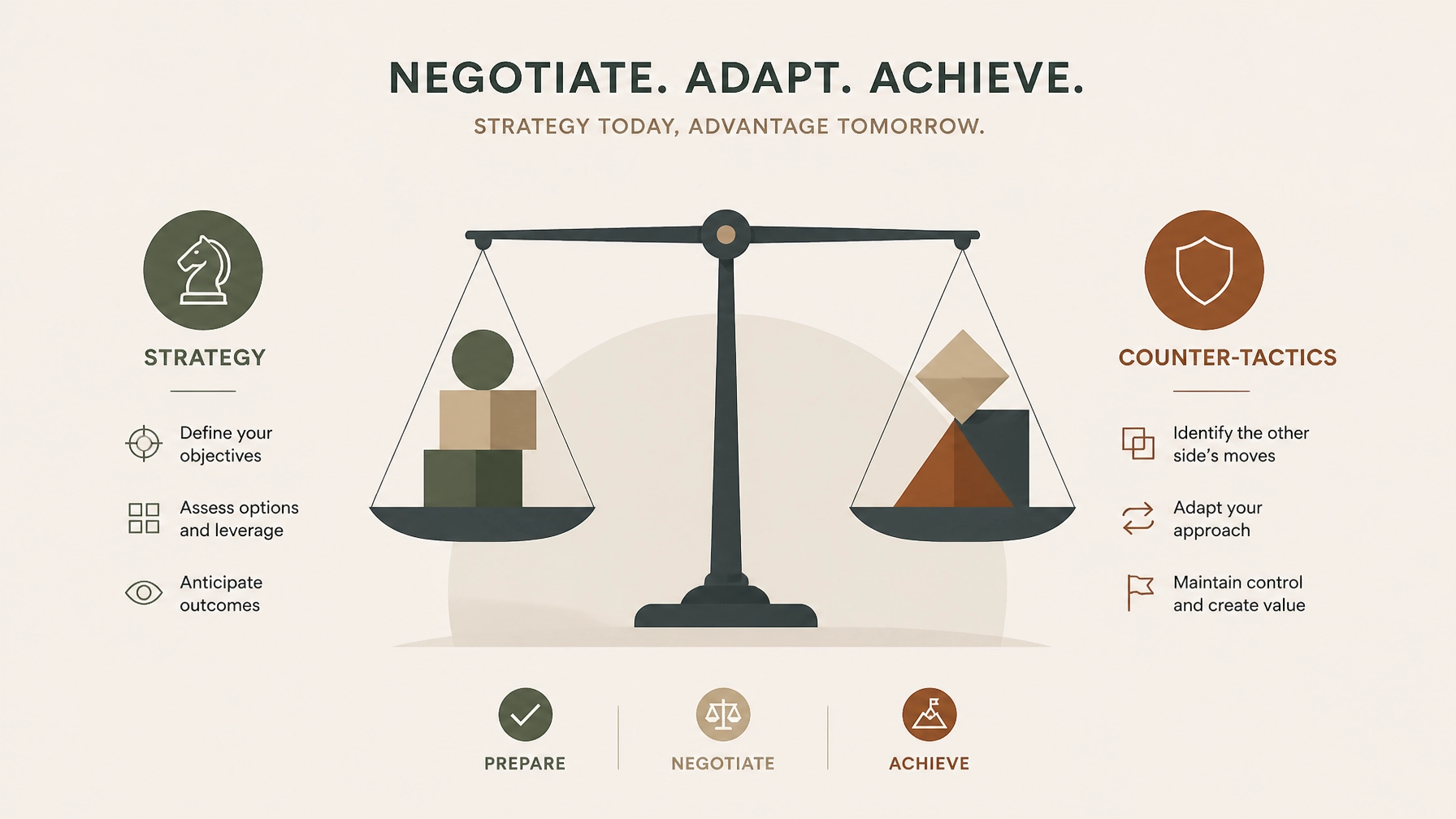
Salesforce employs sophisticated, highly rehearsed enterprise negotiation playbooks. Recognizing these plays in real-time allows Procurement Teams to counter them effectively.
1. The "Good Cop / Bad Cop" Play
- The Play: Your Account Executive acts as your collaborative friend who desperately wants to help you get internal executive approval, while their Sales Director or VP steps in later as the immovable authority figure who claims, "My hands are tied; corporate won't approve this discount without a multi-year expansion."
- The Counter: Maintain strict organizational escalation discipline. Do not let emotional rapport dictate commercial terms. Respond to the escalation with in-kind escalation and formal objective data: "We appreciate leadership review, but our benchmark data indicates this net pricing does not reflect current enterprise market realities. Let's focus on what aligns with peer valuations."
2. The "Use It or Lose It" Budget & Quota Pressure
- The Play: Salesforce reps create artificial scarcity as fiscal year-ends approach, warning that special discounting, free pilots, or promotional credits will evaporate at midnight on January 31st.
- The Counter: Recognize that software vendors have quarterly quotas every 90 days. Rushed deals invariably contain hidden liabilities and missed cost-reduction opportunities. True enterprise leverage stems from your willingness to maintain your current run-rate or evaluate alternative architectures if terms are unacceptable.
3. The "New SKU" and Bundle Confusion
- The Play: As Salesforce expands into Data Cloud, AI (Einstein 1), and industry-specific clouds, reps bundle legacy essentials with expensive new SKUs, making it difficult to audit individual product pricing or discount transparency.
- The Counter: Demand unbundled pricing transparency. Insist that every new SKU be evaluated on its own standalone ROI and market benchmark before inclusion in any enterprise agreement.
Step 4: Navigating Key Contract Traps in Salesforce Enterprise License Agreements (SELA)
A successful salesforce enterprise license agreement is defined just as much by its protective clauses as its headline pricing. Through our Contract Risk Review & Mitigation service, we routinely expose dangerous contract traps embedded in legacy agreements:
- Uncapped Annual Price Escalators: Standard Salesforce agreement templates often include automatic annual price uplifts (frequently 5% to 7%). Enterprise buyers must negotiate hard caps limiting annual renewals to 0% to 4%, protecting long-term budget predictability.
- Restrictive Co-Terming and Cross-Penalties: Beware of clauses that penalize you for reducing user counts mid-term or bundling unrelated business units under restrictive cross-default conditions.
- Audit and True-Up Vulnerabilities: Vague language around license deployment and environment tracking can expose your organization to aggressive compliance audits. Ensure clear definitions of authorized use, non-production environments, and notification windows.
Step 5: Structuring the Deal for Long-Term Value and Flexibility
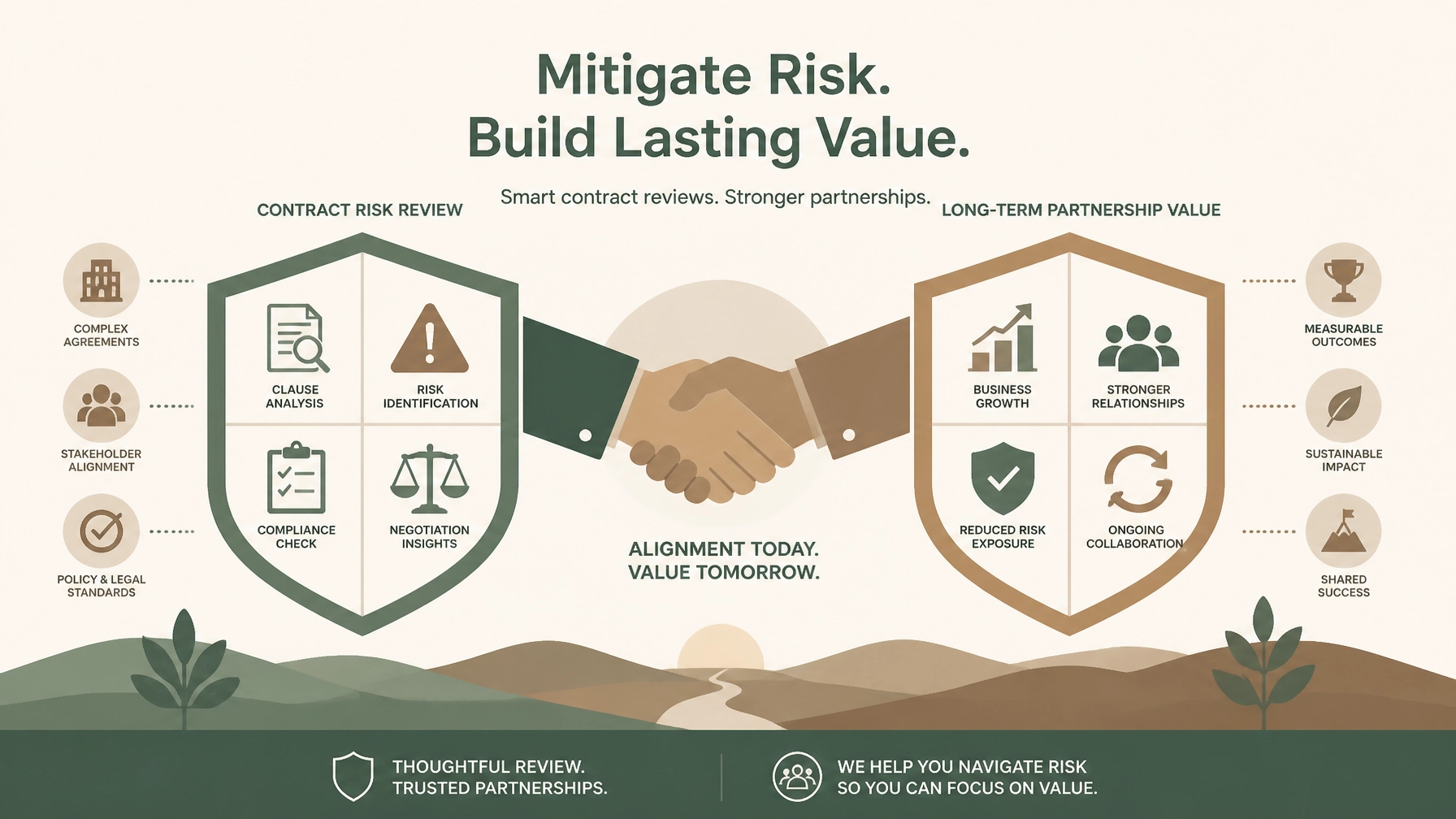
Enterprise negotiations should not merely solve this year's budget shortfall; they must establish a sustainable, flexible commercial framework for the future.
- Ramp-Up Structures: Instead of paying for peak projected license counts on day one, negotiate a staged ramp schedule that aligns financial commitments with actual adoption milestones.
- License Swap and Flex Rights: Secure contractual rights to reallocate license types (e.g., swapping Sales Cloud Enterprise seats for Service Cloud or Platform licenses) as your operational priorities shift.
- Performance and Adoption Protections: Tie future expansions to verified business value realization rather than blanket vendor commitments.
Secure Your Enterprise Savings with Full Negotiation Support
Navigating a complex Salesforce renewal while managing day-to-day IT operations and financial governance is a formidable challenge. Salesforce has thousands of negotiations under its belt; your team likely handles this cycle once every few years.
That is why leading Fortune 500 enterprises partner with The Negotiator Guru.
Our Full Negotiation Support service provides end-to-end guidance: from roadmap planning and right-price benchmarking to real-time counter-tactics at the bargaining table. Because we operate with complete impartiality and back our work with a 10% savings guarantee, your success is our sole priority.
Contact our team today to schedule a confidential consultation and discover how we can secure superior pricing, watertight terms, and lasting value for your next Salesforce enterprise negotiation.
More resources
From Fortune 500 giants to fast-growing innovators, TNG has helped clients save 20% – 40%+ on enterprise software contracts — even when they thought it was impossible

5 Tips for Negotiating a Salesforce Extension
In this article we will discuss how to successfully extend your current Salesforce contract in order to create additional time to successfully prepare and negotiate your renewal agreement. For more detail, read our guide on negotiating with Salesforce.
An extension is commonly needed whenever our clients engage us too late (i.e. too close to their contract renewal) and we need time to successfully complete the Discovery and Strategy Phases of our proprietary 4-Step Negotiation Plan.
Tip #1: Be Confident
We find that most of our clients have either rarely or never requested a contract extension with either Salesforce or any other IT Supplier. As such, this very basic concept becomes daunting for the average IT or Procurement leader as they don’t have either the experience, or past playbook, to execute with natural confidence. This sentiment is augmented by the fact that Salesforce will automatically inform you that they never allow extensions. If you’ve read our previous articles, then you’ll know this is yet another canned answer out of their sales playbook. Please know that extensions are granted all the time as long as you know how to ask for them…as such, they are considered the exception vs. the rule.
Tip #2: Focus on the Facts
Share only what is necessary with Salesforce without going into too much detail. You don’t want to expend all of your negotiation equity during this process or you’ll end up hurting yourself down the road. Keep in mind that Salesforce will try and obtain as much information as possible during this stage so they can decide 1) whether or not to grant the extension and 2) to determine how prepared you are as an organization.
Tip #3: Establish the Why
Like any human scenario, it’s always easier to influence people if they understand the intent and context behind any request. This scenario is no different as you’ll want to answer in a way that is authentic to your organization but intentionally vague in material content. Typical responses we find most effective are the following:
- Active interest in exploring new digital capabilities and need time to make internal decisions;
- Internally restructuring the Salesforce relationship accountability;
- Aligning multiple stakeholders within your organization to accurately capture the wants and needs over the next 5 years;
- In the process of obtaining end user feedback and need some additional time to finalize, analyze, and make decisions, etc.
Tip #4: Create a Timeline with Milestones
Salesforce will be far more willing to accept an extension request if they understand the timeline in which you plan on making decisions. This in a sense shows a partnership mentality which is both real and healthy. Develop a basic timeline of when you plan on making internal and external decisions that provides a good amount of cushion in favor of your organization.
Tip #5: Keep your Promises
Constant and honest communication is key. All too often we find individuals/companies making the mistake of playing the power client position. In other words, the client exemplifies a lack of empathy or care for the sales process and holds all information back thinking that they are protecting their position. After years of research and proven experience we have repeatedly disproven that hypothesis. Instead, we find providing regular milestone updates to Salesforce (or any IT supplier) shows a level of commitment to the relationship and will pay dividends at the final negotiated deal. Summary It’s important to recognize that each client scenario offers its unique challenges and opportunity. That being said, the guiding principles laid out above will prove effective no matter your situation. Be confident in your request, focus on the facts of your specific situation, build credibility with Salesforce by providing context into the request, set expectations via timeline with milestones, and deliver on your promises. We use these same effective tactics every day and hope you find them useful in your future endeavors.
Summary
It’s important to recognize that each client scenario offers its unique challenges and opportunity. That being said, the guiding principles laid out above will prove effective no matter your situation. Be confident in your request, focus on the facts of your specific situation, build credibility with Salesforce by providing context into the request, set expectations via timeline with milestones, and deliver on your promises. We use these same effective tactics every day and hope you find them useful in your future endeavors.

Key Points to Remember When Negotiating Your Salesforce Master Subscription
Customer Relationship Management (CRM) has become one of the most expensive IT investments for organizations around the world according to the annual “IT Trends Study” conducted by the Society of Information Management.
This IT investment growth is being fueled by two primary industry drivers:
- Large organizations are both replacing homegrown systems as well as utilizing their CRM platform to further connect their internal and external stakeholders, processes, and communication strategies; and,
- Small to medium-sized organizations are rapidly acquiring this technology to make a positive step-change in their customer interactions and client prospecting.
While there are many Software-as-a-Service (SaaS) CRM platforms to choose from in the marketplace today, Salesforce continues to dominate the space. Subsequently, if you are looking at CRM solutions in the marketplace, you’re likely considering Salesforce as an option.
Why is Salesforce (SFDC) the market leader and what makes it different than the others?
While this article is not intended to be a tactical comparison of CRM solutions available today, our vast experience and focus on Salesforce naturally has revealed a few key points:
- SFDC has been, and continues to be, very strong in outbound and inbound marketing tactics;
- SFDC arguably was the first mover in defining a SaaS CRM solution that is decoupled from any other large enterprise agreement (ex: Microsoft, Oracle, etc.) making it easier to obtain;
- SFDC developed a buying channel that is direct to a business end-user vs. going through a channel partner/value added reseller (VAR);
- SFDC was founded with the intent of truly being a platform where vertical applications could easily connect and integrate (like the Apple App Store); and,
- SFDC has perfected the sales process inside of organizations in a way that their divide and conquer sales tactics commonly identifies continues growth opportunities across the organization.
Why is negotiating a Salesforce agreement so difficult?
The funny thing is that the entire go-to-market model of SFDC makes it very easy to acquire licenses as needed. This is in fact one of the many elements that make negotiating with SFDC difficult. In other words, very often our clients come to us after they have identified SFDC has spread throughout their organization without their knowledge and/or with very little governance. Our clients often describe this situation similar to an “internal virus” (their words, not ours) that spreads organically at a very fast pace. The result of this unmanaged growth can lead to the following (by no means comprehensive):
- Little to no license asset management leading to “shelfware” (acquisition of more licenses than are being used);
- Incorrect license purchase creating higher costs than needed;
- Different monthly subscription fees for the same license type;
- Lack of an enterprise agreement leading to contractual risk (etc.);
- No defined growth or utilization strategy; and;
- A platform that is very difficult to disengage which drastically increases the internal cost of
- change.
CIOs and IT Procurement leaders often find it difficult to negotiate a more favorable agreement when renewing their SFDC agreement.
We find the following to be the primary drivers:
- Like other very well-known and established software companies, SFDC has developed a sales process that is very difficult to crack if you don’t deal with them every day (like we do); Find out more about this here.
- The standard SFDC SaaS contract allows for SFDC to introduce price adjustments at any time;
- If a client is reducing their license count, SFDC’s standard contracts permit higher per unit pricing;
- SFDC sales leadership and staff are highly motivated to continuously drive revenue growth at existing clients;
- To be explicitly clear about this, if a client’s contract is renewed with flat revenue, this is a very negative reflection on your account management team;
- SFDC licenses are constantly changing; and,
- SFDC account management changes (by design) every 6 – 18 months which naturally negates knowledge continuity, etc.

4 Key Steps to Successfully Prepare for a Salesforce Negotiation
Here are a few quick steps to prepare for your Salesforce negotiation:
1. Assemble a best-in-class negotiation team
Including an expert negotiator in your team can help you acquire the most reasonable Salesforce subscription agreement. As discussed in previous articles, Salesforce is an expert at “divide and conquer” sales tactics.
As such, they will be looking to speak with different stakeholders at all levels of your business with the intent of gaining as much intelligence about your needs as possible. To properly prepare for, and counter, these tactics we recommend establishing a negotiation team 6 months prior to any planned contract renewal/execution. Within this team you should include business, souring, and legal stakeholders that have decision-making authority on behalf of your organization.
As part of the planning process, the negotiation team should create a working group of business stakeholders that can provide inputs into the needs and wants of the organization.
2. Perform a thorough review of the current contract prior to renewal
Part of our standard client onboarding process is a meticulous review of their current contract. While this may seem like common sense, it’s amazing how many prospective clients we speak with that never think of conducting this initial due diligence. Since our entire team originated from large organizations, we actually understand why this happens…initiative overload!
Before we accept a new client, we ask them whether or not they have reviewed their current contract to determine if they actually received the products/services that were under contract within the current term. On average, only about 35% actually completed this step prior to engaging our firm. After we conduct the analysis, we on average find that 60% of our clients do not actually receive/activate the products/services that they pre-paid for as part of their original contract negotiation.
Subsequently, we suggest you review all special contract terms that are part of your expiring agreement that may impact your contract renewal (i.e. price protection, etc.).
3. Prepare for a Proactive Negotiation
A proactive negotiation can enhance your leverage with Salesforce. As stated earlier, we recommend a 6-month runway to ensure the most leverage. If you are a renewing customer, Salesforce will generally start engaging your business stakeholders 3-4 months prior to your natural renewal date. Getting ahead of this stakeholder engagement will only help your organization. To ensure organization, we suggest developing a communication plan that directly advises each level of the organization what to expect, what to say, and when to say it.
4. Negotiate a 3-year TCO
Our clients commonly come to us asking about what price they should be paying for a specific product or service. Through years of experience, we advise clients to focus on the Total Cost of Ownership (TCO) for the entire contract instead of becoming fixated on a specific line item on the proposal. Like many other major software companies, Salesforce incentivizes its sales reps differently depending on the product or service. Instead of becoming fixated on a specific price point for a Sales Cloud license we suggest focusing on the net contract value. In other words, identify a TCO that you are comfortable with from a price-to-value standpoint and focus on driving the most value for your needs within that spectrum.
We commonly obtain a 10 – 15% value increase by negotiating a net TCO vs. that of a line item rate basis. This, of course, is easier said than done but we wanted to share this facts-based article for you to consider as you embark on your Salesforce negotiation.
Start with a CIA.
That’s a Client Intake Assessment.
Upload your contract data or schedule a discovery call. If we can’t identify at least a 10%+ from a TNG Right Pricing™ opportunity, we won’t take your money (but we will offer you some free advice!)
