

Understanding Microsoft’s Negotiation Strategies


Most companies are paying 20-50% more than they should be on their Microsoft contracts. In this article, we are going to walk through what you need to know about negotiating with Microsoft, as well as specific tactical levers you can use to reduce your Microsoft contract by up to 50%.
8 Important things to note when it comes to negotiating your Microsoft contracts:
- Your sales rep has two key drivers: to get your company to adopt Azure and to sell you an E5 license.
- The Business Desk makes all of the final decisions regarding price, etc.
- The Divide and Conquer approach is still the most common tactic to drive sales.
- Microsoft’s fiscal year strategically ends on June 30th so they can capture multi-year budgets from their enterprise clients.
- Putting a price cap on a specific product does nothing to ensure your company’s rates because Microsoft changes product SKUs so regularly that your price cap will be null and void the next time you go to negotiate.
- Make sure that you have the appropriate affiliate language to ensure your entire company can use the products the right way.
- Consider whether your company would benefit from a Microsoft Products and Services Agreement (MPSA)
- If you’re switching from a Perpetual Agreement to an Office 365 contract, you have the opportunity to capture the lowest price you’ll ever receive from Microsoft.
Is this article we'll cover all those points in depth so you can understand Microsoft's negotiation strategy.
What you need to know when negotiating with Microsoft
Microsoft has a footprint in nearly every established company in the world. The Microsoft Office Suite revolutionized the way we work since nearly the beginning of the internet.
While the company has experienced both successes and challenges in its history, Microsoft has profited as a result of two primary factors: 1) a good product, and (equally as important) 2) a great enterprise sales team.
We’ll spare you a history lesson about Microsoft here but it’s important to recognize and respect the strength of their first mover advantage and subsequent (now legacy) footprint. This history has allowed Microsoft to be a fast follower with adjacent technologies within the marketplace. In other words, Microsoft monitors new concepts and technologies in the marketplace prior to investing their own resources. This strategy has largely worked over the last two decades as Microsoft will simply build or buy a proven technology stack that has proven successful and plug and play into their existing customer base.
Fast forward to present day, Microsoft Entreprise continues to be a fast follower within the marketplace. Their legacy footprint has allowed for continuous introductions of new technologies to their existing client base. Software as a Service (SaaS) solutions has significantly lowered the barrier to entry for new technologies to be introduced to their client base. This has created a new dynamic for Microsoft as it now employs tactics to eliminate competing technologies within its legacy client base. We will discuss these tactics in further detail within this article.
How Microsoft's pricing model has evolved
Up until 2011, Microsoft’s primary revenue stream originated from 1) net new technology sales and 2) maintenance fees. The new technology sales were largely on-premise meaning the software would be installed within a customer’s server environment. For those existing customers, Microsoft earned an 18% maintenance fee (calculated from the original purchase price) simply by pushing technology upgrades to the customer. This maintenance fee was largely recession proof as companies largely paid for upgrades thinking they were required but rarely ever installing the actual upgrade. As the market evolved into a SaaS based consumption model, Microsoft introduced Office 365 to drive predictable monthly revenue from their customers.
This new pricing model has transformed its business and propelled its revenue. This evolution has allowed them to push adjacent SaaS services to their clients such as cloud storage, security services, etc.
Because they are now training their clients to purchase software on a subscription model, it’s easier for Microsoft sales representatives to upsell other products. Knowing how a sales rep is incentivized and how they think will allow you to make the best decisions for your company and negotiate effectively.
Through our active Microsoft negotiations across a wide variety of companies, we have a constant pulse on which products Microsoft is currently incentivizing. This can help you gain significant leverage in your negotiation.
What is your sales representative's role in a Microsoft Negotiation?
Your Microsoft sales representative’s primary job is to gather as much intelligence as possible from your organization’s stakeholders in the interest of finding new products and services to push into your organization. On the contrary, your goal is often to control and/or reduce expenditures for your company. This means your intentions are automatically at odds.
Based on the new dynamic landscape within the marketplace, Microsoft Entreprise is now focused on eliminating any competing solutions from their customer’s technology stack. As discussed previously, Microsoft’s acquisition strategy has largely been focused on those technologies which have developed a large footprint within their customers. Your Microsoft sales representative is highly incentivized to eliminate competing software from your environment and will make the case that you are able to achieve cost savings by simply eliminating these competing solutions. At face value this sound nice but in practice it’s rarely ever true without proper negotiation support.
While there are some benefits to centralizing your technology through a single source, rarely is cost-savings one of those benefits. The cost savings presentation sounds well and good, but it often doesn’t lead to any actual value-capture benefits for companies. Instead, Microsoft gains a larger share of your technology stack and, with it, more negotiating power.
We’re seeing this increasingly with the promotion of Azure, their cloud solution, Power BI, their analytics tool, and anything machine learning and/or artificial intelligence related. These priorities will change as new products are developed but the principles are the same.
Within the last 2 years, Microsoft (like Google and their G-Drive) has started to build technologies that are reliant on the Azure platform to work properly. This forces companies that were not originally interested in Microsoft Azure to introduce the capability into their environment. Microsoft is hoping that your storage requirements grows both organically and inorganically.
Based on polling, we find that 87% of Microsoft customers expand their utilization of Azure within 2 years after the technology is introduced into their organization. This is complemented by the fact Microsoft, Amazon, and Google have made purchasing storage so simple and commoditized that anyone with the organization can do it. This is literally the ideal situation for Microsoft.
From an Office 365 perspective, your sales rep will want to push you toward an E5 license. This is their highest tier license for enterprise customers. Naturally, this is also their most expensive product which drives the greatest sales incentive for your sales representative.
To summarize, your sales representative’s top 2 priorities are:
- Get your company to adopt Azure.
- Get your company to purchase an E5 license.
What is the Microsoft ‘Business Desk’?
While your sales rep (i.e. “Account Executive”) and their management (i.e. “Vice President of xyz”) will be your primary point of contact, they have very little decision authority once it comes to rate adjustments..
That’s where the “business desk’ comes in. Microsoft has been testing, validating, and refining this concept for years and they’ve got it down to a science.
The ‘business desk’ is the Bad Cop to your seemingly accommodating sales rep’s role of Good Cop. The sales rep portrays a helpful, eager personality but they can’t finalize any decisions that actually affect your rates. The business desk contemplates their options, makes decisions, develops the basic communication plan, and informs the sales reps next actions with you, the client.
If you want to get the best rates possible for your company, you need to train your sales rep on how to interact with and communicate with the business desk on your behalf. With the right combination of messages and timing you can meet or exceed your negotiation goals.
They Will Try to Divide and Conquer
The Divide and Conquer tactic is widely known as one of the oldest plays in every enterprise sales playbook. The tactic has been used for years across all industries as it continually proves to be successful in driving more revenue.
Your Microsoft sales team will build relationships at multiple levels of your organization to learn more about the potential software needs of your organization than you do. They will use this information to introduce products and services to different levels of the organization to create buy-in and acceptance prior to any negotiation officially starting.
If you are a sizable account with Microsoft ($1M+ per year) you will also have some executive attention within Microsoft. This team will naturally want to engage with your (the customer) executive team to “gain alignment.” While executive relationships between your two organizations is not always a bad thing, it’s important expectations are carefully managed so that your executive team doesn’t agree to products or services you may not actually need. It’s best to create a negotiation plan that includes how and when your executives will communicate with Microsoft (if at all).
We have found that the large majority of our executive clients have an interest in participating in the negotiation. It’s important you include them in your communication planning so that they too can be empowered to participate within the guidelines you establish for them.
As for the rest of the organization, drive alignment across all your stakeholders within your organization early and often. Make sure everyone is on the same page about your needs, your budget, and your forward-looking initiatives and business plans.
You need to get clear on what you need and when you need it. If Microsoft is successful in their Divide and Conquer technique, they’ll tell you the answers to these questions and their answers will be an over-inflated version of what you would develop internally.
Microsoft Contract Language Risk Mitigation
What is Microsoft's Fiscal Year?
Like Salesforce, Microsoft does not follow the typical calendar year in the interest of accessing two corporate budgets. Microsoft’s fiscal year ends on June 30th of each year.
They do this in order to split their software expense across two corporate budget years to capture 1) end of year funds and 2) new budgets from their clients before they spend it.
Quick Win: How to properly negotiate Price Caps
Often we find clients have negotiated a price cap on specific products rather than on the total spend of the contract.
While price caps are well intended by the client, the problem is that Microsoft literally invented the concept of price caps in the early days of enterprise agreements to overcome buyer reservations. Microsoft subsequently defeats these protections by simply changing product names and SKU numbers on a frequent basis. In other words, if you put a price cap on a specific product during your negotiation, that product will almost certainly have changed at the time of your renewal in 1, 3, or 5 years which effectively negates any protection intended by the customer. Instead of placing a price cap directly on defined products, we recommend you establish protection based on the total spend of your contract.
Affiliate Language
Ensure that you have proper affiliate language in your contract. This means that multiple different subsidiaries of a company can use the same license versus having to have their own separate contracts. We’ve seen this trap laid in a few different M&A situations, specifically.
License Floors
In the world of business, it’s common for software companies to acquire or divest business units on a regular basis. Especially with our private equity clients, adding or removing thousands of employees each month is not uncommon.
Frequently, the contract will state that a certain amount of licenses allows for specific price reductions. With companies changing size and needing different licenses so frequently, this can be a problem. It’s important to create the lowest floor possible so that you aren’t hit with any penalties and avoid renegotiation triggers.
Areas of Opportunity
As with our Salesforce negotiations, we help our clients determine both the Right Size and Right Price approach for their specific needs. While companies like Gartner provide a wealth of information with tactics and general rate benchmarking, we recommend narrowing down the data to determine which companies are your closest peers in terms of industry, size, AND annual spend.
Obtain Net New Products at Very Reasonable (or Free) Prices
Showing interest in the incentivized products we mentioned earlier can reap huge rewards for your company. Use these products to drive cost savings within your core product baseline costs as well as to add new digital capabilities for little to no cost.
Don’t Over-License
In order to know what software license type you require, you need to have a clear understanding of how different stakeholders within your company are going to use your various Microsoft products. Develop no more than five personas for your organization based on how you’re going to use the platform. These personas will inform your license strategy.
Within our Right Size process we start by isolating the core functionality utilized by each persona and then matching that to the capabilities available within the various products. Using the Microsoft Office 365 Suite as an example, your Microsoft sales team will almost always recommend purchasing the E5 license for your organization as it offers the greatest capability, protection, etc (blah, blah, blah).
Rarely do our clients ever need the E5 license (only 5% to be exact). In fact, most organizations don’t even use the full capability offered within E3. This is why it’s so important to develop specific personas based on utilization within your organization. In a perfect world, you would be able to assign different license types based on the unique demands from each of your personas. In other words, it’s very common for the output of our Right Size assessment to suggest E3, E1, and K1 (yes, there is such a thing) within a client’s environment in the interest of driving the lowest total cost of ownership (TCO) with the greatest digital capability.
The simple act of selecting a lower license than the E5 (if appropriate) can save your company 60% or more.
Another example of successful Right Sizing is the isolation of shared computers. Within the manufacturing and healthcare industries, there are often shared computers that are available and used by multiple employees. Microsoft’s standard approach is to license each individual person in the company with an individual license. If you have shared computers, instead of licensing each individual you simply need to license each shared device. You can purchase a restricted use license with a desktop version for Windows and Office. For example, Instead of five employees being assigned five individual E5 licenses, you now have a single low priced license that meets their needs.
Another restricted-use license includes having an “email only” license for those that don’t need a computer but just want access to work email from their own devices.
In other cases, we’ve helped some clients realize they don’t need Office 365 at all and they can simply stay with their perpetual license. License types truly depend on the client and their individual needs.
Get an MPSA
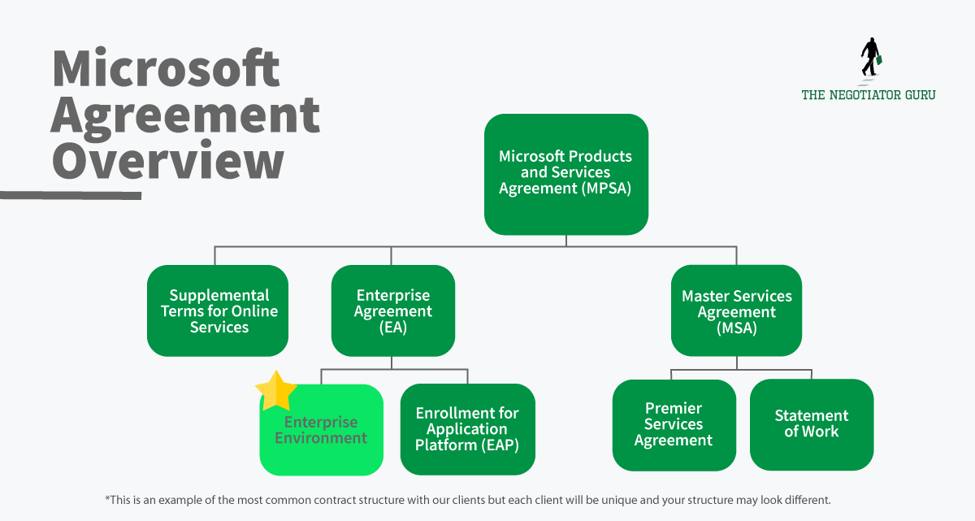
During your renewal you should take an inventory of your multiple agreements (servers, office products, etc.) and explore the benefits and risks of combining under one agreement called the Microsoft Products and Services Agreement (MPSA). The MPSA acts as a parent to the child agreements for your individual products and services and makes for an easier and more streamlined contracting experience down the road for all involved.
Historically, your Office products are on an Enterprise Agreement while the infrastructure products are on a Server & Cloud Enrollment (SCE) Agreement.
The more you can consolidate and co-term your agreements, the more leverage you’ll have. You’ll be able to negotiate the entire consolidated contract with the “business desk” versus two or more separate, and distinct contracts.
What you need to know about converting from a perpetual license to a subscription based license (Office 365)
If you’re converting from a perpetual license to an Office 365 contract, you have a huge opportunity to capture the lowest price point you’re ever going to get from Microsoft.
This conversion is its own license - it has its own SKU. The reason for this is that you’ve already paid for a part of that license through your original perpetual license purchase. If properly negotiated, the cost for this conversion license should only be the difference between the upgrade cost (current version to new) and your original cost.
Most Microsoft customers don’t know about this opportunity and let this massive cost avoidance opportunity slip through the cracks never to be seen again.
For context, the price difference is about 50% and it will be realized year-over-year. If properly negotiated, you'll reap continuous benefits from this opportunity.
FAQ's
What is the difference between Microsoft E1, E3, E5 licenses?
The difference between a Microsoft E1, E3, E5, and K1 license is in capability. The primary differences are:
- The number of Microsoft apps you can access;
- If you have download rights; and,
- If you can download the application (desktop version) versus online only (web browser access).
Microsoft Office 365 E1 is your “lowest” level license for the Microsoft Office Suite via web browser access.
Microsoft 365 E3 is your basic mid-level license which includes additional applications and allows users to download desktop applications. This by far the most common license for all enterprises. Microsoft 365 E5 is your highest level license which includes your core apps, download rights, and specialized apps like Advanced Threat Protection (ATP), etc. There are several other core licenses (suck K1, F1, Desktop Only, etc.) which can, and should, be used to lower your Microsoft spend. For most organizations, an E1 or E3 license will satisfy most of your end-users requirements. Can I mix E1, E3, and E5 licenses within a Microsoft contract?
Microsoft 365 E5 is your highest level license which includes your core apps, download rights, and specialized apps like Advanced Threat Protection (ATP), etc. There are several other core licenses (suck K1, F1, Desktop Only, etc.) which can, and should, be used to lower your Microsoft spend. For most organizations, an E1 or E3 license will satisfy most of your end-users requirements.
Can I mix E1, E3, and E5 licenses within a Microsoft contract?
While most companies who are longtime Microsoft users understand that you can mix several different products and services within an Enterprise Agreement, many aren’t aware of the fact that you can mix and match different license types for your core licenses as well.
In a well negotiated (and proactively managed) Microsoft contract, it’s very common for different persona groups to leverage different core licenses in the interest of Right Sizing™ your environment.
For example, a persona group in your company may use an E1 license, and then a different persona group (such as your IT department) may use an E5 license, depending on their use case.
If you are not mixing licenses at the moment, then you are likely paying for capability you don’t need for a subset of users who do not need the fully upgraded licenses.
How do you know what Microsoft license you need?
The easiest way to figure out what you need from a Microsoft license perspective is to hire an outside advisor to help you with that analysis.
It is much faster to hire someone who looks at licenses all day and can match up your needed capabilities with the ideal license type.
If you are going to do this yourself, the best way is to dive deep into the spec sheets on the license pages for each license on Microsoft’s website.
It is also very important to conduct a persona analysis inside of your organization if you have not already done so. This is a simple process.
- Identify 1-5 personas within your organization who use Microsoft products. These would be different individuals who use Microsoft in different ways.
- Identify the specific needs and wants of each persona group as it relates to Microsoft.
- Match each persona’s needs and wants to the best fitting license type for that persona group.
This is part of our Right Size™ secret sauce at The Negotiator Guru and how we help our clients reduce their spend with Microsoft.
What does the Microsoft contract structure look like?
The Microsoft contract structure is a constantly changing evolution. Historically, Microsoft has had Enterprise Agreements, Master Service Agreements, and supplemental terms and conditions that are unique to a specific product set. Historically, these have all acted as individual contracts. What Microsoft has done over the last 3-5 years is rolled all of their contracts into the Microsoft Products and Service Agreement (MPSA). It is a contractual container for these existing MSA’s, EA’s, and supplemental terms and conditions.What you want to do is be very careful when Microsoft is asking you to sign brand new agreements. More often than not, you are actually in a better contractual position by using your existing MSA’s, EA’s, and Supplemental Terms and then attaching that to the MPSA.
This is especially important because Microsoft is trying to move users to accepting online terms and conditions. While that may seem like a convenient aspect to contract management, with almost all of these online terms and conditions, there is a clause that allows them to change those terms and conditions at their will.
If this is not actively managed, changes within online terms and conditions can lead to unknown legal and/or commercial risk. We have many clients that engage us after they discover (either voluntarily or involuntarily) that they are out of compliance with their contract. The result can come in the form of an unbudgeted expense, lawsuit, and/or customer loss.
This is why it is extremely important to memorialize your specific contracts with Microsoft as much as possible...you can still do so within the new MPSA structure.
As you can see, contracts with Microsoft can quickly become complex which is why it is helpful to hire an outside advisor like The Negotiator Guru. Contact us today to discuss your Microsoft agreement.
What Microsoft products give me leverage in my negotiation?
There are certain Microsoft products that give you leverage in a negotiation with Microsoft. The short answer is that any product or service they have recently introduced to the marketplace (generally within the last 6 months) will provide amazing leverage for you.
The Microsoft sales team is highly incentivized to sell new products into existing accounts at renewals.
What is the typical term of a Microsoft contract?
A typical term of a Microsoft contract ranges anywhere from 3-7 years. The most common is 5 years with multinational enterprise customers.
For companies ranging from $5B-$15B in annual revenue, Microsoft will often do a lot of 1-3 year agreements.
For companies under $1B, Microsoft will often structure annual or month-to-month contracts.
Can you renegotiate a Microsoft contract early?
Yes. When you renegotiate early it is called an “early commit.” That being said, it’s important to note that not every early commit contract will provide value for the end customer. It’s very important that you hire an advisor like The Negotiator Guru to help you analyze the cost/benefit analysis of a new deal.
What are key risks of a Microsoft contract?
There are numerous risks that Microsoft customers can experience depending on what their environment looks like both in size, scope, and geographic footprint. One of the most common risks for all customers is the ability for Microsoft to audit customers. This is very similar to other software providers such as Oracle, SAP, Salesforce, etc. For a specific assessment of your contractual and/or technical architecture risk you’ll need to leverage an advisory firm like The Negotiator Guru.
To be clear, The Negotiator Guru does not provide 3rd party maintenance services like that of a Rimini Street but rather senior expert negotiation services. The two capabilities are very different and distinct.
Understanding Microsoft Audit Rights
Microsoft Audit rights typically emerge when you have any sort of restricted use license or on-premise architectural limitations. Related to the restricted use license, this is generally a custom made license for your company to serve a specific internal use case. These are negotiated licenses with Microsoft and can drive significant cost savings if used, and managed, correctly.
If you as the client don’t have a software asset management team, or the equivalent responsibilities assigned internally, then there is an increased risk that you’ll be audited and fined.
This audit risk typically comes up 6-8 months before your contract renewal. This is done by design by Microsoft to gather leverage for the upcoming renewal negotiation. In general, Microsoft will sometimes let audit compliance fees slip in exchange for new products and/or services within the customer’s renewing contract. Remember, this is largely driven by your account team who are highly incentivized to drive new product/service additions to the existing customer base.
Another typical resolution for compliance risk will be a required license upgrade which in turn satisfies your account team’s desire to increase their revenue of your account as well.
Are payment terms on a Microsoft contract negotiable?
Yes. Payment terms are negotiable.
Several years ago, Microsoft made a partnership with the banking sector to provide bridge financing. This makes it quite easy for a client to leverage payment terms of 180 days instead of the standard 30 days via their value added reseller (VAR).
You have the flexibility on payment terms. Simply ask Microsoft for the flexibility, and they will put you in touch with one of their payment partners like PNC Bank. The Negotiator Guru also has finance partners that allow our clients to extend their payment terms for any software contract including, but not limited to, Microsoft.
Can you change payment terms on a Microsoft contract from annual to quarterly?
Sometimes is the appropriate answer here. Depending on your specific situation, you may be able to change your payment terms from annual to quarterly or monthly.
Who has decision making authority inside of Microsoft and why?
There are multiple levels of decision making authority inside of Microsoft. That is purely by design. The decision making largely depends on the annual contract value of your new and/or prospect contract with Microsoft. Subsequently, the decision making rights change depending on if you are a new customer or a renewal customer.
For the purposes of a renewal, the primary decision maker is the business desk. This is a specific group inside of Microsoft that is meant to handle your renewal from end-to-end.
The business desk is incentivized to keep your revenue flat as their worst case scenario. Your account team is presented with a 10% revenue growth target for each of their accounts. If they are unable to satisfy this target, they will refocus their energy on those accounts where there is growth opportunity. At such time, they will hand off the deal to their renewal team at the “business desk.”
The business desk is essentially a sales enablement team in the background supporting your account team and driving the deal from behind the scenes.
To bypass this, you should aim to incorporate the business desk as part of your negotiation. This helps eliminate the extra step of the business desk being separate from your deals and improves the outcome of your negotiation.
The other thing you can do to improve your negotiation, and achieve better decision making authority, is to require a sales executive sponsor from Microsoft to join in on your negotiation. For example, if you spend $5M+ per year with Microsoft, you should require an SVP from the sales organization within Microsoft to be part of your negotiations.
With that type of connection, you can pass through a lot of back and forth and get to the bottom line much quicker.
When you have a high level sponsor involved in the deal, this enables you to exchange value in different ways with Microsoft such as collaborating on white papers, case studies, or structuring deals to work with Microsoft's innovation team, or test new products. Having a high level sponsor enables all of these additional leverage points to be brought into a negotiation.
The Bottom Line
Microsoft has a deliberately designed sales process and most companies are so entwined in their products that they readily accept new subscription charges and upgrades without digging deeper into their specific needs.
Our goal here is to help educate you on the best practices for negotiating with Microsoft. If you have additional questions or want to see more articles like this - whether for Microsoft or other SaaS companies - let us know so we know where to prioritize our focus for future articles.
More resources
From Fortune 500 giants to fast-growing innovators, TNG has helped clients save 20% – 40%+ on enterprise software contracts — even when they thought it was impossible

Best Practices for IT Sourcing During Merger & Acquisition Initiatives
When should planning for a merger or acquisition begin?
If your answer is Day 1 - the first day after you close the deal - you’re wrong and you’re behind by at least 6-12 months.
Planning & executing a marriage like this is not something that should be done alone nor should you wait till the contracts are signed to begin the process.
In this article, I’m going to teach you everything you need to know about the appropriate steps IT Sourcing should take before, during, and after the M&A transaction. We are going to discuss best-in-class planning and execution techniques for IT Sourcing during both 1) merger and 2) acquisition initiatives. Foundationally, people will use the same tactical steps for either a merger or acquisition so all the information you find here will apply generally to both.
There are many reasons you should not do this alone:
You need outside help to get the job done successfully.
Every company that we have ever met, or heard about, that has tried to successfully identify and execute on synergy initiatives purely with their own internal resources has completely failed. This failure can come in the form of missing transaction deadlines, cost savings opportunities, or losing key talent due to burnout, just to name a few. In fact, companies that primarily utilize internal resources generally extend the timeline for any synergy recognition by 2-3 years.
This is for multiple reasons ranging from workload overallocation, employee burnout, to employee turnover. We could write an entirely separate article just on the emotional impacts your employees will feel after M&A activities are announced. These emotions are also unique to which side of the acquisition their jobs are located (buyer vs. seller).
If you think about the rationale behind any M&A transaction it really boils down to a desire for higher revenues and lower costs. To ensure your company is able to recognize the benefits of this transaction as quickly as possible, you’re going to need help.
Resource Constraints
This is a full-time job. Managing activities around identifying Day 1 requirements (activities to keep the business operating) and Value Capture Initiatives (activities that are intended to reduce demand, labor, or cost) requires a huge time investment.
Asking your existing resources to oversee these activities in addition to their other responsibilities is unrealistic. It is the equivalent of giving two full-time jobs to one person. Things will naturally slip through the cracks and this is entirely avoidable.
Market Intelligence is another resource constraint that is important to mention. There are market intelligence research firms out there, like Gartner, McKinsey, and Forrester, to name a few, who provide a wide-angle view of market data. Their data is a great starting point for many organizations but it won’t help you get to the finish line without advisors and execution partners.
Value Capture Initiatives
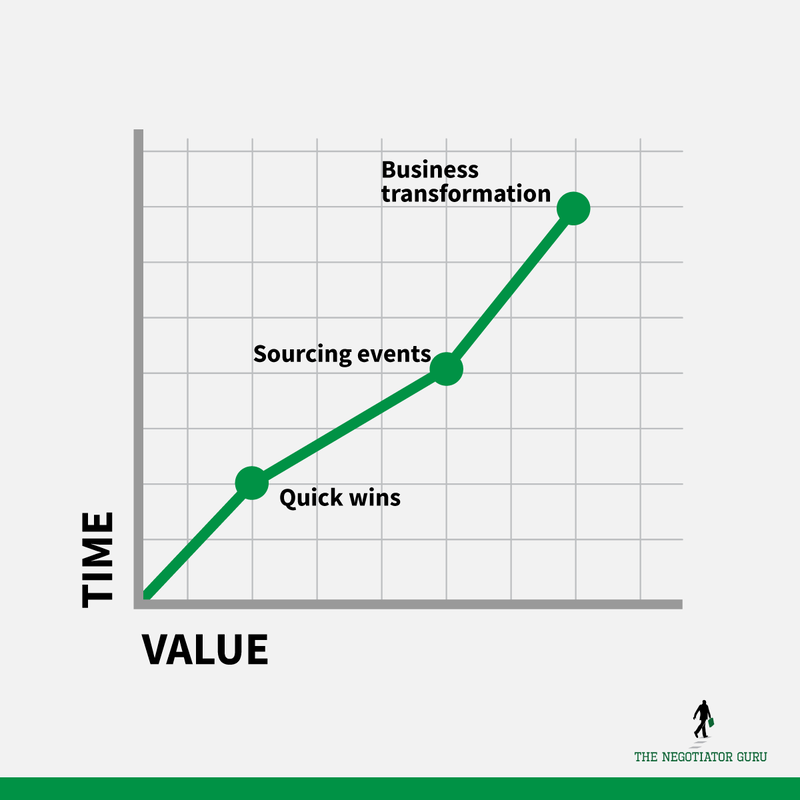
We recommend isolating cost savings initiatives into a minimum of 3 categories. The following three titles are widely used within the industry:
- Quick Wins
- Strategic Sourcing Events
- Business Transformation
Naturally, when we identify Quick Win opportunities we are indicating that the time (and corresponding effort) to value is relatively short. On the other side of the spectrum, when we identify a Business Transformation initiative we recognize a large opportunity exists but it will take significant time/effort to realize.
Every M&A transaction will present different opportunities and challenges. You will be pulled in so many different directions that at times it will feel as if you’re getting nothing done at all. At those moments, it’s important to recognize the planning and analysis efforts that have taken place to make this opportunity come to life.
Speaking from experience, we strongly advise you to “keep things simple” when it comes to identifying, classifying, and tracking your Value Capture Initiatives. The more complexity you add the less time you’ll have achieving synergies that make a material impact for your company.
Quick Wins
Finding efficient, simple ways to reduce IT spend is paramount for any company… especially one which is embarking on an M&A transaction. The easiest and quickest solutions come from simply taking an inventory of each company’s supply base and contracts.
Combining company spend can create natural opportunities to renegotiate agreements - especially in the IT sector. By analyzing contracts to identify areas of overlap and redundancy, you can find multiple cost-saving opportunities including volume discounts and supplier/contract consolidation.
Strategic Sourcing Events
Strategic Sourcing Events are what most people think of when they conceptualize how IT will identify and realize cost savings as a result of combining company spend. Naturally, these initiatives require more effort than Quick Win opportunities of which may not be readily apparent prior to Day 1.
These initiatives will focus on rationalizing the supply base, rates, and services. A smart approach will be to break out these initiatives via a digital capability taxonomy that matches how your organization categorizes IT services to its internal and/or external users. This will proactively align your cost savings initiatives to your internal business units and company objectives.
Sourcing events will most often include the typical procurement steps of conducting RFPs (Requests for Proposal) and negotiating with suppliers to rebid contracts. This step can take anywhere from 3-24 months depending on the size, scale, and complexity of your transactions.
Business Transformation
This last one is the most complex. It involves changing the way the business functions - whether a process change or a platform change or some other foundational alteration. These opportunities take the longest, clocking in around 1 to 3 years to complete.
Identifying corporate synergy initiatives is a complex endeavor. You need a team of both internal and external experts dedicated to driving value capture for the NewCo (newly combined company). If your transaction is relatively small, this team can be as simple as one person… the point being there always needs to be someone dedicated to this effort.
Only outside expertise will be able to truly advise you on target market rates, supplier options, service levels, etc. You only know the rates and the companies you’ve worked with - you don’t know what other businesses are paying for the same products, not to mention any new suppliers coming your way through the M&A.
Bringing in outside help is critical to ensuring you are well-positioned to identify, analyze, and execute cost synergies on, and before, Day 1.
Legal Reasons
It's an SEC violation if you act on behalf of another publicly-traded company before you actually own them. This could be viewed as collusion within the marketplace.
To refrain from any violations, it’s advisable for companies to leverage external, independent advisors to ensure the information on the newly combined company is used appropriately and only for value capture initiatives.
You want to bring someone in who can help you do the appropriate analysis so that there’s a distance between your company, your employees, and the company you’re merging with or acquiring.
Process Standardization
No matter whether you are a 100-person company or 100,000, you’ll quickly discover the importance of having standard procedures within any M&A transaction. Program management information needs to be collected, analyzed, and presented in a consistent manner to eliminate ambiguity for senior executives.
Standing up a PMO (Program Management Office) who can standardize the analysis and the presentation of information can, and will, greatly reduce chaos.
You need to start the planning process immediately.
In an ideal world, the minimum amount of time you really need to get this right, for a large transaction of $1 billion or more, is six months prior to close to complete the planning process.
Ideally, you will stand up your Enterprise Integration Management Office (EIMO) once you enter the final due diligence process with your target company. Again, the earlier you can get this planning started, the quicker you’ll be able to realize those profits.
An EIMO is a separate individual business unit and is accountable for all the integration activities including both the identification of synergies as well as Day 1 activities.
The knowledge transfer process from your due diligence team to your EIMO and Integration Management Teams (IMT) will prove to be invaluable.
Experience has taught us that no matter how prepared you think you are, there will always be hiccups along the way. The longer runway you have prior to Day 1, the greater the probability your company will start saving money on, or before, Day 1 rather than in year 2 or 3.
In order to prevent both roadblocks and bottlenecks, you need to empower your people with clear and distinct decision-making authority immediately.
Most organizations fall behind in their execution plans based on a lack of clear decision-making authority when acting on behalf of the newly combined company.
This naturally drives all decisions to the EIMO which turns into a bottleneck for the organization.
We recommend setting clear guiding principles and tactical direction (via examples) early within the planning phase to ensure your key stakeholders are aligned and empowered to act as catalysts for the EIMO. While each organization’s decision-making authority and autonomy is unique to their culture, what remains consistent is the speed in which decisions will need to be made before, during, and after the transaction.
In short, the more authority you can safely push downwards inside of your organization, the better.
The change management process is critical.
Clear communication guidelines need to be created in coordination with your legal team and need to take into consideration internal, external, and regulatory impacts.
Internally, you’ll have employees concerned about their existing roles within the company and how the transaction will affect their lives.
Externally, you’ll need to manage expectations with suppliers of both companies.
Immediately upon announcing any M&A transaction, the phone will start ringing for both organizations. Suppliers will be trying to take advantage of the change to gain more business and/or to increase rates.
Be prepared to immediately publish a message to all your suppliers after an announcement. Doing so will help to avoid a tidal wave of requests within your planning phase. At a minimum, publish a blanket statement on your external facing website for suppliers to read in a self-service manner.
Clear and proactive communication both internally and externally will allow your organization to be ahead of the Q&A frenzy.
Two Key Phases of an M&A Transaction
Planning: Generally, this encompasses all activities between the transaction announcement and Day 1 (first day of the NewCo).
Execution: Generally, this encompasses all activities that take place to realize the operational synergies identified within the planning phase. Most commonly, these activities are post Day 1, however, we will discuss opportunities to start in the planning phase.
It’s critically important to start planning immediately after (or even before) the announcement of the transaction. If you fail to start pre-Day 1, it’s important to understand that you will have already lost a significant amount of potential value capture from the NewCo. As with any cost savings project, you need to prepare as far in advance as possible to ensure your execution teams are well prepared and aligned.
An Opportunity Tracker for Tracking/Reporting in Both Phases
Within both phases, it is extremely important you develop and actively manage an Opportunity Tracker in the interest of identifying 1) initiatives that are business-critical for continuity purposes and 2) those which will identify cost savings for the new company.
Tracking these initiatives in an easy to understand and consistent manner will provide several intrinsic values for your organization and its many stakeholders. Most importantly, it will serve as a single source of truth for reporting and execution purposes.
Your Opportunity Tracker needs to capture two primary areas of work: Operational Requirements for Day 1 and Value Capture Opportunities that contemplate action before, on, or after Day 1.
Example of a Day 1 Operational Requirement:
What happens to the acquired company’s email server after Day 1?
Do the companies merge their email platforms or do they keep them completely separate?
Who will be accountable for the transition plan?
While this action may not be a value capture initiative, keeping email working for the NewCo is arguably critical to business continuity. This is an example of an operational requirement.
Example of a Value Capture Opportunity:
A value capture opportunity is essentially a cost savings synergy that originates from the harmonization of suppliers, contracts, etc.
Expanding upon our email Day 1 requirement above, if your organization makes a decision that the NewCo will migrate to a single email platform (most common), this would create a value capture opportunity based on a contract/rate negotiation event with a new or existing supplier.
Examples of initiatives may include a renegotiation with Microsoft or a sourcing event to identify a new service provider. The objective is that you need to quickly and easily be able to isolate those line items that are Day 1 Requirements vs. Value Capture Opportunities. Within the Opportunity Tracker, each line item will include details about the Cost to Achieve, ROI, resources needed to achieve the goal, etc.
Download my Opportunity Tracker template to see how this information can be laid out.
We also go over the Opportunity Tracker in detail later in this article.
Organizational Design
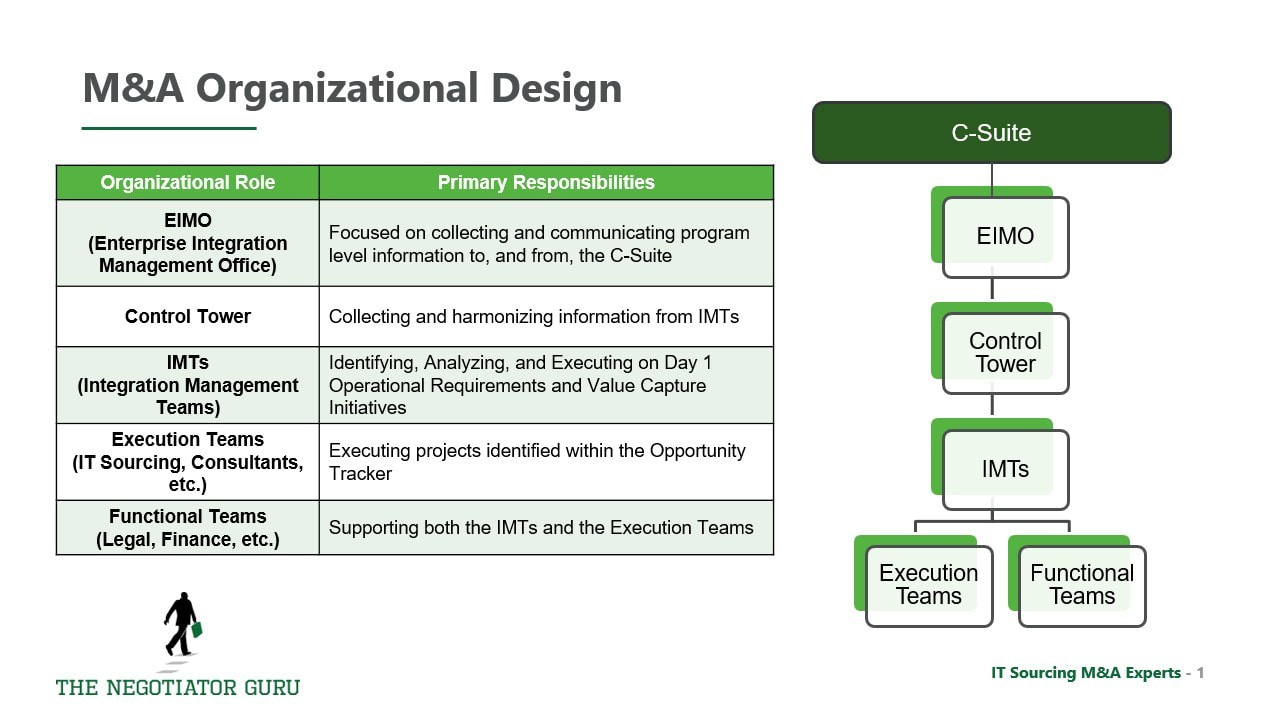
Whether your business makes $1 million a year or $1 billion, every company needs to create an EIMO (previously explained under “You Need to Start the Planning Process Immediately”) that acts as its own specific business unit. The process is the same, although the size and scope may change.
If you’re going through an acquisition, the acquiring company is responsible for creating the EIMO business unit that reports directly to the CEO. If you’re merging, the company that will be retaining the CEO will be responsible for the EIMO.
Basically, the EIMO business unit needs to be attached to the leadership team of the new company.
Requirements of the EIMO
This unit needs to have its own budget. You know that in business, you’re going to have to spend money to make money and this temporary department is no different.
Most companies spend 5% of the new company’s value on M&A services in order to save 40% after the transaction is complete.
In addition to their own budget, your EIMO needs its own targets.
Although it’s not technically making money, it will be saving your company significant sums if organized properly.
Control Tower
Underneath the EIMO, you’ll have a Control Tower.
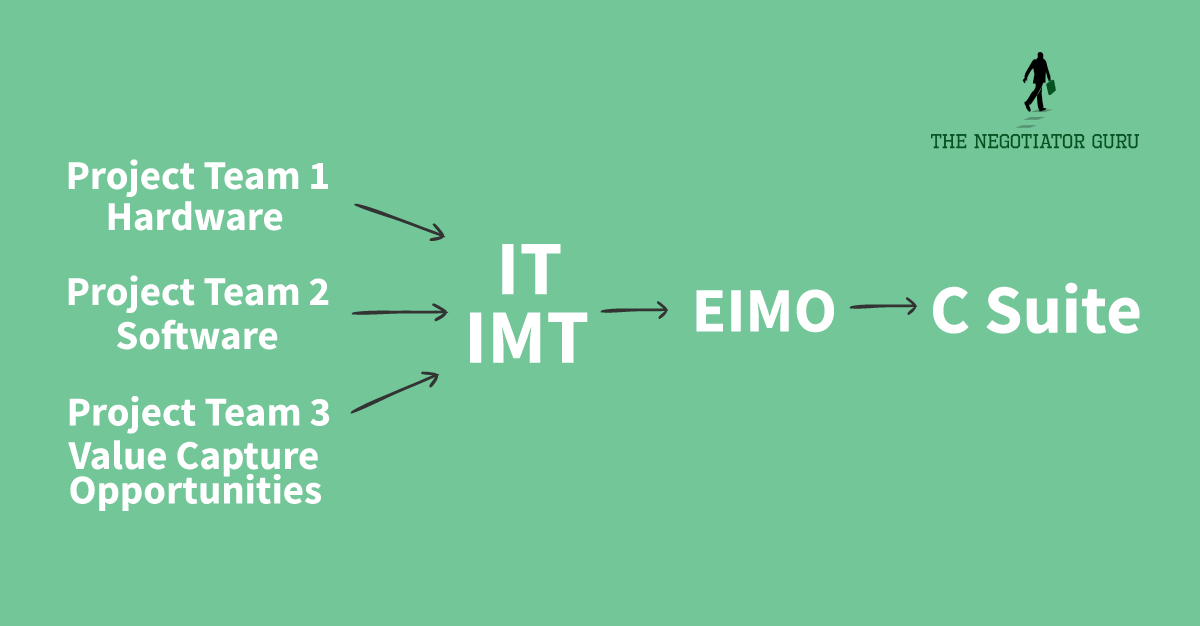
The Control Tower ensures that all of the information that’s coming from the IMTs (and the Functional Teams below them) are being harmonized in a consistent and actionable way. If all of the information is well organized, you’ll be able to make smarter business decisions.
Integration Management Teams & Leads
To properly succeed, you need a dedicated Integration Management Team whose full-time job is to identify synergy opportunities and Day 1 requirements.
This team will have a leader who is accountable for all the activities of the team. Reporting to the leader will be individual owners of specific initiatives or capabilities.
For example, in an IT IMT you’ll have one lead who is responsible for all the activities of the team and the rest of the team will be made up of one person per category of spend. Maybe one person in charge of infrastructure or hardware, another in charge of software, and another in charge of services, etc.
Basically, one person on the team per vertical of how the business operates. These individuals are accountable for identifying Day 1 operational requirements and value capture opportunities for the NewCo.
Functional Teams
While your IMTs are focusing on Day 1 operational requirements, it’s important for your IT Sourcing/Procurement team to work alongside these same teams in the interest of identifying value capture opportunities.
In realistic terms purely based on how large organizations operate, it’s important to recognize that the IMTs will often be more focused on Day 1 operational requirements while your IT Sourcing/Procurement team will be primarily focused on value capture opportunities. This is completely acceptable as long as there is continuous alignment.
Planning Phase
Step 1: Clean Room
During the very beginning of the Planning Phase, you need to set up - either virtually or physically - a Clean Room.
A Clean Room is essentially a quarantined environment where you store and analyze information about the new company you're either acquiring or merging. This information is only available to a handful of individuals within the IT IMT and Functional Teams, and they will be responsible for analyzing data, contracts, etc. in the interest of identifying both Day 1 operational requirements and value capture initiatives.
The room itself can be virtual in nature such as a secure SharePoint or Google Drive. The bifurcation of information from the rest of the organization is important to minimize public perception, as well as operational and regulatory risk. Make sure each individual that has access to this virtual or physical Clean Room signs a separate Confidentiality Agreement to ensure information is not shared with others prior to close.
Obviously, your legal team will be the ultimate determining factor for who should have access and when information can be shared more broadly as each transaction is different.
Most of your value capture initiatives will originate from the Clean Room as these individuals will be able to compare suppliers, contracts, rates, etc. and place them on the Opportunity Tracker.
Step 2: Gather Data
Both companies will upload data and information into the Clean Room.
The company being acquired (or losing CEO status during the merger) needs to upload their data according to the same taxonomy of how the new leading company categorizes their spend.
This is subtle but a very important nuance.
You, the acquiring company, want their data to match up with your spend categories as much as possible so that you can create an accurate analysis.
For example, your spend taxonomy splits categories out by hardware, software, services, mobile telecom infrastructure, etc.
When you acquire data from the other company, map their spend according to your own taxonomy so that you can have a one-to-one relationship between your current contracts and their contracts that will eventually have to become one unified contract. You want to compare apples to apples, not oranges.
Step 3: Analyze
When you have the Clean Room filled up with the data from both your company and the other company, you’ll be able to start analyzing the opportunities available.
This will give you your first look into:
- Combined company spend per category
- Supplier overlap, if any
- Current state rates per supplier/digital capability
With this information, you can start identifying initiatives within your Opportunity Tracker.
If each company has a Microsoft contract, for example, you can start looking at the costs in each of your contracts - who has better rates and how you can negotiate those further with a larger volume, etc.? This is considered a Quick Win opportunity.
If there is no supplier overlap in the same category of spend, then you don’t have a Quick Win opportunity but instead a Sourcing Opportunity. In this case, you can go to market with your new combined spend and do an RFP to move everyone to the same supplier under one contract instead of multiple.
Keep An Eye Out for Contract Risk
As I’ve mentioned before in other posts on IT Software negotiation, it is very common for major software providers to intentionally insert M&A language in their master service agreements and/or order forms that are very ambiguous and open-ended. What remains consistent is that, by default, this inserted language will always be in favor of the software company. Subsequently, they know their primary contacts within the client organization rarely review such language as it’s not top of mind at that point in time.
We find that 2 out of 3 clients entering into an M&A transaction don’t even think to look for contract risk within their existing contracts. Subsequently, we find this same statistic holds true for the number of times we identify risk in those contracts we review on behalf of the client.
One very common example of contractual risk we identify for clients is value-based pricing mechanisms. Specifically, large software companies will include language that indicates “the parties will readdress pricing based on increased customer value extracted from the platform.” We call this commercial risk as it essentially creates an open playing field for renegotiation. Some of our clients actually call this “ransom language” based on software companies being well aware of the cost of change to move off the platform during a very sensitive time. In other words, these suppliers will charge a “ransom” that is just under that of the cost of change baseline, just because they can.
While it may be fair to say the NewCo will achieve greater value from the platform, it’s important to proactively identify and mitigate (to the extent possible) any potential risks (such as commercial risk) to ensure you minimize and value capture slippage.
Other very common questions you should ask yourself during your contract risk assessment include the following:
- Are you allowed to terminate for convenience?
- Are you allowed to use your existing contract with a new subsidiary and/or wholly owned entity?
- Are you able to renegotiate the contract now to avoid any surprises after Day 1 and/or the natural expiration of your current contract?
When you’re doing this assessment, prioritize your time and energy around your largest spend contracts first. Look at your top 20 supplier contracts in terms of spend - no more than that - before you look at all the others.
You don’t have to comb through each of these contracts by hand either. There are software products out there that will do an Optical Character Recognition (OCR) scan for you and isolate contracts that have keyword risk.
Levels of Contract Risk Remediation:
Level 1 - OCR
Once you stand up your Clean Room with your various contracts and documents, you essentially want to run them through some sort of search tool to identify if they have any key topics that might trigger a negotiation event as a result of the transaction.
A few examples of OCR companies include Kronos OCR, Seal OCR, KIR OCR, Vanguard OCR, and a few others can be found here. We have no affiliation with any of these products, we merely want to provide information you may find useful.
Common causes for renegotiation include:
Assignment - Does the contract allow you assign it to another company? You’re buying the company but not all contracts can be assigned during an M&A.
Change of Control - This concept is similar to assignments. Basically, does the contract include continued control language that would allow for a new company to take over said contract?
Governing Law & Dispute Resolution - What state, county, or jurisdiction does this contract live in? Some suppliers don’t want to work in specific jurisdictions because of legal restrictions or political friction.
Limitation of Liability - Your legal team will have language surrounding what kinds of liability guidelines they’re willing to accept, especially with suppliers. During an M&A, you’re acquiring so many new suppliers it’s easy to lose sight of this potential risk, particularly within the R&D field. As contracts naturally expire, you’ll want to align the new suppliers to your standard contract language to minimize risk.
Renewal - Are your contracts set to automatically renew? Are they evergreen?
Restricted Covenants - This language essentially outlines that, in order to receive your pricing today, you basically have to spend a certain amount (or meet certain thresholds) per contract cycle/year. These contracts include Minimum Spend Levels.
Termination - Do the contracts include Termination for Convenience? If they don’t, you need to know the terms of termination and weigh that as a “cost to achieve” within any initiative within the Opportunity Tracker.
These are some of the most common reasons for renegotiation with suppliers. While it’s possible to have human eyes scan contracts for this language, it’s much less expensive to have a software churn this out for you with the intent and understanding that this process will only highlight 75% (at best) of your basic risks.
We always recommend you supplement strategic supplier contract risk assessments (typically your top 10 suppliers by spend) with a Level 2 assessment.
Level 2 – Human Eyes Looking for IT Risks
Level 2 contract risk evaluation is necessary to identify specific and material risks that may adversely impact your company. From a tactical perspective, this requires human review with a specific focus on high impact risks to your organization.
The following risks are typically identified in Level 2 evaluations:
Volume Based Pricing (Data Pulls) - No matter the size of the M&A transaction, you’ll almost always have two different suppliers providing the same or similar service. If you aren’t able to consolidate to one supplier right away, and require data to be pulled/integrated from multiple systems, you have the potential to see volume-based contracts skyrocket for 6-12 months as a result of both companies using both services.
It’s important to remember that volume-based contracts come in all shapes and sizes ranging from raw data consumption to API calls. It’s important to conduct an assessment of your Day 1, 30, and 100 requirements to ensure, at the very least, your most strategic supplier relationships (aka highest cost contracts) are analyzed to proactively identify this situation. Identifying these additional costs on, or around, Day 1 will inform your business case on how quickly you merge systems, processes, etc.
In situations where two companies need to run concurrent systems for quite some time for operational and/or regulatory reasons, it’s very common for this to create a “negative synergy.” In other words, this will be an added expense to the NewCo that will degrade the potential synergy cost savings generated from the transaction.
You need to identify systems/processes that will run concurrently as early as possible within the Planning Phase. The supplier contracts that are governing these systems/processes will need to be analyzed immediately to quickly identify the potential financial impact to the NewCo. Naturally, if you identify a situation that causes you to spend an extra $1 million+ during the transition period, you’ll be more inclined to get it streamlined earlier rather than later.
Pricing Mechanisms tied to moving targets (R&D department spend, annual revenue, etc.) - Almost all software suppliers sell with a “value-based pricing” mindset but only some of these suppliers charge a customer tactically in this manner. Within large organizations, we often find this within supplier contracts supporting the R&D department.
Some software suppliers charge by value obtained while others benchmark the perceived value extracted by utilizing your annual revenue, and/or R&D spend, as a cost metric.
This can be a slippery slope because, for most businesses with an R&D department, your annual spend is going to double. Without the proper protections in place, this potentially equates to your existing contract cost doubling as well.
While contractually this is something they may be allowed to pursue, most strategic suppliers will accept an M&A transaction as a renegotiation event IF you catch this potential risk early.
Yes, we intentionally underlined “IF” within the last sentence. It’s important that you renegotiate these contracts as early as possible before your cost and leverage spin out of control. If properly managed, most savvy software suppliers will accept a decrease in their potential future revenue if they feel comfortable that they will secure a strategic position within the NewCo’s supply base. Again, this needs to be very carefully managed.
License Restrictions - Are there country-specific license agreements? Or are they global in nature?
For example, if a software contract only allows you to use their platform in a specific country, but the NewCo will require employees to access that same platform globally, you could be hit with massive fines for license infringement.
Notice Obligation - Does a contract require explicit notice prior to an acquisition or merger taking place in order to be transferred to the NewCo?
If notice is required, and you don’t provide the same during your Planning Phase, you could find yourself in breach of contract and face heavy fines, a potential lawsuit, or termination of service.
The NewCo Spend Baseline & Supplier List
Just like building a new house, it’s important you build a strong foundation. Your foundation for the NewCo starts with a combined spend baseline and supplier list.
Tactically speaking, this can be achieved through spend visibility tools or by just using a simple Excel Spreadsheet. From a baseline perspective, you will want to create a master list of all your suppliers, which organization they are currently supporting, and the annual spend of each split out by organization (if the supplier is servicing both companies). Data permitting, we also suggest you identify “how” each supplier is supporting each organization by assigning a spend category and/or a digital capability taxonomy code. If you have this level of detail, it will prove to drive efficiencies for downstream analysis activities.
Create your spend/supplier baseline as soon as possible during the Planning Phase. Subsequently, you’ll want to create this baseline before you start identifying any cost savings initiatives no matter how much your organization is pushing for the same. We have seen countless hours wasted when clients, and/or partners, start identifying opportunities before they have built and aligned on, a foundational baseline.
While this may feel like a tactical step, it is extremely important as it creates the foundation for future steps you’ll take.
From this foundational list, you’ll be able to quickly identify, analyze, and execute the following Quick Wins:
- Identify duplicate suppliers providing the same service to both organizations; and,
- Identify overlapping services across multiple suppliers.
IT Sourcing Initiatives Identification
This next step needs to be done in a very coordinated and organized way. For simplicity purposes, we suggest creating a separate Excel Spreadsheet that is purely dedicated to identifying synergy opportunities.
We strongly advise this be a standalone document for quality assurance, data backup, and access control reasons. Within this document, hereby referred to as the “Opportunity Tracker,” you will be proactively identifying your value capture initiatives, stakeholders, synergy targets, etc.
The Opportunity Tracker will serve multiple downstream purposes but most importantly will serve as a single point of truth for synergy planning and execution. It will help you identify prospective value capture (financial opportunity) and the time and resources it will take to achieve them.
The overall guiding principle is that this Opportunity Tracker is going to keep your initiatives straight from a Project Management standpoint and it’s going to help you prioritize what to work on first.
Your Opportunity Tracker should classify opportunities based on:
Initiative Grouping - This is usually based on supplier and/or digital capability. The main priority here is to roll multiple actions with one supplier into a single initiative.
Category of Spend - Categories of spend may include IT Software, Hardware, Mobile Telecom, etc.
Type of Opportunity - There are 3 different types of opportunities (referenced above under “Value Capture Initiatives”): Quick Wins, Strategic Sourcing Events, and Business Transformation.
- Quick Wins are those initiatives that can be done quickly and with very little effort.
- Strategic Sourcing Events are initiatives that require a sourcing professional to source the marketplace to capture the most value for your NewCo. Most commonly, this will include activities such as supplier rationalization.
- Business Transformation initiatives fundamentally change the way you do business. These generally take the longest amount of time, effort, and budget but will return the greatest amount of value to the NewCo. Most commonly, these initiatives will include process changes, etc.
Supplier Impacted - It’s very important to identify which supplier(s) will be impacted by each initiative. You want to be sure to break this out by organization so you can quickly identify the location of the impact.
Stakeholders - In this cell, you need to identify key stakeholders that need to stay aligned and supportive of the initiative. The identification of key stakeholders is very important not only for project tracking purposes but also for tracking change management efforts. Specifically, you’ll want to ensure stakeholders are aligned to the “why” statement of any change so they can proactively act as change catalysts. Other downstream ways to use this data will be to ensure cross-pollination of ideas, identify and proactively prevent burnout, and to enable delegation.
Frequency of Savings - Will tackling this initiative give your company recurring savings or is the value capture a one-time occurrence?
Type of Synergy - There are basically 8 different types of synergy that I’ll go over briefly here:
- Wedding Present - When a supplier gives you cost savings or a concession in the interest of goodwill. They want to be in your good graces during and after the M&A.
- Demand Optimization - When you are lowering demand to use a specific supplier or to use a specific service. Your costs go down because you have fewer licenses, etc.
- Supplier Rationalization - We touched on this briefly in the Strategic Sourcing Events section above. Depending on niche offerings, digital capabilities, rates, etc, you need to deliberately create a supplier strategy that drives the greatest value for your NewCo. This may, or may not, include eliminating duplicate suppliers, etc.
- Process and Specification Rationalization - Takes place when you’re eliminating duplicate processes, etc.
- Payment Term Optimization - This primarily focuses on improving cash flow terms for your NewCo by extending payment terms, net discount rates, etc. This is a very important, but tactical, synergy opportunity that collectively could make a significant net positive impact for the New Co.
- Price Alignment - Quite simply, the process of leveraging an existing contract that secures the best rates with a single supplier.
- Supplier Relationship Management - This is often harder to quantify from a value capture standpoint but often a critical component to strategic suppliers for the NewCo. Identifying an initiative with this classification is a deliberate identification that a supplier relationship needs to be uplifted in order to extract the greatest amount of potential value.
- Volume Consolidation - Last, but certainly not least, this classification focuses on consolidating the volume of spend with suppliers to drive better rates and commercial terms for the NewCo.
Confidence to Achieve - While completely subjective, determining whether you have high, medium, or low confidence in achieving this initiative is still an important consideration for tracking and prioritization purposes.
Time - Identifying the amount of time an initiative will take in order to start achieving the synergy. This is one of several critical variables within the Opportunity Tracker to ensure synergy financial planning and resource allocation alignment. We recommend quantifying this in terms of months.
Resource Requirements - In this section, you outline what resources are required to successfully execute the initiative. This includes both internal and external resources.
Internally, which of your staff will be attached to the execution of this project?
Externally, will you need advisors? Sourcing support? Legal, financial, or PM support? This can come in the form of advisory support to identify “should cost” benchmark rates, management consulting, or sourcing professionals who know how to run sourcing events (ex: RFPs).
You’ll want to establish a baseline cost for each role in order to calculate a “Cost to Achieve” over time. The Cost to Achieve is your gross costs that will be incurred during the Planning and Execution of a specific initiative. In other words, these are negative costs against any specific synergy estimates for a specific initiative. Naturally, you will want to identify and execute those initiatives that have the lowest Cost to Achieve with the greatest synergy potential.
Synergy Estimate - In this cell, you’ll identify the financial value capture target you have identified (by year) for the NewCo. In a perfect world, this should be calculated as the net synergy which contemplates the gross savings potential against your gross Cost to Achieve. In doing so, you’ll be able to better prioritize resources to those initiatives with the greatest potential upside.
One important thing to note about these synergies - each initiative can have more than one synergy opportunity attached to it!
Execution Phase
In order to successfully execute your plan, we recommend focusing on a few foundational concepts that we have found (through client feedback) organically drives downstream efficiency. In the interest of brevity, we have included a basic outline of these best practices below.
Establish Guiding Principles to Prioritize Projects
The first thing you want to do is establish guiding principles around how individual projects will be resourced based on complexity and value capture potential.
It’s critical to align with your internal finance team on a cost-to-achieve metric that is consistent across the organization. You need to have a clear run rate value identified for the several different internal resources types that will be supporting the execution of your projects. At a bare minimum, you need to identify a blended hourly internal resource cost that is all-encompassing.
To drive process efficiency, you may be more inclined to push decision-making authority farther down into the organization and enable project teams to make decisions based on value vs. cost.
This will decrease time to value on your synergy initiatives. It eliminates the need to request resources or approval to hire from the EIMO which would otherwise bottleneck progress.
We recommend allowing Project Teams to make unilateral resourcing decisions if the cost to achieve is 30% or less than the expected value from the project.
For example, if you project to save $100K by completing this initiative, then it’s acceptable for the Project Team to spend $30K to achieve the savings without a need for individual requests for approval.
Internal Alignment is Critical
The most important thing to keep in mind during the M&A Execution Phase is ensuring continuous alignment between Functional Teams, IMTs, and the EIMO.
In order to keep alignment between the teams, you need to leverage the Opportunity Tracker as the single point of truth for all initiatives and their respective synergy targets. The Opportunity Tracker should be accessible by all relevant stakeholders that are looking to consume information about synergy targets, project status, etc. The more you enable a self-service environment the less you’ll need to respond to data requests, etc.
Subsequently, we recommend establishing weekly check-ins with both Project Execution and Leadership Teams to ensure continuous alignment. During these meetings you should also raise any material issues, risks, and/or achievements for immediate recognition and triaging.
With all of this being said, it’s important that you are cognizant of not placing too many meetings on the calendar that may be close to the same purpose. This problem already exists in almost every corporate culture during the normal course of business so please recognize that this problem will exacerbate itself in an M&A environment.
This graphic represents how we believe weekly project alignment should occur:
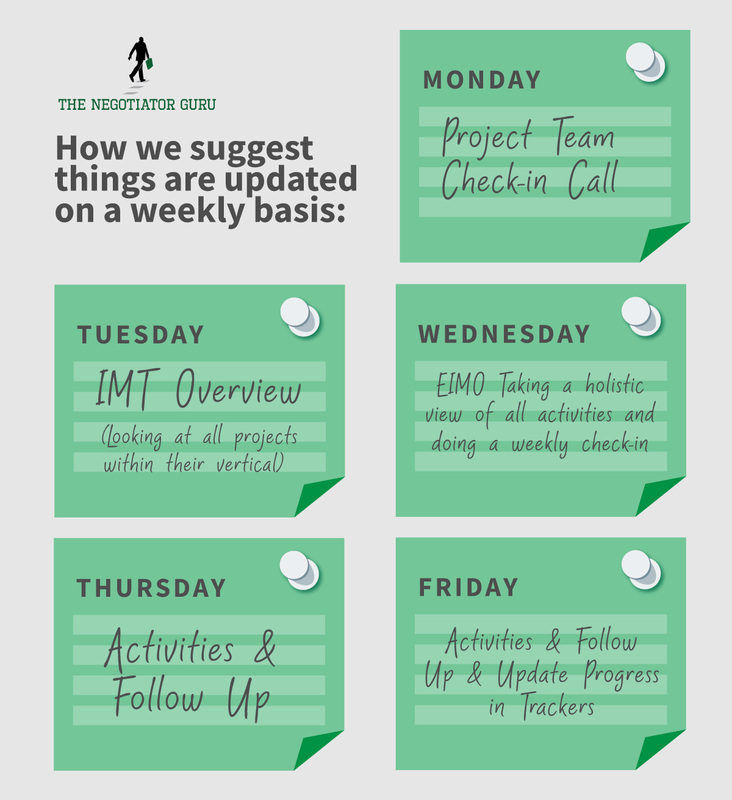
This weekly cadence encourages Project Teams to make substantial forward progress before Friday of each week. In other words, this naturally incentivizes those with a personal drive for success to share actions taken/planned each week.
The Opportunity Tracker (as the single source of truth) will enable Leadership teams to monitor this progress in both a self-serve and meeting environment so they can be prepared to ask and answer questions. As we hope you can now see, the Opportunity Tracker will be the discussion platform of choice during both Planning and Execution Phases as it will be managed and presented on a weekly basis in a multitude of forums.
Don’t forget to include the Finance Department in these weekly updates. By doing so, you’ll eliminate any surprises down the road from a synergy tracking standpoint while also ensuring proper expectations are managed at the C-Suite level.
Build a Control Tower
Leverage a Control Tower framework to ensure information is reported in a clean and consistent manner.
This is especially important when reporting information to the EIMO who is then reporting information to the C-Suite.
The Control Tower should report on the following topics:
Resource Allocation Monitoring - How many resources are being used? Are you overtaxed or undertaxed in certain areas of the organization?
Value Capture Initiative Status - How many projects do you have underway and planned? What does your pipeline look like?
Synergy Target Update vs Actuals - This is an update of the financial synergy targets for planned projects, and the actuals for projects that are underway.
Significant Risks/Issues - These can’t always be predicted ahead of time and should be communicated as they arise.
Each of these topics need to be addressed with each IMT. This information should then be harmonized, prioritized, and presented in a consistent manner to the C-Suite.
Establishing clear lines of communication, decision-making capabilities, and tracking systems combined with weekly alignment meetings will help ensure a smooth and efficient Execution Phase.

My 3 Guiding Principles for The Negotiator Guru
Imagine you are a C-Suite executive and your business is built on a franchise model.
Each franchise branch is owned and managed by a different person but they all use the same ERP and the big corporate umbrella entity that you own pays for all the services.
The individual owners dictate which software and services they use, how many licenses they need, etc.
Your annual bill for all the different contracts comes to $2.5 million.
How would you feel if I looked through your contracts and told you that, based on the prices your peers pay, you should actually be billed closer to $900,000 - a more than 60% savings - for the same host of services?
You’d probably want to flip the table we’re sitting at.
I started The Negotiator Guru because I believe in 3 things:
- Clients should all pay the same price for the same product*
- Clients have the right to know what rates they should be paying in comparison to their peers.
- Clients should know what to look for in software contracts to eliminate potential issues before they arise.
I want to go into each of these beliefs in more detail and give some case study examples to further demonstrate why I think these points are so important.
Clients should all pay the same price for the same product.
It’s common for people to believe the price they’re paying is equal to what their neighbor paid for the same product.
Due to both Master Service and Non-Disclosure Agreements between most software vendors and their customers, companies are not allowed to publicly share what rates they’re paying for their different products/services. Subsequently, software suppliers will almost never advertise a specific price point for enterprise customers but rather indicate “call for details” in the interest of driving the most revenue from the potential relationship.
In other words, in the art of enterprise SaaS sales, you won’t find any published rate information for you to benchmark your contract against. The only way for you to identify whether or not your rates are competitive is to engage a firm that holds that market intelligence as a result of analyzing contracts on a daily basis.
The fact of the matter is: Prices always vary.
No one pays retail as an enterprise customer but some companies achieve significant discounts compared to other similarly-sized operations.
In some cases, you’re getting ripped off if you’re not getting an 80-90% discount off published prices.
It wouldn’t be logical to expect a huge company like Coca-Cola and a small startup to be paying the same price purely based on volume alone. But brands of the same size with similarly-sized contracts (based on annual revenue & annual spend for their contract) should be paying the same price.
I have great respect for wonderful sales executives who sell value to customers, but my company believes the market should dictate a fair price for all IT goods & services (Services, Software, Hardware, etc).
The enterprise sales executive is arguably the greatest asset these IT companies have within their organizations. The good ones truly know how to sell “perceived” value.
Regardless of how personable a sales executive is, we believe the market should dictate what a fair price is - much like buying or selling a home. In order for this work, we believe that rate information should be readily available to customers. In order for this information to be shared legally, we need to enter into a commercial agreement with your company and charge for these advisory services.
Clients have the right to know what rates they should be paying in comparison to their peers.
On a daily basis we see similar-sized clients with similar-sized contracts have a 30 – 60% price variance.
Now, whether this is because some companies didn’t have strong negotiating skills or perhaps they just didn’t know how their contracts compared to the market doesn’t matter. What does matter is that clients know how their contract prices compare so they can make future decisions accordingly.
Ideally, through access to more information regarding IT contract pricing, you’ll be able to secure the best rates for your company. Leveraging this information can significantly impact a company’s bottom line.
But even if you aren’t able to achieve best-in-class pricing, we believe you should know what those rates are to empower decisions on how to work that supplier moving forward.
Often, relationships with IT suppliers run into the roots of your business and once you’re in that deep, it can be hard to break loose to find another vendor.
Even if you can’t get off of a big platform like Salesforce, Oracle or another ERP, you can make better-informed decisions about how you’re going to increase or decrease your use of that platform in the future.
There are a few market intelligence firms out there that supply basic and watered-down pricing information to clients but require a $30,000 per year subscription fee (per seat). This cost to have access to this benchmark data isn’t a feasible or justifiable expense for many companies.
We don’t feel that only Fortune 500 companies should have access to market intelligence firms and benchmark data.
The existing methods used to decide what the best price really is for any given enterprise could be improved. Most market intelligence firms take a general approach to setting correct pricing rather than looking at the specifics of each contract and the unique needs of each company.
For example, these firms will recommend that you should be getting a 60% discount if you’re spending $1 million with a particular IT company as a blanket rule.
Instead, we take into consideration the specific needs of our clients and use a Right Size, Right Price approach within every contract negotiation.
Clients should know what to look for in software contracts to eliminate potential issues before they arise.
Having a deep understanding of the terms of your most expensive contracts will help you save hundreds of thousands of dollars.
Here I want to briefly outline a few common contract issues that I see my clients face:
Price Protection (and not just by SKU)
Price protection generally comes up when you’re signing your first contract with a software provider. IT companies will compete for your business by offering you the lowest prices for their services with the expectation that they’ll be able to raise the rates once you’ve completely adopted the product.
Companies will always try to find ways to increase your annual expense. This is largely due to sales incentive plans in place with their sales development organization. Common tactics used by software companies include random internal audits to monitor usage (overage fees), product lift and shift changes (new SKUs), and service fees (for enhanced customer support).
More often than not our clients are very astute individuals that use their best efforts to price protect their organization’s contract for future years. That being said, it’s unrealistic to think anyone knows how to mitigate all the potential risks unless you do this everyday.
For example, to mitigate against the software companies from simply changing product names (SKUs) to bypass any preexisting price protection you may have on a specific product, we suggest you introduce contract language that protects your company using your total spend (vs a product-specific SKU) as the common denominator.
M&A Language
Make sure you have specific language in your contract about what happens in the case of a merger or acquisition.
Be sure to include language about a Termination for Convenience. This is a provision allowing you to get out of the contract if you acquire, or are acquired by, another company within a certain time frame - usually 90 days to 6 months.
Termination for Convenience eliminates the risk of having duplicate service providers for the same service after the transaction is closed. Without this stipulation, companies can find themselves with millions of dollars in expenses that are avoidable.
Note: In the interest of this article’s brevity we aren’t going to stipulate all the protections you need in an M&A transaction as this will be further explored in a future article. While the guiding principles of what to include within your contracts will remain consistent, client-specific protections will always require advisory services.
Termination for Breach
Termination for Breach language is important information to include in your contracts. In these cases, attorneys have to be involved and mal intent has to be proven by the accusing party.
This rarely ever happens and having the language laid out in the contract incentivizes IT companies to behave their best throughout the contract term.
License Limitations
It’s common to have language surrounding license limitations in your contracts. This basically says that you can use a specific license at a specific site for a specific reason.
These stipulations probably make sense on the surface and won’t alarm the person reading the contract but in most companies, with thousands of employees, not everyone is reading the contract. This could lead employees to inadvertently infringe on how the license may be used.
The best way for most companies to avoid this is to have seat-based pricing attached to specific personas (usage rights) rather than volume-based pricing.
Audit Rights
We’ll go into this further in a future article but I want to point it out here that you should be in control of the audit capabilities - don’t leave that in the hands of the supplier.
When IT companies retain audit rights, they have a Trojan Horse to get inside your company and find more ways to increase your pricing. They already know more about your company than you do - don’t give them the reigns to take over completely.
Roles & Responsibilities (when working with multiple parties)
Establishing clear lines of accountability is incredibly important when you’re working with multiple third parties.
As the owner of Company ABC, you’ve got Supplier X and Supplier Y. In each contract where there are dependencies for another supplier to take action, you will want to include a Roles & Responsibilities Matrix so that all parties are contractually agreeing to the same responsibilities/accountabilities. Conducting this exercise is not only a good way to align parties prior to the start of any project but also contractually protects you from any finger pointing across these same parties which will ultimately cost you time and money.
This Roles and Responsibilities matrix is oftentimes called a “RACI” Matrix - Responsible, Accountable, Consulting, Inform. The example below shows how it is used to clearly define roles and responsibilities across and within parties.
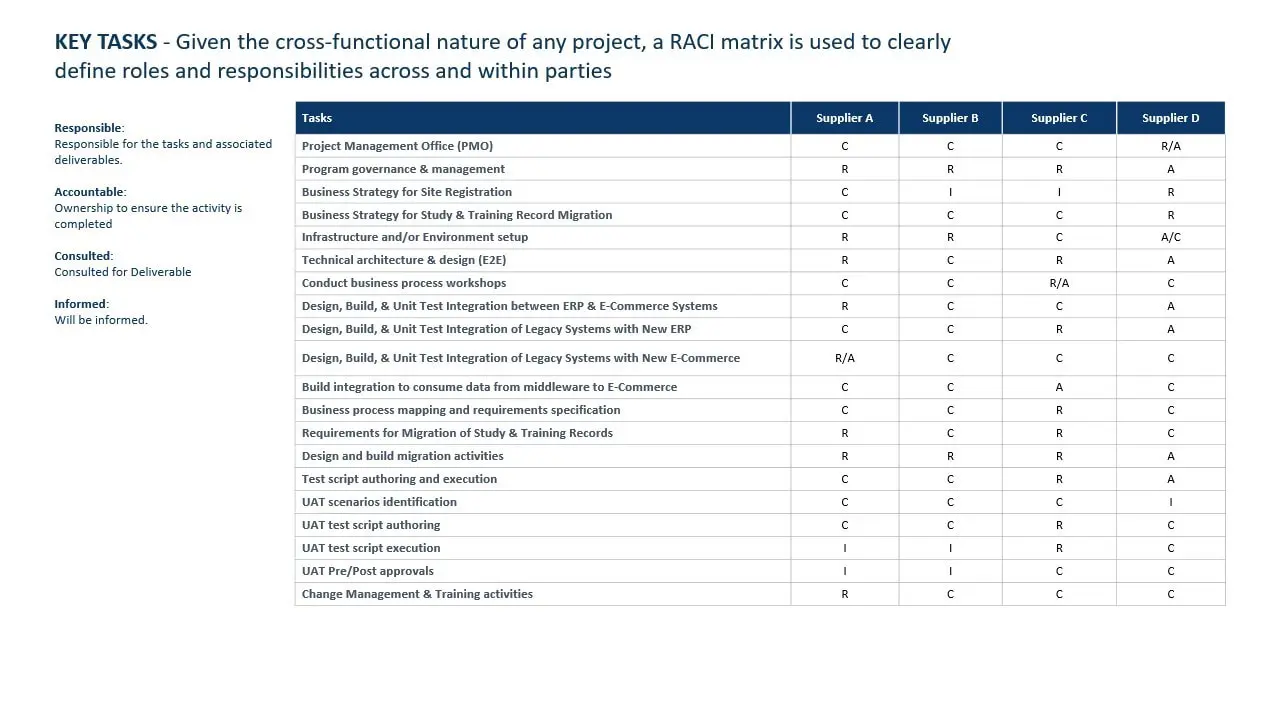
You can clearly see the task at hand, who is responsible for it, who is accountable for it, who needs to be consulted for it, and who is informed by it. Where appropriate we suggest including your internal resources as well as more often than not your suppliers will require your team to take action as well. Our clients use the RACI matrix process within their internal organizations as well to drive alignment and avoid potential issues before they arise.
From a tactical perspective, it’s important that the same RACI matrix is included within each supplier’s contract so that everyone is operating from the same table, terms, and conditions. This often takes some negotiation but with the proper foundation and alignment, you shouldn’t have any pushback from your suppliers. In fact, if you do have a supplier that is heavily pushing back against this exercise we recommend our clients view this as a potential leading indicator for what’s to come with that particular relationship.
With these 3 guiding principles, we ensure our clients are negotiating the best contracts for their needs.
Whether you’re in the process of negotiating your first IT contract or are looking to save big on your next renewal process, we’re here to share our experience and expertise with you.
We want to ensure that you’re paying the right price for the right products.
We want to make sure you have benchmark data to help you make decisions about the future of those contracts.
We want you to avoid contractual pitfalls by including key language around important, often overlooked points.

The Difference Between Gartner & The Negotiator Guru
Gartner, at its core, is a market intelligence firm. It uses a wide-angle lens to give you a big-picture view of market and industry trends. You can use their data as general negotiation guidance and add their toolkits to your own.
There is absolutely value in this broad-stroke model but it can be limiting when it comes to looking for data and resources that more specifically mirror the size and needs of your organization.
In this article, I want to outline the similarities and differences between a simple market intelligence firm approach and a niche service provider approach. There are many reasons you might want to research best practices from a 30,000-foot view as well as dive deeper at a 5,000-foot view.
Many of my clients will use both Gartner’s and The Negotiator Guru’s (TNG) services to achieve the best results for their companies.
The graphic below gives a basic overview of the similarities and differences between our companies and we’ll break each one down in this article.
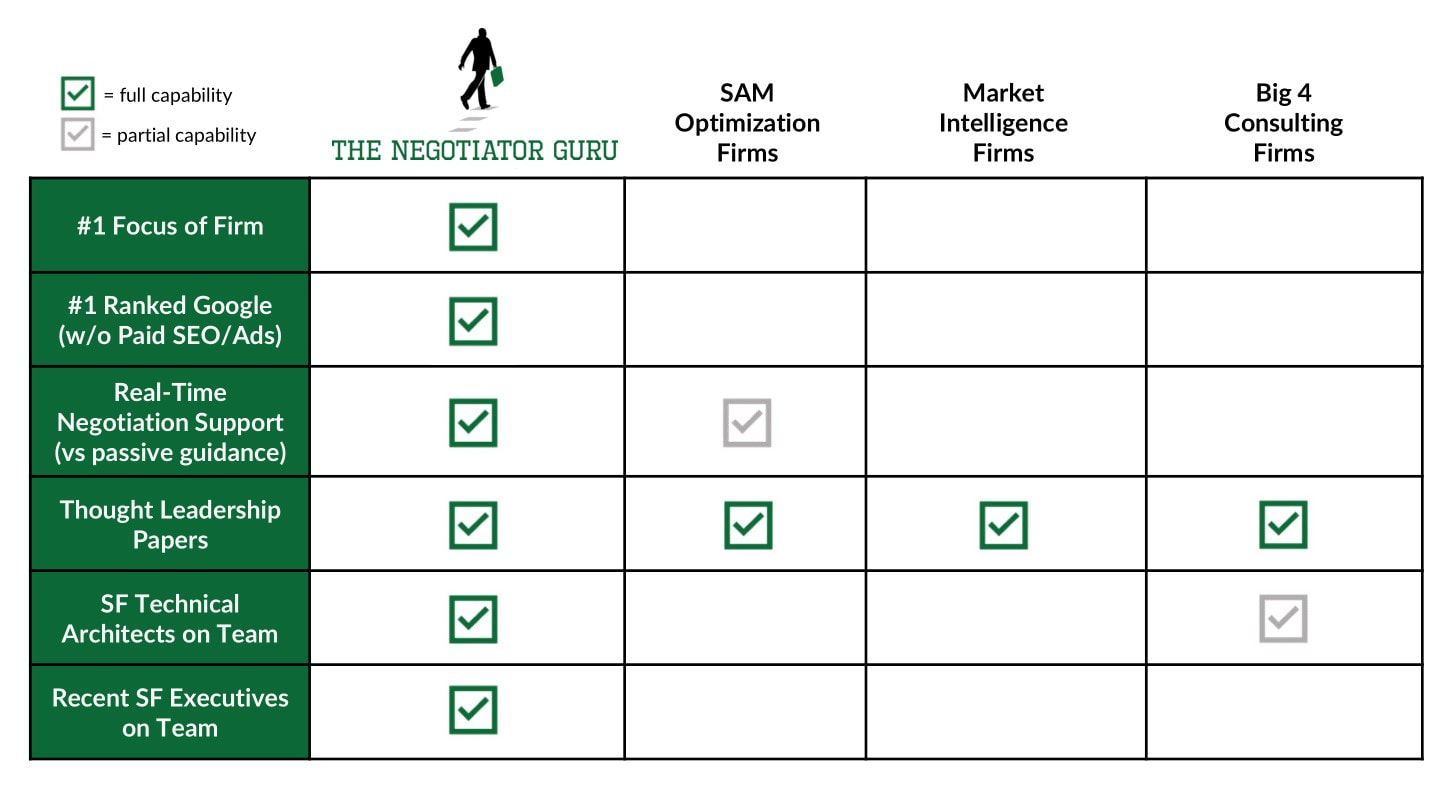
There Are Some Similarities Between Gartner & The Negotiator Guru
Both Gartner and TNG provide information on market and industry trends as well as general guidance on IT Cost Optimization. We have each developed our own toolkits to strategically approach each client’s needs. We overlap when it comes to providing general guidance to CIO’s.
Our companies also both provide rate benchmark data although, as you’ll read below, we go about this in different ways. Gartner has quite a bit of data they provide in aggregated terms which is useful but, without isolating the information by industry or annual spend or similar categories, it can be difficult for CIOs and their supporting functions to narrow down actionable intelligence that is defensible and realistic.
There Are Many Differences Between Gartner & The Negotiator Guru
The keyword I would use to describe the services Gartner and TNG have in common is ‘general.’ Gartner is a great resource for general information across a wide array of topics but rarely provides niche depth that our customers are longing to consume.
In contrast, TNG has a deep and disciplined focus within the IT Software vertical which enables our team to share actionable insights that are localized, specific, and highly relevant to our clients. In fact, it was our early clients that helped shaped this disciplined focus as they made their niche needs clearly known to our team. Due to our outstanding client family, TNG has been on a journey to fill our clients’ market intelligence needs for specific supplier relationships. This has organically driven our firm to be the worldwide leader in Salesforce Contract Negotiation Advisory Services which typically is 80% of our work portfolio at any given time.
With the average cost of a Gartner subscription being $30,000 per seat, plus additional consulting costs in order to receive personalized advisory services, it’s worth your while to be informed on what they can and cannot help you achieve.
Because we provide specialized data and consulting services, we’re able to dig deeper into our clients’ businesses and tailor our process to better achieve the results they’re looking for.
The following are a few of the specific areas The Negotiator Guru differs from Gartner in terms of what services and results we can offer our clients.
Right Size
While Gartner has a wealth of industry data and information, it can be nearly impossible for a client to look at the data and isolate a specific instance to best compare themselves to their peers. This leaves clients feeling informed but uncomfortable about how this information is applicable, and more importantly defensible, within their environment.
In certain circumstances, Gartner will provide “best in class” rates for a specific digital capability or service portfolio. One would argue that this provides directionally correct price targets to use as a market intelligence within their supplier negotiation. We generally agree, however, it’s important to note that your software sales executive (or worse yet your internal colleagues) will very quickly share with you that you don’t fit the profile of those rates for XYZ reason. We know this because we’ve been in these conversations on countless occasions.
In the rare case that you obtain “best in class” rate information for your specific topic of interest, you are still missing a critical piece of knowledge which we call our “Right Size” guidance. Using conservative figures, there is a 15-20% value-capture opportunity just by applying Right Size practices to your research and internal analysis before entering into any IT contract negotiation
Our supplier-specific expertise is one of the biggest contributors to this Right Sizing approach.
Within our Discovery Phase, we take an inventory of your current products and licenses and match them against your actual business needs. Almost always, we find that our clients are over licensed and have shelfware within their environment. This is an example of Right Sizing.
From a Right Pricing standpoint, not only do we understand “best in class” rates, we localize price targets based on industry, client size, and contract value. This enables our clients to feel 100% confident about the market intelligence as we’re benchmarking their rates against that of their likesize industry peers.
To expand upon this difference, we’ll use our expertise in Salesforce as an example.
As raised and validated by leading consulting and intelligence firms, TNG has the most comprehensive database of Salesforce rates in the world. This capability allows our team to quickly and easily perform a price benchmarking exercise for our clients. In many instances, we’ll inform prospective clients that their rates are within an acceptable margin of their “Right Price” benchmark and that the only real opportunity (if any) is to pursue “Right Sizing” inside of their environment. At TNG, our culture and client centric values direct our work and guide us to only accept prospective clients where we know with certainty there is a strong potential to drive huge impact.
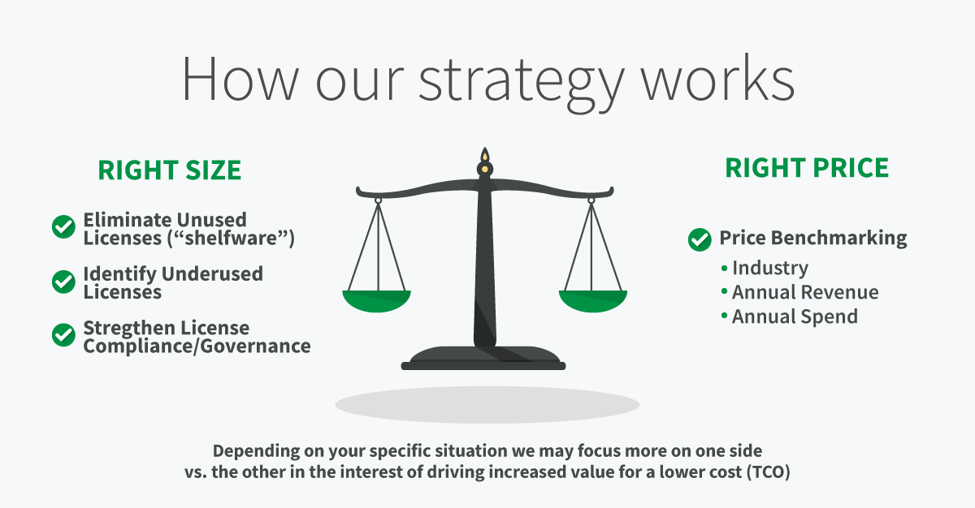
Being able to combine Right Price and Right Size analysis will have a significant impact on the effectiveness of your supplier negotiation strategies.
Contract Language Risks
As a result of our deep supplier-specific expertise, our team on average analyzes 5 - 15 software contracts per day. As a result, we know what’s “normal” with all of the large enterprise software platforms and any common risks that are inserted unbeknownst to our clients. By doing this every single day, our team is easily able to identify commonly-used, ambiguous language that always favors the supplier.
Large software companies know their customers rarely spend time analyzing terms and conditions within their contracts. Furthermore, the widely accepted principle of Software-as-a-Service (SaaS) leads clients to believe the terms are standard and unchangeable.
Unfortunately, this simply isn’t true. As part of our Contract Execution Phase, we conduct a deep dive assessment of our client’s supplier contract as part of our standard service (another major difference from Gartner). To put the impact of this added service into context, our team identifies a unique contractual risk within SaaS contracts alone 33% of the time. If the contract we are analyzing is not a SaaS contract, contractual risks are identified, on average, 85% of the time. Knowing what to look for in each supplier’s contract language helps our clients avoid common pitfalls and supplier-centric renegotiation strategies.
Sales Playbook Coaching
Another key difference between taking a general approach on market intelligence (Gartner) vs. a software specific deep niche (TNG) is the ability to learn and leverage the sales playbook(s) for these large enterprise suppliers. It may not surprise you that within the most successful software sales organizations are repeatable and prescriptive sales playbooks that guide the near robotic actions of their sales representatives.
As a result of learning these sales playbooks we are literally able to tell our clients the moves their suppliers are going to take next. This intelligence allows us to be one step ahead within the negotiation process while leveraging the interests of both parties.
While the art of negotiation is an art and not a science, arming yourself with this intelligence allows you to deploy counterintelligence strategies inside of your organization (to counteract common supplier tactics such as divide and conquer) while also proactively preparing counterpoints to their foreseeable arguments. As a result, our clients commonly tell us that they were the most prepared they have ever been before, during, and after a negotiation.
Advisory and Execution Services
We don’t just tell you what is possible. We help you achieve it.
The biggest criticism most companies have of typical market intelligence and/or management consulting firms is that they’ll tell you what “best in class” looks like but will leave you to figure out how to achieve it within your organization. If they do offer advisory services that help you implement their “best in class” then it will be for additional fees that eat away at the cost savings potential, etc.
We’re a full, beginning-to-end provider who will help you all the way through to the execution of the contract..
At TNG, we not only share a “best in class” picture but also create a realistic future state localized for your business. We help you implement that future state while also limiting risks to your organization long after our engagement ends. This is all part of our standard duty of care for our clients.
4-Step Negotiation Process
Our proprietary 4-step negotiation process allows us to deliver a clear and consistent service to our clients. In the interest of brevity we won’t go into detail of what each step entails, however, please know that within the Discovery and Strategy steps you will walk away with a forward looking roadmap as part of the overall engagement. If even offered, this would be an extra advisory fee from Gartner and/or any other market intelligence and/or management consulting firm.
The graphic below quickly outlines our negotiation process:
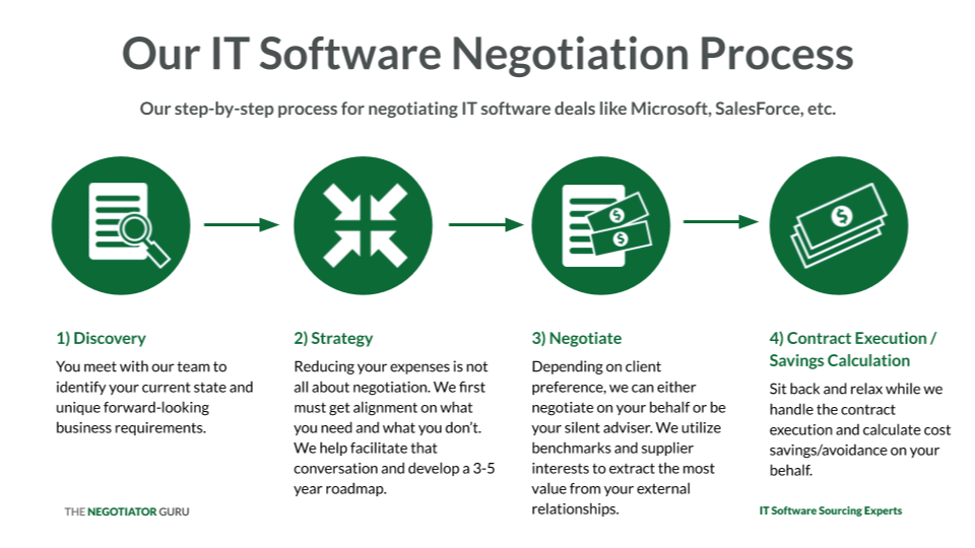
Compensation & Fees
Our compensation for these services is also entirely different from Gartner’s method.
As mentioned above, Gartner’s average subscription rate is $30,000 per person plus any additional consulting fees.
With this package, you have access to their standard publications, toolkits, and potentially a limited number of “analyst calls” which are quick conversations with the author of the publications. Any additional advisory assistance, if even possible, comes as an upcharge. Even with this additional cost, you will be on your own from an execution standpoint.
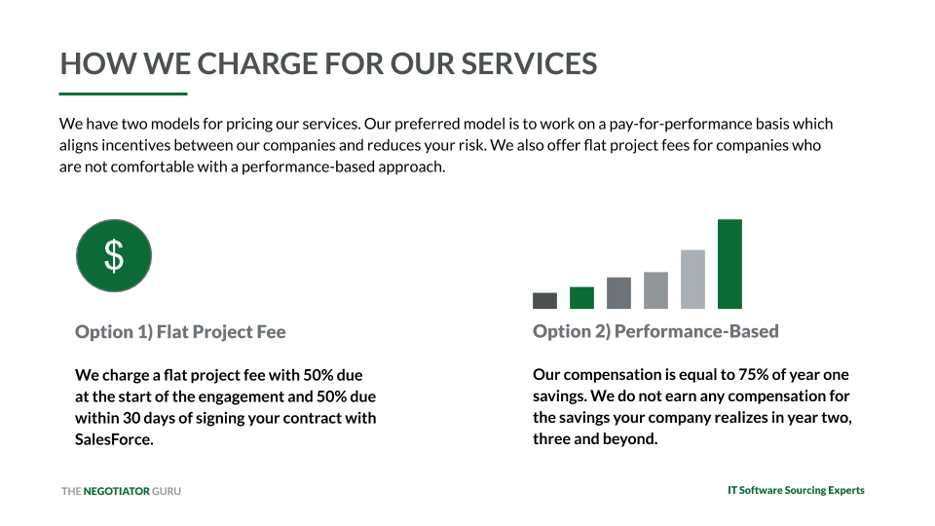
We charge either an Advisory Fee based on annual contract value or we offer a Pay Per Performance option with a simple baseline calculation.
We don’t charge based on a subscription service to our articles, we provide all this information for free.
Our rates contain no hidden charges or surprise upsells. On top of that, we’ll help you execute the strategies we develop with you.
We’re incredibly transparent with how we price our services and our clients never question the value they achieved from engaging with TNG.
Combining a Broad Overview Approach with a Specialized, Niche Consulting Firm is a Winning Equation
One of the questions we hear frequently is whether someone can/should work with both Gartner AND The Negotiator Guru.
The answer is yes!
Gartner provides a lot of good, general information. TNG helps you zoom in on the information that is most relevant to your organization so you can determine which key findings are critical for driving cost savings/avoidance while lowering your contractual risk.
Gartner is a market intelligence research firm that has a very limited advisory component separate from their articles. They do not generally provide execution services.
TNG provides information without a subscription fee and our advisory and execution services are provided in the same package.
Bringing in TNG to help you pinpoint your specific needs, value capture opportunities, and execution strategies will provide immediate and long-term intrinsic value for your organization. Remember, TNG will only accept you as a client if there is clear and distinct net positive impact potential… well, we can’t speak for the other guys.
Start with a CIA.
That’s a Client Intake Assessment.
Upload your contract data or schedule a discovery call. If we can’t identify at least a 10%+ from a TNG Right Pricing™ opportunity, we won’t take your money (but we will offer you some free advice!)
