

The Difference Between Gartner & The Negotiator Guru


Gartner, at its core, is a market intelligence firm. It uses a wide-angle lens to give you a big-picture view of market and industry trends. You can use their data as general negotiation guidance and add their toolkits to your own.
There is absolutely value in this broad-stroke model but it can be limiting when it comes to looking for data and resources that more specifically mirror the size and needs of your organization.
In this article, I want to outline the similarities and differences between a simple market intelligence firm approach and a niche service provider approach. There are many reasons you might want to research best practices from a 30,000-foot view as well as dive deeper at a 5,000-foot view.
Many of my clients will use both Gartner’s and The Negotiator Guru’s (TNG) services to achieve the best results for their companies.
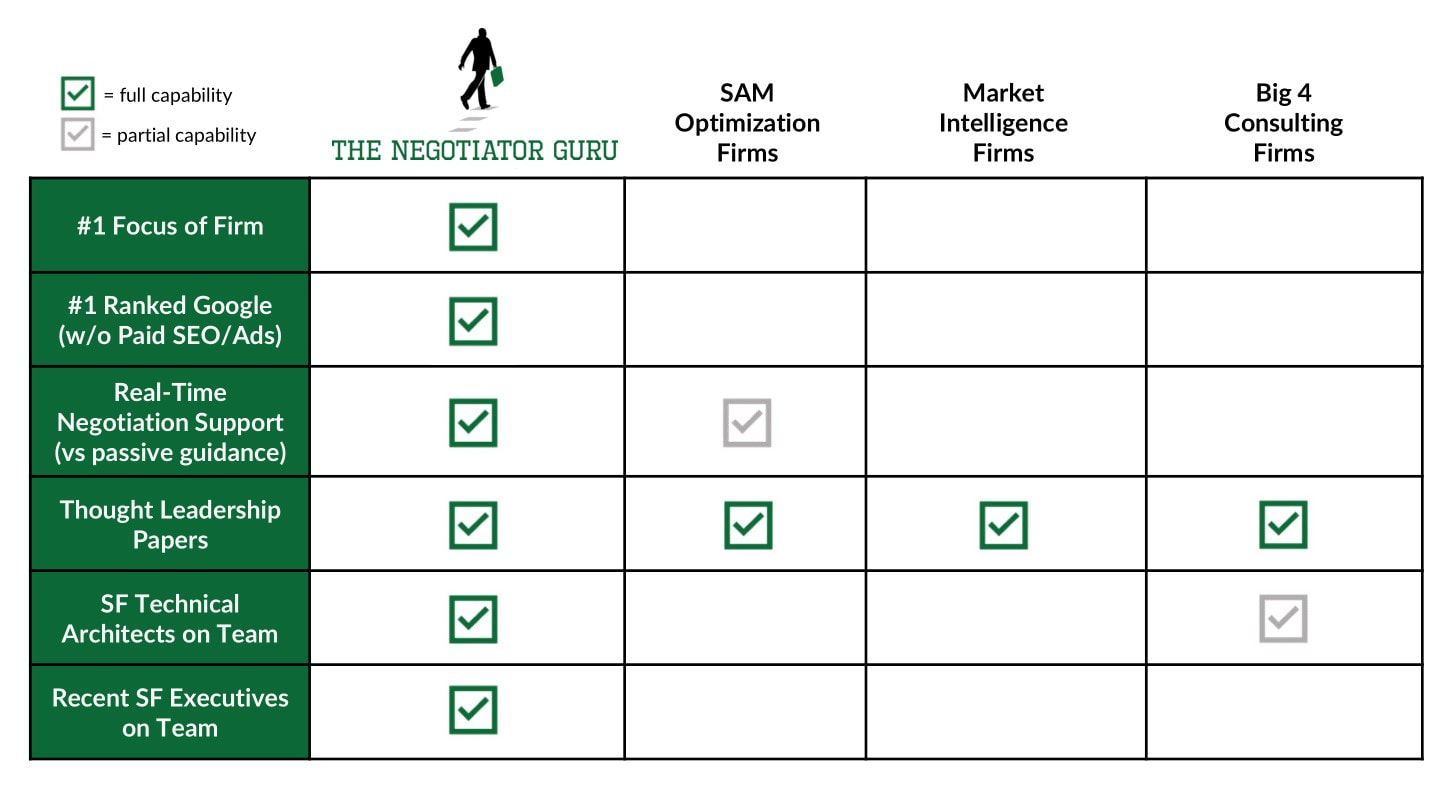
The graphic below gives a basic overview of the similarities and differences between our companies and we’ll break each one down in this article.
There Are Some Similarities Between Gartner & The Negotiator Guru
Both Gartner and TNG provide information on market and industry trends as well as general guidance on IT Cost Optimization. We have each developed our own toolkits to strategically approach each client’s needs. We overlap when it comes to providing general guidance to CIO’s.
Our companies also both provide rate benchmark data although, as you’ll read below, we go about this in different ways. Gartner has quite a bit of data they provide in aggregated terms which is useful but, without isolating the information by industry or annual spend or similar categories, it can be difficult for CIOs and their supporting functions to narrow down actionable intelligence that is defensible and realistic.
There Are Many Differences Between Gartner & The Negotiator Guru
The keyword I would use to describe the services Gartner and TNG have in common is ‘general.’ Gartner is a great resource for general information across a wide array of topics but rarely provides niche depth that our customers are longing to consume.
In contrast, TNG has a deep and disciplined focus within the IT Software vertical which enables our team to share actionable insights that are localized, specific, and highly relevant to our clients. In fact, it was our early clients that helped shaped this disciplined focus as they made their niche needs clearly known to our team. Due to our outstanding client family, TNG has been on a journey to fill our clients’ market intelligence needs for specific supplier relationships. This has organically driven our firm to be the worldwide leader in Salesforce Contract Negotiation Advisory Services which typically is 80% of our work portfolio at any given time.
With the average cost of a Gartner subscription being $30,000 per seat, plus additional consulting costs in order to receive personalized advisory services, it’s worth your while to be informed on what they can and cannot help you achieve.
Because we provide specialized data and consulting services, we’re able to dig deeper into our clients’ businesses and tailor our process to better achieve the results they’re looking for.
The following are a few of the specific areas The Negotiator Guru differs from Gartner in terms of what services and results we can offer our clients.
Right Size
While Gartner has a wealth of industry data and information, it can be nearly impossible for a client to look at the data and isolate a specific instance to best compare themselves to their peers. This leaves clients feeling informed but uncomfortable about how this information is applicable, and more importantly defensible, within their environment.
In certain circumstances, Gartner will provide “best in class” rates for a specific digital capability or service portfolio. One would argue that this provides directionally correct price targets to use as a market intelligence within their supplier negotiation. We generally agree, however, it’s important to note that your software sales executive (or worse yet your internal colleagues) will very quickly share with you that you don’t fit the profile of those rates for XYZ reason. We know this because we’ve been in these conversations on countless occasions.
In the rare case that you obtain “best in class” rate information for your specific topic of interest, you are still missing a critical piece of knowledge which we call our “Right Size” guidance. Using conservative figures, there is a 15-20% value-capture opportunity just by applying Right Size practices to your research and internal analysis before entering into any IT contract negotiation
Our supplier-specific expertise is one of the biggest contributors to this Right Sizing approach.
Within our Discovery Phase, we take an inventory of your current products and licenses and match them against your actual business needs. Almost always, we find that our clients are over licensed and have shelfware within their environment. This is an example of Right Sizing.
From a Right Pricing standpoint, not only do we understand “best in class” rates, we localize price targets based on industry, client size, and contract value. This enables our clients to feel 100% confident about the market intelligence as we’re benchmarking their rates against that of their likesize industry peers.
To expand upon this difference, we’ll use our expertise in Salesforce as an example.
As raised and validated by leading consulting and intelligence firms, TNG has the most comprehensive database of Salesforce rates in the world. This capability allows our team to quickly and easily perform a price benchmarking exercise for our clients. In many instances, we’ll inform prospective clients that their rates are within an acceptable margin of their “Right Price” benchmark and that the only real opportunity (if any) is to pursue “Right Sizing” inside of their environment. At TNG, our culture and client centric values direct our work and guide us to only accept prospective clients where we know with certainty there is a strong potential to drive huge impact.
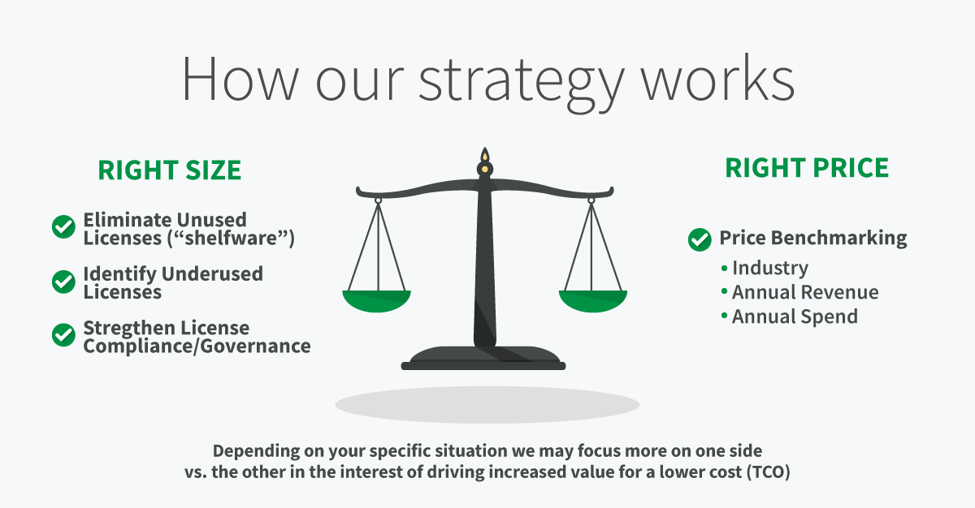
Being able to combine Right Price and Right Size analysis will have a significant impact on the effectiveness of your supplier negotiation strategies.
Contract Language Risks
As a result of our deep supplier-specific expertise, our team on average analyzes 5 - 15 software contracts per day. As a result, we know what’s “normal” with all of the large enterprise software platforms and any common risks that are inserted unbeknownst to our clients. By doing this every single day, our team is easily able to identify commonly-used, ambiguous language that always favors the supplier.
Large software companies know their customers rarely spend time analyzing terms and conditions within their contracts. Furthermore, the widely accepted principle of Software-as-a-Service (SaaS) leads clients to believe the terms are standard and unchangeable.
Unfortunately, this simply isn’t true. As part of our Contract Execution Phase, we conduct a deep dive assessment of our client’s supplier contract as part of our standard service (another major difference from Gartner). To put the impact of this added service into context, our team identifies a unique contractual risk within SaaS contracts alone 33% of the time. If the contract we are analyzing is not a SaaS contract, contractual risks are identified, on average, 85% of the time. Knowing what to look for in each supplier’s contract language helps our clients avoid common pitfalls and supplier-centric renegotiation strategies.
Sales Playbook Coaching
Another key difference between taking a general approach on market intelligence (Gartner) vs. a software specific deep niche (TNG) is the ability to learn and leverage the sales playbook(s) for these large enterprise suppliers. It may not surprise you that within the most successful software sales organizations are repeatable and prescriptive sales playbooks that guide the near robotic actions of their sales representatives.
As a result of learning these sales playbooks we are literally able to tell our clients the moves their suppliers are going to take next. This intelligence allows us to be one step ahead within the negotiation process while leveraging the interests of both parties.
While the art of negotiation is an art and not a science, arming yourself with this intelligence allows you to deploy counterintelligence strategies inside of your organization (to counteract common supplier tactics such as divide and conquer) while also proactively preparing counterpoints to their foreseeable arguments. As a result, our clients commonly tell us that they were the most prepared they have ever been before, during, and after a negotiation.
Advisory and Execution Services
We don’t just tell you what is possible. We help you achieve it.
The biggest criticism most companies have of typical market intelligence and/or management consulting firms is that they’ll tell you what “best in class” looks like but will leave you to figure out how to achieve it within your organization. If they do offer advisory services that help you implement their “best in class” then it will be for additional fees that eat away at the cost savings potential, etc.
We’re a full, beginning-to-end provider who will help you all the way through to the execution of the contract..
At TNG, we not only share a “best in class” picture but also create a realistic future state localized for your business. We help you implement that future state while also limiting risks to your organization long after our engagement ends. This is all part of our standard duty of care for our clients.
4-Step Negotiation Process
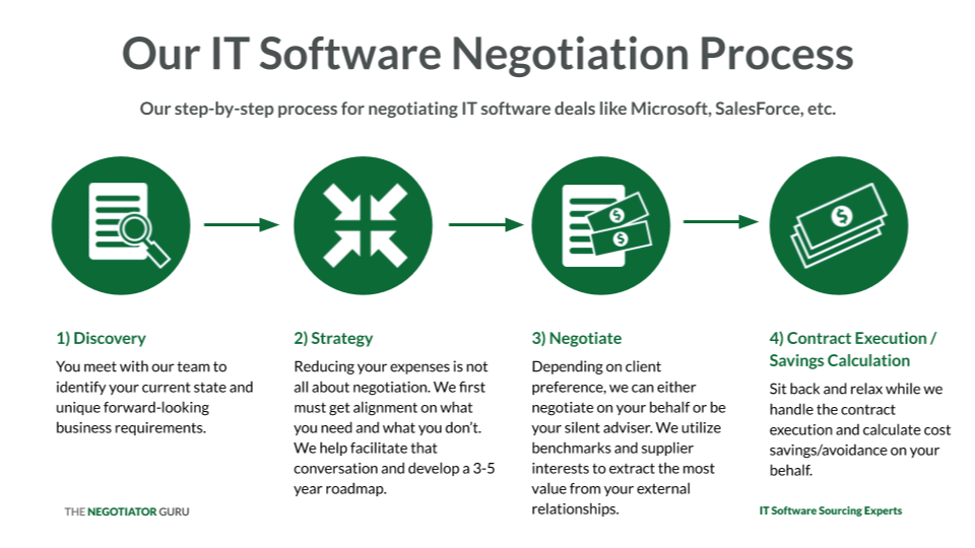
Our proprietary 4-step negotiation process allows us to deliver a clear and consistent service to our clients. In the interest of brevity we won’t go into detail of what each step entails, however, please know that within the Discovery and Strategy steps you will walk away with a forward looking roadmap as part of the overall engagement. If even offered, this would be an extra advisory fee from Gartner and/or any other market intelligence and/or management consulting firm.
The graphic below quickly outlines our negotiation process:
Compensation & Fees
Our compensation for these services is also entirely different from Gartner’s method.
As mentioned above, Gartner’s average subscription rate is $30,000 per person plus any additional consulting fees.
With this package, you have access to their standard publications, toolkits, and potentially a limited number of “analyst calls” which are quick conversations with the author of the publications. Any additional advisory assistance, if even possible, comes as an upcharge. Even with this additional cost, you will be on your own from an execution standpoint.
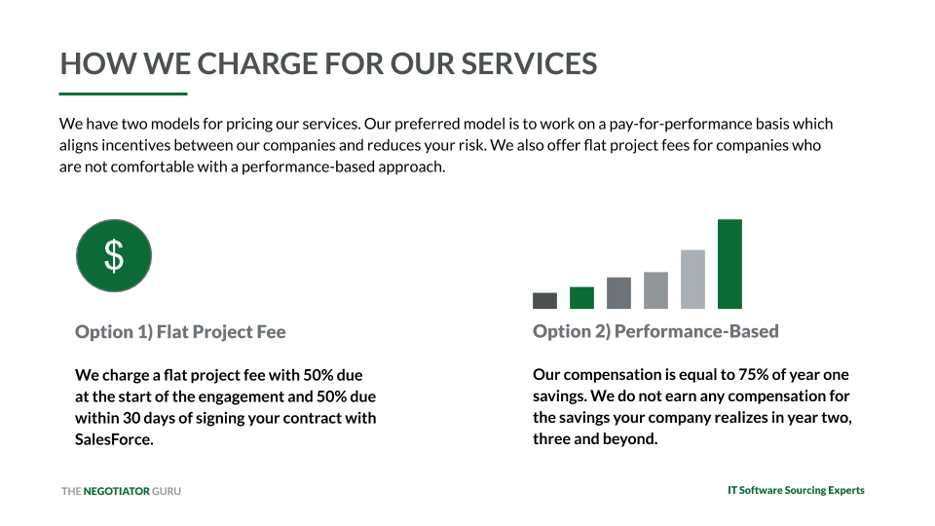
We charge either an Advisory Fee based on annual contract value or we offer a Pay Per Performance option with a simple baseline calculation.
We don’t charge based on a subscription service to our articles, we provide all this information for free.
Our rates contain no hidden charges or surprise upsells. On top of that, we’ll help you execute the strategies we develop with you.
We’re incredibly transparent with how we price our services and our clients never question the value they achieved from engaging with TNG.
Combining a Broad Overview Approach with a Specialized, Niche Consulting Firm is a Winning Equation
One of the questions we hear frequently is whether someone can/should work with both Gartner AND The Negotiator Guru.
The answer is yes!
Gartner provides a lot of good, general information. TNG helps you zoom in on the information that is most relevant to your organization so you can determine which key findings are critical for driving cost savings/avoidance while lowering your contractual risk.
Gartner is a market intelligence research firm that has a very limited advisory component separate from their articles. They do not generally provide execution services.
TNG provides information without a subscription fee and our advisory and execution services are provided in the same package.
Bringing in TNG to help you pinpoint your specific needs, value capture opportunities, and execution strategies will provide immediate and long-term intrinsic value for your organization. Remember, TNG will only accept you as a client if there is clear and distinct net positive impact potential… well, we can’t speak for the other guys.
More resources
From Fortune 500 giants to fast-growing innovators, TNG has helped clients save 20% – 40%+ on enterprise software contracts — even when they thought it was impossible

5 Tips for Negotiating a Salesforce Extension
In this article we will discuss how to successfully extend your current Salesforce contract in order to create additional time to successfully prepare and negotiate your renewal agreement. For more detail, read our guide on negotiating with Salesforce.
An extension is commonly needed whenever our clients engage us too late (i.e. too close to their contract renewal) and we need time to successfully complete the Discovery and Strategy Phases of our proprietary 4-Step Negotiation Plan.
Tip #1: Be Confident
We find that most of our clients have either rarely or never requested a contract extension with either Salesforce or any other IT Supplier. As such, this very basic concept becomes daunting for the average IT or Procurement leader as they don’t have either the experience, or past playbook, to execute with natural confidence. This sentiment is augmented by the fact that Salesforce will automatically inform you that they never allow extensions. If you’ve read our previous articles, then you’ll know this is yet another canned answer out of their sales playbook. Please know that extensions are granted all the time as long as you know how to ask for them…as such, they are considered the exception vs. the rule.
Tip #2: Focus on the Facts
Share only what is necessary with Salesforce without going into too much detail. You don’t want to expend all of your negotiation equity during this process or you’ll end up hurting yourself down the road. Keep in mind that Salesforce will try and obtain as much information as possible during this stage so they can decide 1) whether or not to grant the extension and 2) to determine how prepared you are as an organization.
Tip #3: Establish the Why
Like any human scenario, it’s always easier to influence people if they understand the intent and context behind any request. This scenario is no different as you’ll want to answer in a way that is authentic to your organization but intentionally vague in material content. Typical responses we find most effective are the following:
- Active interest in exploring new digital capabilities and need time to make internal decisions;
- Internally restructuring the Salesforce relationship accountability;
- Aligning multiple stakeholders within your organization to accurately capture the wants and needs over the next 5 years;
- In the process of obtaining end user feedback and need some additional time to finalize, analyze, and make decisions, etc.
Tip #4: Create a Timeline with Milestones
Salesforce will be far more willing to accept an extension request if they understand the timeline in which you plan on making decisions. This in a sense shows a partnership mentality which is both real and healthy. Develop a basic timeline of when you plan on making internal and external decisions that provides a good amount of cushion in favor of your organization.
Tip #5: Keep your Promises
Constant and honest communication is key. All too often we find individuals/companies making the mistake of playing the power client position. In other words, the client exemplifies a lack of empathy or care for the sales process and holds all information back thinking that they are protecting their position. After years of research and proven experience we have repeatedly disproven that hypothesis. Instead, we find providing regular milestone updates to Salesforce (or any IT supplier) shows a level of commitment to the relationship and will pay dividends at the final negotiated deal. Summary It’s important to recognize that each client scenario offers its unique challenges and opportunity. That being said, the guiding principles laid out above will prove effective no matter your situation. Be confident in your request, focus on the facts of your specific situation, build credibility with Salesforce by providing context into the request, set expectations via timeline with milestones, and deliver on your promises. We use these same effective tactics every day and hope you find them useful in your future endeavors.
Summary
It’s important to recognize that each client scenario offers its unique challenges and opportunity. That being said, the guiding principles laid out above will prove effective no matter your situation. Be confident in your request, focus on the facts of your specific situation, build credibility with Salesforce by providing context into the request, set expectations via timeline with milestones, and deliver on your promises. We use these same effective tactics every day and hope you find them useful in your future endeavors.

Key Points to Remember When Negotiating Your Salesforce Master Subscription
Customer Relationship Management (CRM) has become one of the most expensive IT investments for organizations around the world according to the annual “IT Trends Study” conducted by the Society of Information Management.
This IT investment growth is being fueled by two primary industry drivers:
- Large organizations are both replacing homegrown systems as well as utilizing their CRM platform to further connect their internal and external stakeholders, processes, and communication strategies; and,
- Small to medium-sized organizations are rapidly acquiring this technology to make a positive step-change in their customer interactions and client prospecting.
While there are many Software-as-a-Service (SaaS) CRM platforms to choose from in the marketplace today, Salesforce continues to dominate the space. Subsequently, if you are looking at CRM solutions in the marketplace, you’re likely considering Salesforce as an option.
Why is Salesforce (SFDC) the market leader and what makes it different than the others?
While this article is not intended to be a tactical comparison of CRM solutions available today, our vast experience and focus on Salesforce naturally has revealed a few key points:
- SFDC has been, and continues to be, very strong in outbound and inbound marketing tactics;
- SFDC arguably was the first mover in defining a SaaS CRM solution that is decoupled from any other large enterprise agreement (ex: Microsoft, Oracle, etc.) making it easier to obtain;
- SFDC developed a buying channel that is direct to a business end-user vs. going through a channel partner/value added reseller (VAR);
- SFDC was founded with the intent of truly being a platform where vertical applications could easily connect and integrate (like the Apple App Store); and,
- SFDC has perfected the sales process inside of organizations in a way that their divide and conquer sales tactics commonly identifies continues growth opportunities across the organization.
Why is negotiating a Salesforce agreement so difficult?
The funny thing is that the entire go-to-market model of SFDC makes it very easy to acquire licenses as needed. This is in fact one of the many elements that make negotiating with SFDC difficult. In other words, very often our clients come to us after they have identified SFDC has spread throughout their organization without their knowledge and/or with very little governance. Our clients often describe this situation similar to an “internal virus” (their words, not ours) that spreads organically at a very fast pace. The result of this unmanaged growth can lead to the following (by no means comprehensive):
- Little to no license asset management leading to “shelfware” (acquisition of more licenses than are being used);
- Incorrect license purchase creating higher costs than needed;
- Different monthly subscription fees for the same license type;
- Lack of an enterprise agreement leading to contractual risk (etc.);
- No defined growth or utilization strategy; and;
- A platform that is very difficult to disengage which drastically increases the internal cost of
- change.
CIOs and IT Procurement leaders often find it difficult to negotiate a more favorable agreement when renewing their SFDC agreement.
We find the following to be the primary drivers:
- Like other very well-known and established software companies, SFDC has developed a sales process that is very difficult to crack if you don’t deal with them every day (like we do); Find out more about this here.
- The standard SFDC SaaS contract allows for SFDC to introduce price adjustments at any time;
- If a client is reducing their license count, SFDC’s standard contracts permit higher per unit pricing;
- SFDC sales leadership and staff are highly motivated to continuously drive revenue growth at existing clients;
- To be explicitly clear about this, if a client’s contract is renewed with flat revenue, this is a very negative reflection on your account management team;
- SFDC licenses are constantly changing; and,
- SFDC account management changes (by design) every 6 – 18 months which naturally negates knowledge continuity, etc.

4 Key Steps to Successfully Prepare for a Salesforce Negotiation
Here are a few quick steps to prepare for your Salesforce negotiation:
1. Assemble a best-in-class negotiation team
Including an expert negotiator in your team can help you acquire the most reasonable Salesforce subscription agreement. As discussed in previous articles, Salesforce is an expert at “divide and conquer” sales tactics.
As such, they will be looking to speak with different stakeholders at all levels of your business with the intent of gaining as much intelligence about your needs as possible. To properly prepare for, and counter, these tactics we recommend establishing a negotiation team 6 months prior to any planned contract renewal/execution. Within this team you should include business, souring, and legal stakeholders that have decision-making authority on behalf of your organization.
As part of the planning process, the negotiation team should create a working group of business stakeholders that can provide inputs into the needs and wants of the organization.
2. Perform a thorough review of the current contract prior to renewal
Part of our standard client onboarding process is a meticulous review of their current contract. While this may seem like common sense, it’s amazing how many prospective clients we speak with that never think of conducting this initial due diligence. Since our entire team originated from large organizations, we actually understand why this happens…initiative overload!
Before we accept a new client, we ask them whether or not they have reviewed their current contract to determine if they actually received the products/services that were under contract within the current term. On average, only about 35% actually completed this step prior to engaging our firm. After we conduct the analysis, we on average find that 60% of our clients do not actually receive/activate the products/services that they pre-paid for as part of their original contract negotiation.
Subsequently, we suggest you review all special contract terms that are part of your expiring agreement that may impact your contract renewal (i.e. price protection, etc.).
3. Prepare for a Proactive Negotiation
A proactive negotiation can enhance your leverage with Salesforce. As stated earlier, we recommend a 6-month runway to ensure the most leverage. If you are a renewing customer, Salesforce will generally start engaging your business stakeholders 3-4 months prior to your natural renewal date. Getting ahead of this stakeholder engagement will only help your organization. To ensure organization, we suggest developing a communication plan that directly advises each level of the organization what to expect, what to say, and when to say it.
4. Negotiate a 3-year TCO
Our clients commonly come to us asking about what price they should be paying for a specific product or service. Through years of experience, we advise clients to focus on the Total Cost of Ownership (TCO) for the entire contract instead of becoming fixated on a specific line item on the proposal. Like many other major software companies, Salesforce incentivizes its sales reps differently depending on the product or service. Instead of becoming fixated on a specific price point for a Sales Cloud license we suggest focusing on the net contract value. In other words, identify a TCO that you are comfortable with from a price-to-value standpoint and focus on driving the most value for your needs within that spectrum.
We commonly obtain a 10 – 15% value increase by negotiating a net TCO vs. that of a line item rate basis. This, of course, is easier said than done but we wanted to share this facts-based article for you to consider as you embark on your Salesforce negotiation.
Start with a CIA.
That’s a Client Intake Assessment.
Upload your contract data or schedule a discovery call. If we can’t identify at least a 10%+ from a TNG Right Pricing™ opportunity, we won’t take your money (but we will offer you some free advice!)
