

My 3 Guiding Principles for The Negotiator Guru


Imagine you are a C-Suite executive and your business is built on a franchise model.
Each franchise branch is owned and managed by a different person but they all use the same ERP and the big corporate umbrella entity that you own pays for all the services.
The individual owners dictate which software and services they use, how many licenses they need, etc.
Your annual bill for all the different contracts comes to $2.5 million.
How would you feel if I looked through your contracts and told you that, based on the prices your peers pay, you should actually be billed closer to $900,000 - a more than 60% savings - for the same host of services?
You’d probably want to flip the table we’re sitting at.
I started The Negotiator Guru because I believe in 3 things:
- Clients should all pay the same price for the same product*
- Clients have the right to know what rates they should be paying in comparison to their peers.
- Clients should know what to look for in software contracts to eliminate potential issues before they arise.
I want to go into each of these beliefs in more detail and give some case study examples to further demonstrate why I think these points are so important.
Clients should all pay the same price for the same product.
It’s common for people to believe the price they’re paying is equal to what their neighbor paid for the same product.
Due to both Master Service and Non-Disclosure Agreements between most software vendors and their customers, companies are not allowed to publicly share what rates they’re paying for their different products/services. Subsequently, software suppliers will almost never advertise a specific price point for enterprise customers but rather indicate “call for details” in the interest of driving the most revenue from the potential relationship.
In other words, in the art of enterprise SaaS sales, you won’t find any published rate information for you to benchmark your contract against. The only way for you to identify whether or not your rates are competitive is to engage a firm that holds that market intelligence as a result of analyzing contracts on a daily basis.
The fact of the matter is: Prices always vary.
No one pays retail as an enterprise customer but some companies achieve significant discounts compared to other similarly-sized operations.
In some cases, you’re getting ripped off if you’re not getting an 80-90% discount off published prices.
It wouldn’t be logical to expect a huge company like Coca-Cola and a small startup to be paying the same price purely based on volume alone. But brands of the same size with similarly-sized contracts (based on annual revenue & annual spend for their contract) should be paying the same price.
I have great respect for wonderful sales executives who sell value to customers, but my company believes the market should dictate a fair price for all IT goods & services (Services, Software, Hardware, etc).
The enterprise sales executive is arguably the greatest asset these IT companies have within their organizations. The good ones truly know how to sell “perceived” value.
Regardless of how personable a sales executive is, we believe the market should dictate what a fair price is - much like buying or selling a home. In order for this work, we believe that rate information should be readily available to customers. In order for this information to be shared legally, we need to enter into a commercial agreement with your company and charge for these advisory services.
Clients have the right to know what rates they should be paying in comparison to their peers.
On a daily basis we see similar-sized clients with similar-sized contracts have a 30 – 60% price variance.
Now, whether this is because some companies didn’t have strong negotiating skills or perhaps they just didn’t know how their contracts compared to the market doesn’t matter. What does matter is that clients know how their contract prices compare so they can make future decisions accordingly.
Ideally, through access to more information regarding IT contract pricing, you’ll be able to secure the best rates for your company. Leveraging this information can significantly impact a company’s bottom line.
But even if you aren’t able to achieve best-in-class pricing, we believe you should know what those rates are to empower decisions on how to work that supplier moving forward.
Often, relationships with IT suppliers run into the roots of your business and once you’re in that deep, it can be hard to break loose to find another vendor.
Even if you can’t get off of a big platform like Salesforce, Oracle or another ERP, you can make better-informed decisions about how you’re going to increase or decrease your use of that platform in the future.
There are a few market intelligence firms out there that supply basic and watered-down pricing information to clients but require a $30,000 per year subscription fee (per seat). This cost to have access to this benchmark data isn’t a feasible or justifiable expense for many companies.
We don’t feel that only Fortune 500 companies should have access to market intelligence firms and benchmark data.
The existing methods used to decide what the best price really is for any given enterprise could be improved. Most market intelligence firms take a general approach to setting correct pricing rather than looking at the specifics of each contract and the unique needs of each company.
For example, these firms will recommend that you should be getting a 60% discount if you’re spending $1 million with a particular IT company as a blanket rule.
Instead, we take into consideration the specific needs of our clients and use a Right Size, Right Price approach within every contract negotiation.
Clients should know what to look for in software contracts to eliminate potential issues before they arise.
Having a deep understanding of the terms of your most expensive contracts will help you save hundreds of thousands of dollars.
Here I want to briefly outline a few common contract issues that I see my clients face:
Price Protection (and not just by SKU)
Price protection generally comes up when you’re signing your first contract with a software provider. IT companies will compete for your business by offering you the lowest prices for their services with the expectation that they’ll be able to raise the rates once you’ve completely adopted the product.
Companies will always try to find ways to increase your annual expense. This is largely due to sales incentive plans in place with their sales development organization. Common tactics used by software companies include random internal audits to monitor usage (overage fees), product lift and shift changes (new SKUs), and service fees (for enhanced customer support).
More often than not our clients are very astute individuals that use their best efforts to price protect their organization’s contract for future years. That being said, it’s unrealistic to think anyone knows how to mitigate all the potential risks unless you do this everyday.
For example, to mitigate against the software companies from simply changing product names (SKUs) to bypass any preexisting price protection you may have on a specific product, we suggest you introduce contract language that protects your company using your total spend (vs a product-specific SKU) as the common denominator.
M&A Language
Make sure you have specific language in your contract about what happens in the case of a merger or acquisition.
Be sure to include language about a Termination for Convenience. This is a provision allowing you to get out of the contract if you acquire, or are acquired by, another company within a certain time frame - usually 90 days to 6 months.
Termination for Convenience eliminates the risk of having duplicate service providers for the same service after the transaction is closed. Without this stipulation, companies can find themselves with millions of dollars in expenses that are avoidable.
Note: In the interest of this article’s brevity we aren’t going to stipulate all the protections you need in an M&A transaction as this will be further explored in a future article. While the guiding principles of what to include within your contracts will remain consistent, client-specific protections will always require advisory services.
Termination for Breach
Termination for Breach language is important information to include in your contracts. In these cases, attorneys have to be involved and mal intent has to be proven by the accusing party.
This rarely ever happens and having the language laid out in the contract incentivizes IT companies to behave their best throughout the contract term.
License Limitations
It’s common to have language surrounding license limitations in your contracts. This basically says that you can use a specific license at a specific site for a specific reason.
These stipulations probably make sense on the surface and won’t alarm the person reading the contract but in most companies, with thousands of employees, not everyone is reading the contract. This could lead employees to inadvertently infringe on how the license may be used.
The best way for most companies to avoid this is to have seat-based pricing attached to specific personas (usage rights) rather than volume-based pricing.
Audit Rights
We’ll go into this further in a future article but I want to point it out here that you should be in control of the audit capabilities - don’t leave that in the hands of the supplier.
When IT companies retain audit rights, they have a Trojan Horse to get inside your company and find more ways to increase your pricing. They already know more about your company than you do - don’t give them the reigns to take over completely.
Roles & Responsibilities (when working with multiple parties)
Establishing clear lines of accountability is incredibly important when you’re working with multiple third parties.
As the owner of Company ABC, you’ve got Supplier X and Supplier Y. In each contract where there are dependencies for another supplier to take action, you will want to include a Roles & Responsibilities Matrix so that all parties are contractually agreeing to the same responsibilities/accountabilities. Conducting this exercise is not only a good way to align parties prior to the start of any project but also contractually protects you from any finger pointing across these same parties which will ultimately cost you time and money.
This Roles and Responsibilities matrix is oftentimes called a “RACI” Matrix - Responsible, Accountable, Consulting, Inform. The example below shows how it is used to clearly define roles and responsibilities across and within parties.
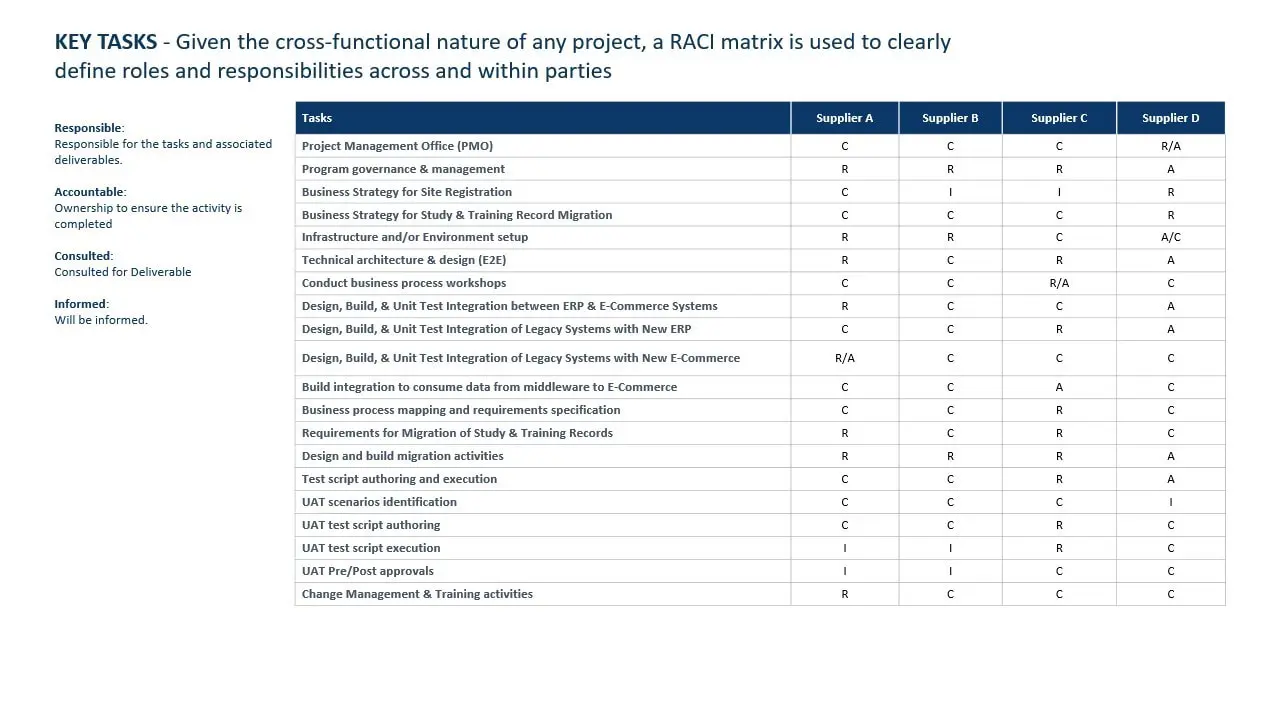
You can clearly see the task at hand, who is responsible for it, who is accountable for it, who needs to be consulted for it, and who is informed by it. Where appropriate we suggest including your internal resources as well as more often than not your suppliers will require your team to take action as well. Our clients use the RACI matrix process within their internal organizations as well to drive alignment and avoid potential issues before they arise.
From a tactical perspective, it’s important that the same RACI matrix is included within each supplier’s contract so that everyone is operating from the same table, terms, and conditions. This often takes some negotiation but with the proper foundation and alignment, you shouldn’t have any pushback from your suppliers. In fact, if you do have a supplier that is heavily pushing back against this exercise we recommend our clients view this as a potential leading indicator for what’s to come with that particular relationship.
With these 3 guiding principles, we ensure our clients are negotiating the best contracts for their needs.
Whether you’re in the process of negotiating your first IT contract or are looking to save big on your next renewal process, we’re here to share our experience and expertise with you.
We want to ensure that you’re paying the right price for the right products.
We want to make sure you have benchmark data to help you make decisions about the future of those contracts.
We want you to avoid contractual pitfalls by including key language around important, often overlooked points.
More resources
From Fortune 500 giants to fast-growing innovators, TNG has helped clients save 20% – 40%+ on enterprise software contracts — even when they thought it was impossible

A 3-Step Process to Reduce Your IT Spend 25% Or More
In the latest meeting with your company’s executives, the ultimate goal was the same as ever - increase revenue, decrease spend.
Do more, with less.
Your directive is to find a 10% cost savings in the next year and you are looking for some quick, streamlined ways to achieve that goal.
Have you taken a good look at your current contract situation? Where can you find savings in the software and products you’re already paying for?In this article, I’m going to share how you can create a system to manage and optimize your current (and future) IT contracts. By taking these steps, you'll achieve the best cost savings (often upwards of 25%) for your company.
How do you manage & optimize your current IT contracts?
To optimize your IT spending, you need to get organized. Tons of contracts are flying around and you have to know where you’re starting from today to be able to optimize for the future.
You have multiple contracts with each supplier you work with. Each product you buy from them throughout the year has its own legal commitments: Master Service Agreements (MSA), Statements of Work (SOW), order forms, etc.
Each supplier has a number of IT contracts they use with their clients.
Any of these types of contractual documents probably have different commercial language.
And they all add up to time and money obligations for you.
The worst part? Almost none of these contracts will be co-termed. Regardless of the company they’re with, each contract will have a different term period. Some of them will be for six months, a year, eighteen months, what have you.
This creates mass chaos and it’s all by design.
In order to get out of that chaos, you need to get above it - get a bird’s eye view of the landscape of your IT contracts. This can be a very arduous process but the payoff is huge. Take the time to align each of the contracts so you can properly optimize around them.
Step 1: Create an Asset Inventory List
If you don’t have a contract management system - and most companies don’t, even the biggest ones out there - you need to create an Asset Inventory List.
Basically, list out all your suppliers and all the IT contracts. You need to be clear on what contracts you have with a specific supplier.
You can do this with a fancy Excel spreadsheet like the one I’ve created below. You can download this template for your own use.
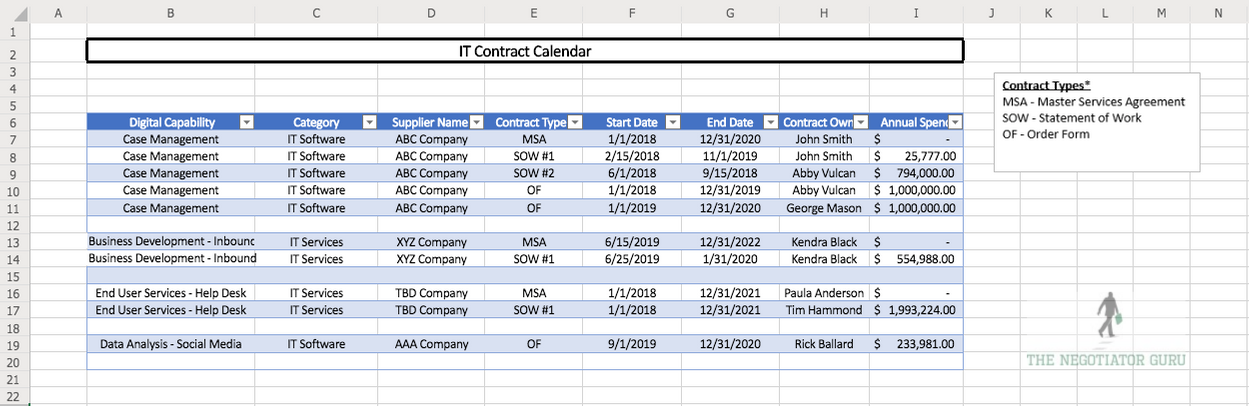
Essentially, this list will have the vendor name, contract type, contract term, and price. Consultant groups charge millions for this fancy spreadsheet but you can create one yourself from my free template.
Through this process, you’ll identify 2 things:
- How much you’re spending every year.
- How many IT contracts you have with each supplier.
With this information, you can tackle the next step. You now know what contracts are coming up for renewal and when. You know the negotiation period and can bring in extra help in advance to work through that process. And finally, you can now work on co-terming all the order forms and SOWs.
hese adjustments create more administrative ease versus the chaotic burden they’re designed to be.
Once you’ve got a survey on your IT contract landscape, you can move on to Step 2.
Step 2: Analyze Each Supplier Against a Right Size/Right Price Matrix
Start with the suppliers that are your biggest spend items. These will most likely be your ERP provider, your Microsoft Office contract, and your CRM software. Do an internal assessment of these suppliers and determine:
- How much you’re spending;
- When you’re going to renew; and,
- What you’re planning to do in the future.
This will help you determine that you are, in fact, only paying for the items that you need versus those that you don’t. All too often companies are paying for products that they aren’t even using because they don’t have a handle on their contracts.
The second thing you’ll be able to keep an eye out for is whether you’re paying for the right license types or not. Challenge your company to look at ways you can downgrade your subscriptions.
The third piece of knowledge you’ll gain from this process is figuring out which business capabilities each supplier is supporting. You’ll be able to see which suppliers are overlapping functionalities.
This overlap is common in decentralized organizations. Each business stakeholder wants to use the software they’re familiar with even though three other companies provide the same capabilities. Your corporation is likely spending way too much on overlapping suppliers that provide the same digital capability.
Paying for software you’re not using is called shelfware. Don’t make the mistake of paying for shelfware.
You need to start this internal assessment process six months before your next contract renewal. If you don’t, you’re going to be playing catch up to these large suppliers because they know more about you than you do.
Step 3: Preparing for negotiation
Create your negotiation team
Your negotiation team should consist of 3 different roles: a business stakeholder, an IT stakeholder, and a negotiator. Sometimes this last role is procurement and sometimes it involves an outside advisor.
Gather benchmark data
In addition to your negotiation team, you’ll need some hard-to-find information. One of the biggest pieces of leverage you can get is benchmark data. This data gives you the prices other firms are paying for the same service. There’s no way your company can know what other businesses are paying unless you bring in an external advisor like The Negotiator Guru.
Create an opportunity analysis
You can analyze your rates against the benchmark to find out how competitive your prices are compared to your industry peers. Similarly, you can analyze your supplier performance metrics, Service Level Agreements, governance process (etc.) against benchmark data to find out how well your suppliers are performing.
And finally, you can analyze your Innovation Quadrant against the benchmark.
How is the supplier driving new ideas, new concepts, process improvements, etc? How are they incentivized to drive cost savings for YOUR company through their relationship with you?
For example:
If you’re using a company like Accenture to run your help desk, there should be a clause in the contract for a 10% target cost savings over the contract term for the services they provide. They do this through process improvements and through automation.
This ensures they are actively working toward providing your company with cost savings to make your business more efficient.
Create a Roadmap of Initiatives
This roadmap has the intent of prioritizing your initiatives to ensure you’re targeting the greatest impact that will take you the least amount of time. Of course, not all initiatives will be easy to achieve but taking a systematic approach to what you work on first is paramount to your success.
To assist with this approach, we suggest categorizing your initiatives so that you can easily sort and isolate the opportunities in front of you. Categories you might consider using include “Quick Win, Strategic Sourcing, and Business Transformational.” Naturally, the progression of cost savings usually increases in scope and impact as you move from Quick Win opportunities to that of Business Transformation.
After you perform your opportunity analysis, get your benchmarks, and create your roadmap of initiatives, you can then pull together a Heat Map. This entails creating a visual graph that clearly identifies the sequencing opportunities.
Here is an example of one of these Heat Maps:
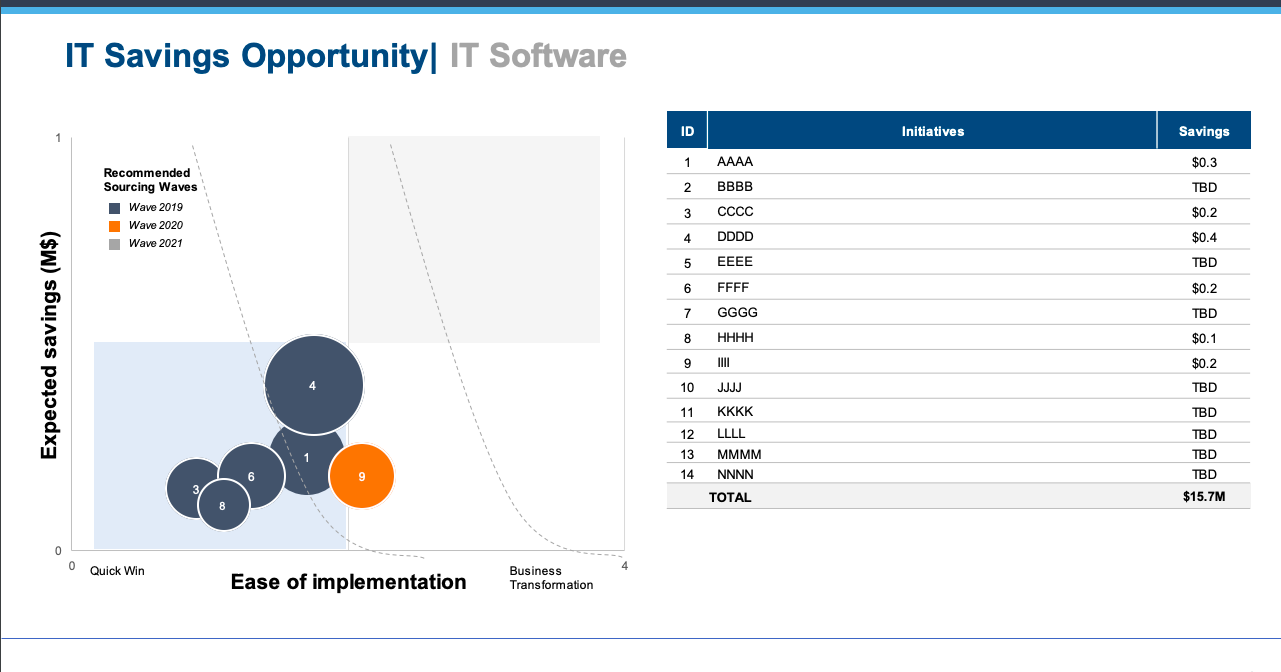
Being proactive with IT contracts can save 25% annually
A stellar negotiation team together with your benchmark data and forward-looking road map will give you a clear direction during the renegotiation process.
Centralizing, and subsequently renegotiating, your contracts with this approach generates on an average 25% P/L cost savings for your company (industry agnostic).
A decentralized company can cost you extra money
If a company has multiple business units and/or sites that are responsible for their own procurement you will undoubtedly have an unstructured supply base. The downstream effects of this situation is that you will have overlap in your supply base, duplicative digital capabilities, and a rats nest of contracts causing incredible inefficiencies and unleveraged spend.
For example, if one branch is using DocuSign for e-signatures and another is using Panda, this is a digital capability overlap that can easily be eliminated.
After your company streamlines your digital capabilities, your company should be able to easily consolidate spend, processes, and contracts. Once you remove the redundancy and get everyone on the same software, you can also negotiate a single contract for your company that drives immediate cost savings and long-term cost avoidance.
IT Contracts create both opportunity and risk in Merger & Acquisition transactions
When combining companies, it’s important to do both a top-down and bottoms-up approach to identifying synergy opportunities within your IT spend.
Top-down approaches involve a lot of financial synergy assumptions based on similar transactions within your industry. These approaches largely identify duplicative roles, processes, etc. and identify a financial target for savings. This approach naturally takes a high-level approach but doesn’t consider the unique needs of your business. To accurately forecast synergy opportunities it should not be the only synergy view to consider.
Bottoms-up approaches, on the other hand, allow you to co-create opportunities with your l business stakeholders that consider business risk, culture, and ease to achieve.
I’ll provide more insight on how to properly prepare for a merger in a future article.
Wrapping It All Up
Follow these steps to properly optimize your current contracts:
- Identify your current state situation.
- Identify your high-spend suppliers.
- Gather benchmark data to see how your contracts stack up.
- Run an Opportunity Analysis to determine overlap and shelfware.
- Create a negotiation team.
- Optimize each contract as its renewal period approaches.

5 Tips for Negotiating a Salesforce Extension
In this article we will discuss how to successfully extend your current Salesforce contract in order to create additional time to successfully prepare and negotiate your renewal agreement. For more detail, read our guide on negotiating with Salesforce.
An extension is commonly needed whenever our clients engage us too late (i.e. too close to their contract renewal) and we need time to successfully complete the Discovery and Strategy Phases of our proprietary 4-Step Negotiation Plan.
Tip #1: Be Confident
We find that most of our clients have either rarely or never requested a contract extension with either Salesforce or any other IT Supplier. As such, this very basic concept becomes daunting for the average IT or Procurement leader as they don’t have either the experience, or past playbook, to execute with natural confidence. This sentiment is augmented by the fact that Salesforce will automatically inform you that they never allow extensions. If you’ve read our previous articles, then you’ll know this is yet another canned answer out of their sales playbook. Please know that extensions are granted all the time as long as you know how to ask for them…as such, they are considered the exception vs. the rule.
Tip #2: Focus on the Facts
Share only what is necessary with Salesforce without going into too much detail. You don’t want to expend all of your negotiation equity during this process or you’ll end up hurting yourself down the road. Keep in mind that Salesforce will try and obtain as much information as possible during this stage so they can decide 1) whether or not to grant the extension and 2) to determine how prepared you are as an organization.
Tip #3: Establish the Why
Like any human scenario, it’s always easier to influence people if they understand the intent and context behind any request. This scenario is no different as you’ll want to answer in a way that is authentic to your organization but intentionally vague in material content. Typical responses we find most effective are the following:
- Active interest in exploring new digital capabilities and need time to make internal decisions;
- Internally restructuring the Salesforce relationship accountability;
- Aligning multiple stakeholders within your organization to accurately capture the wants and needs over the next 5 years;
- In the process of obtaining end user feedback and need some additional time to finalize, analyze, and make decisions, etc.
Tip #4: Create a Timeline with Milestones
Salesforce will be far more willing to accept an extension request if they understand the timeline in which you plan on making decisions. This in a sense shows a partnership mentality which is both real and healthy. Develop a basic timeline of when you plan on making internal and external decisions that provides a good amount of cushion in favor of your organization.
Tip #5: Keep your Promises
Constant and honest communication is key. All too often we find individuals/companies making the mistake of playing the power client position. In other words, the client exemplifies a lack of empathy or care for the sales process and holds all information back thinking that they are protecting their position. After years of research and proven experience we have repeatedly disproven that hypothesis. Instead, we find providing regular milestone updates to Salesforce (or any IT supplier) shows a level of commitment to the relationship and will pay dividends at the final negotiated deal. Summary It’s important to recognize that each client scenario offers its unique challenges and opportunity. That being said, the guiding principles laid out above will prove effective no matter your situation. Be confident in your request, focus on the facts of your specific situation, build credibility with Salesforce by providing context into the request, set expectations via timeline with milestones, and deliver on your promises. We use these same effective tactics every day and hope you find them useful in your future endeavors.
Summary
It’s important to recognize that each client scenario offers its unique challenges and opportunity. That being said, the guiding principles laid out above will prove effective no matter your situation. Be confident in your request, focus on the facts of your specific situation, build credibility with Salesforce by providing context into the request, set expectations via timeline with milestones, and deliver on your promises. We use these same effective tactics every day and hope you find them useful in your future endeavors.

Key Points to Remember When Negotiating Your Salesforce Master Subscription
Customer Relationship Management (CRM) has become one of the most expensive IT investments for organizations around the world according to the annual “IT Trends Study” conducted by the Society of Information Management.
This IT investment growth is being fueled by two primary industry drivers:
- Large organizations are both replacing homegrown systems as well as utilizing their CRM platform to further connect their internal and external stakeholders, processes, and communication strategies; and,
- Small to medium-sized organizations are rapidly acquiring this technology to make a positive step-change in their customer interactions and client prospecting.
While there are many Software-as-a-Service (SaaS) CRM platforms to choose from in the marketplace today, Salesforce continues to dominate the space. Subsequently, if you are looking at CRM solutions in the marketplace, you’re likely considering Salesforce as an option.
Why is Salesforce (SFDC) the market leader and what makes it different than the others?
While this article is not intended to be a tactical comparison of CRM solutions available today, our vast experience and focus on Salesforce naturally has revealed a few key points:
- SFDC has been, and continues to be, very strong in outbound and inbound marketing tactics;
- SFDC arguably was the first mover in defining a SaaS CRM solution that is decoupled from any other large enterprise agreement (ex: Microsoft, Oracle, etc.) making it easier to obtain;
- SFDC developed a buying channel that is direct to a business end-user vs. going through a channel partner/value added reseller (VAR);
- SFDC was founded with the intent of truly being a platform where vertical applications could easily connect and integrate (like the Apple App Store); and,
- SFDC has perfected the sales process inside of organizations in a way that their divide and conquer sales tactics commonly identifies continues growth opportunities across the organization.
Why is negotiating a Salesforce agreement so difficult?
The funny thing is that the entire go-to-market model of SFDC makes it very easy to acquire licenses as needed. This is in fact one of the many elements that make negotiating with SFDC difficult. In other words, very often our clients come to us after they have identified SFDC has spread throughout their organization without their knowledge and/or with very little governance. Our clients often describe this situation similar to an “internal virus” (their words, not ours) that spreads organically at a very fast pace. The result of this unmanaged growth can lead to the following (by no means comprehensive):
- Little to no license asset management leading to “shelfware” (acquisition of more licenses than are being used);
- Incorrect license purchase creating higher costs than needed;
- Different monthly subscription fees for the same license type;
- Lack of an enterprise agreement leading to contractual risk (etc.);
- No defined growth or utilization strategy; and;
- A platform that is very difficult to disengage which drastically increases the internal cost of
- change.
CIOs and IT Procurement leaders often find it difficult to negotiate a more favorable agreement when renewing their SFDC agreement.
We find the following to be the primary drivers:
- Like other very well-known and established software companies, SFDC has developed a sales process that is very difficult to crack if you don’t deal with them every day (like we do); Find out more about this here.
- The standard SFDC SaaS contract allows for SFDC to introduce price adjustments at any time;
- If a client is reducing their license count, SFDC’s standard contracts permit higher per unit pricing;
- SFDC sales leadership and staff are highly motivated to continuously drive revenue growth at existing clients;
- To be explicitly clear about this, if a client’s contract is renewed with flat revenue, this is a very negative reflection on your account management team;
- SFDC licenses are constantly changing; and,
- SFDC account management changes (by design) every 6 – 18 months which naturally negates knowledge continuity, etc.
Start with a CIA.
That’s a Client Intake Assessment.
Upload your contract data or schedule a discovery call. If we can’t identify at least a 10%+ from a TNG Right Pricing™ opportunity, we won’t take your money (but we will offer you some free advice!)
