

5 Tips for Negotiating a Salesforce Extension


In this article we will discuss how to successfully extend your current Salesforce contract in order to create additional time to successfully prepare and negotiate your renewal agreement. For more detail, read our guide on negotiating with Salesforce.
An extension is commonly needed whenever our clients engage us too late (i.e. too close to their contract renewal) and we need time to successfully complete the Discovery and Strategy Phases of our proprietary 4-Step Negotiation Plan.
Tip #1: Be Confident
We find that most of our clients have either rarely or never requested a contract extension with either Salesforce or any other IT Supplier. As such, this very basic concept becomes daunting for the average IT or Procurement leader as they don’t have either the experience, or past playbook, to execute with natural confidence. This sentiment is augmented by the fact that Salesforce will automatically inform you that they never allow extensions. If you’ve read our previous articles, then you’ll know this is yet another canned answer out of their sales playbook. Please know that extensions are granted all the time as long as you know how to ask for them…as such, they are considered the exception vs. the rule.
Tip #2: Focus on the Facts
Share only what is necessary with Salesforce without going into too much detail. You don’t want to expend all of your negotiation equity during this process or you’ll end up hurting yourself down the road. Keep in mind that Salesforce will try and obtain as much information as possible during this stage so they can decide 1) whether or not to grant the extension and 2) to determine how prepared you are as an organization.
Tip #3: Establish the Why
Like any human scenario, it’s always easier to influence people if they understand the intent and context behind any request. This scenario is no different as you’ll want to answer in a way that is authentic to your organization but intentionally vague in material content. Typical responses we find most effective are the following:
- Active interest in exploring new digital capabilities and need time to make internal decisions;
- Internally restructuring the Salesforce relationship accountability;
- Aligning multiple stakeholders within your organization to accurately capture the wants and needs over the next 5 years;
- In the process of obtaining end user feedback and need some additional time to finalize, analyze, and make decisions, etc.
Tip #4: Create a Timeline with Milestones
Salesforce will be far more willing to accept an extension request if they understand the timeline in which you plan on making decisions. This in a sense shows a partnership mentality which is both real and healthy. Develop a basic timeline of when you plan on making internal and external decisions that provides a good amount of cushion in favor of your organization.
Tip #5: Keep your Promises
Constant and honest communication is key. All too often we find individuals/companies making the mistake of playing the power client position. In other words, the client exemplifies a lack of empathy or care for the sales process and holds all information back thinking that they are protecting their position. After years of research and proven experience we have repeatedly disproven that hypothesis. Instead, we find providing regular milestone updates to Salesforce (or any IT supplier) shows a level of commitment to the relationship and will pay dividends at the final negotiated deal. Summary It’s important to recognize that each client scenario offers its unique challenges and opportunity. That being said, the guiding principles laid out above will prove effective no matter your situation. Be confident in your request, focus on the facts of your specific situation, build credibility with Salesforce by providing context into the request, set expectations via timeline with milestones, and deliver on your promises. We use these same effective tactics every day and hope you find them useful in your future endeavors.
Summary
It’s important to recognize that each client scenario offers its unique challenges and opportunity. That being said, the guiding principles laid out above will prove effective no matter your situation. Be confident in your request, focus on the facts of your specific situation, build credibility with Salesforce by providing context into the request, set expectations via timeline with milestones, and deliver on your promises. We use these same effective tactics every day and hope you find them useful in your future endeavors.
More resources
From Fortune 500 giants to fast-growing innovators, TNG has helped clients save 20% – 40%+ on enterprise software contracts — even when they thought it was impossible
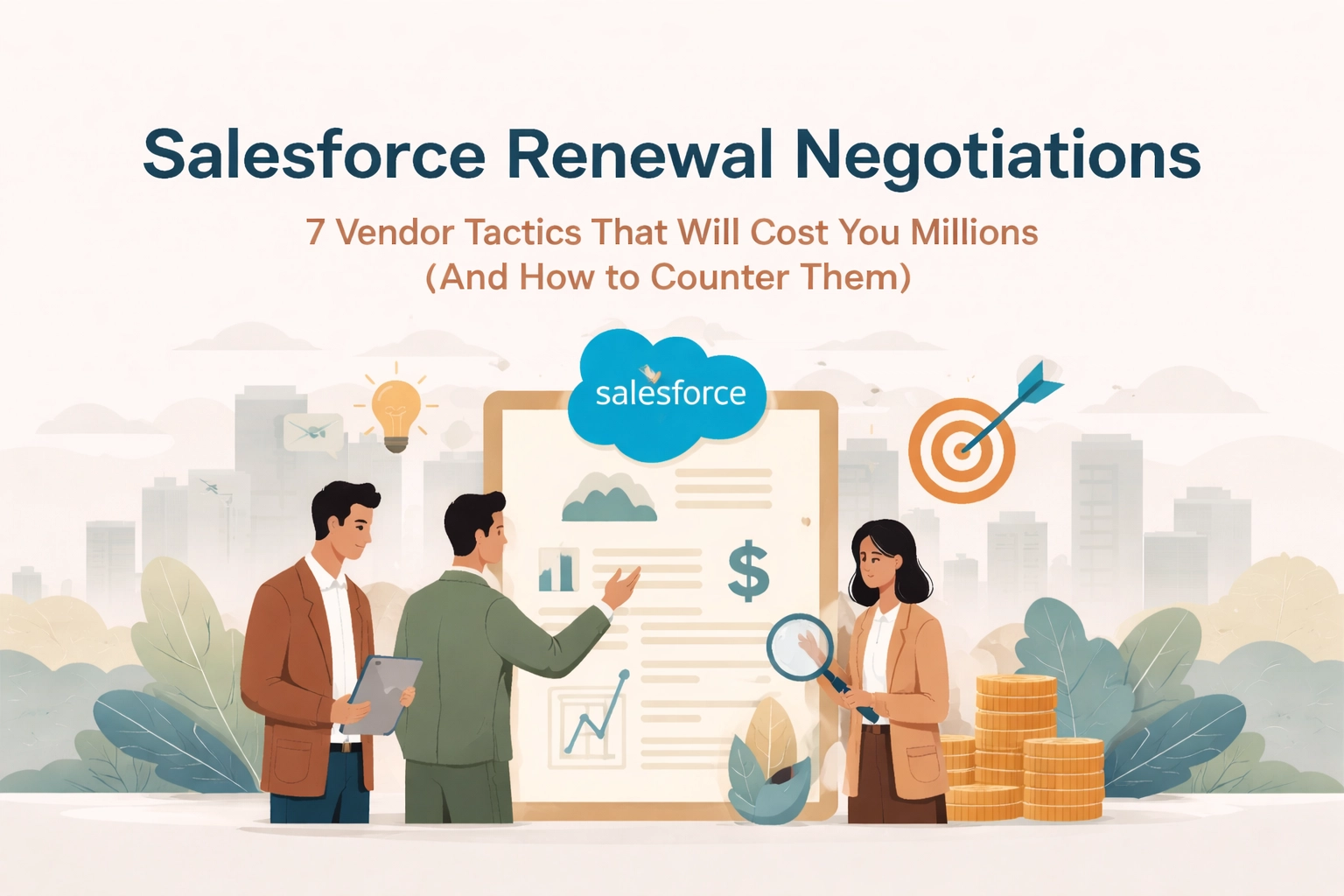
Salesforce Renewal Negotiations: 7 Vendor Tactics That Will Cost You Millions (And How to Counter Them)
Let's cut to the chase: Salesforce didn't become a $30+ billion company by accident. They've built a renewal machine that's incredibly effective at extracting maximum value from enterprise customers: often at your expense.
If you're a CIO, CFO, or procurement leader heading into a Salesforce renewal negotiation, you need to understand exactly what you're walking into. Because here's the uncomfortable truth: your Salesforce rep isn't your partner. They're a highly trained professional whose compensation depends on growing your contract value.
We've helped hundreds of enterprises navigate Salesforce contract negotiations, and we've seen every play in their playbook. Here are the seven tactics that cost organizations millions: and exactly how to counter each one.
Tactic #1: The Timing Trap
Salesforce will reach out months before your renewal: not to help you plan, but to control the conversation before you've had time to assess your actual needs. They'll frame this as "getting ahead of things" or "ensuring a smooth renewal."
Meanwhile, they're identifying upsell opportunities, understanding your budget cycle, and positioning themselves to apply pressure when you're most vulnerable.
The Counter-Move: Start your internal renewal planning 6 months before your renewal date. Audit your current usage, assess alternatives, and build executive alignment before Salesforce initiates contact. When you control the timeline, you control the negotiation.

Tactic #2: The Inflated Baseline
Here's a number Salesforce hopes you never discover: their initial renewal quote typically starts around 10% above your current spend: before any "negotiation" even begins.
Some of these increases are obvious (new list prices, added users) while others are buried in contract language and other means. The goal? Anchor the conversation at a higher number so that any "discount" they offer still results in you paying more than you should.
Furthermore, it's important to understand that your Salesforce AE has a 10%+ revenue uplift target at each renewal which creates an automatic conflict when you're trying to save money. If your account is a "flat" renewal from the previous contract year with no sign of new products/licenses/etc. then you'll be handed over to the renewal desk. This team is compensated differently with the ultimate objective of never allowing your account to decrease below your current spend. Naturally, this team is incentivized to ensure there is 5% revenue growth.
The Counter-Move: Conduct a thorough license audit before engaging. Many organizations discover they're paying for Premium editions when Standard would suffice, or carrying licenses for users who left the company years ago. Our Right Price Benchmarking™ service consistently reveals that enterprises overpay by 20-40% simply because they never questioned the baseline.
Tactic #3: The Automatic Uplift Clause
Buried in your Master Service Agreement are automatic renewal and price increase provisions. These clauses can escalate your costs by 3-7% annually: without any renegotiation, without any added value, and often without you even noticing until the invoice arrives.
The Counter-Move: Scrutinize your MSA for these provisions immediately. Calendar your renewal dates with 6-month advance alerts. When you do renegotiate, explicitly address these clauses and push for caps on annual increases or elimination of auto-renewal terms entirely.
Tactic #4: The True-Up Surprise
True-up clauses sound reasonable: you pay for what you actually use. In practice, they're a landmine waiting to explode your budget.
Without careful tracking, you might add users throughout the year thinking you're within your allocation: only to receive a six-figure true-up invoice at renewal. Salesforce counts on organizations losing track of their usage, and they're rarely wrong.
The Counter-Move: Implement quarterly internal audits to track actual usage against your contracted terms. Better yet, negotiate true-down rights into your contract: the ability to reduce licenses if your needs decrease, not just pay more when they increase.
Tactic #5: The Bundle Trap
This is one of Salesforce's most effective plays. Your rep will offer a "significant discount" on your renewal: but only if you bundle it with additional products, users, or support tiers you didn't ask for.
"I can get you 15% off, but only if we include Marketing Cloud in this deal."
Suddenly, your "discounted" renewal costs more than your original contract, and you're locked into products you may never fully deploy.
The Counter-Move: Flip the script. Bundle your own negotiation asks strategically. Combine price discussions with user alignment, unused license returns, true-down rights, and multi-year price caps. When you present a comprehensive counter-proposal, you gain leverage instead of surrendering it.
Tactic #6: The Support Plan Squeeze
After your initial contract term, Salesforce will push hard to maintain: or upgrade: your Premier or Premier+ support plan. They'll cite "business continuity" and "access to expertise" as justifications.
Here's what they won't tell you: most organizations' support needs drop dramatically after the first year. Your admins get trained. Your users figure things out. The urgent tickets become routine questions.
The Counter-Move: Reassess your support plan annually based on actual ticket volume and complexity. Many enterprises can safely downgrade from Premier to Standard support after their initial term, saving significant budget while reducing upsell pressure from the support team.

Tactic #7: The Middleman Mirage
Your Salesforce account executive seems like your advocate. They're friendly, responsive, and always willing to "go to bat for you" on pricing.
Here's the reality: your AE has almost no authority to offer meaningful discounts. Real decisions happen at the SVP & EVP level in conjunction with Salesforce's Business Desk: a team you'll never meet directly. Your rep is an intermediary who controls the flow of information in both directions, and that information asymmetry benefits Salesforce, not you.
The Counter-Move: Develop clear, logical, outcomes-oriented messaging and ensure everyone your rep contacts delivers it consistently. Document everything in writing. When you hit a wall, escalate directly to the Business Desk through formal channels rather than relying on your rep to "see what they can do." This practice is an art and not a science...we have perfected the practice at TNG.
The Preparation Equation
Here's the framework that separates enterprises who get crushed in Salesforce renewal negotiations from those who walk away with favorable terms:
Spend 75% of your time on preparation. Only 25% on the actual negotiation.
That means:
- Building a comprehensive Salesforce CRM Solution Blueprint (specific editions, feature sets, user counts, and measured value for each application)
- Conducting honest internal assessments of what you actually need vs. what you're currently paying for
- Researching competitive alternatives: not necessarily to switch, but to establish credible leverage
- Aligning your executive team on priorities and walk-away points
Without this preparation, you're bringing a spreadsheet to a gunfight.
Why Impartiality Matters
At The Negotiator Guru (TNG), we don't sell Salesforce. We don't resell licenses. We don't take referral fees from vendors. Our only interest is getting you the best possible deal.
That impartiality is why our Right Price Benchmarking™ data is trusted by enterprises across industries. We know what companies like yours actually pay: not what Salesforce says companies pay.
When you walk into a negotiation armed with real benchmark data and proven counter-tactics, the dynamic shifts. Suddenly, you're not reacting to Salesforce's playbook. You're executing your own.
Ready to Take Control of Your Next Renewal?
Salesforce renewal negotiations don't have to be a losing battle. With the right preparation, the right data, and the right strategy, you can counter every tactic in their playbook and protect your organization from unnecessary spend.
If you're facing a Salesforce renewal in the next 6-12 months, now is the time to start preparing. Check out our Salesforce vendor spotlight for more insights, or explore our enterprise contract renewal solutions to see how we can help.
Because in Salesforce contract negotiation, the prepared win. Everyone else just pays the price.

Inc. Magazine Unveils Its First-Ever List of the Midwest’s Fastest-Growing Private Companies— The Inc. 5000 Series: Midwest
The Negotiator Guru Ranks No. 15 on the inaugural 2020 Inc. 5000 Series: Midwest
NEW YORK, March 25, 2020 – Inc. magazine today revealed that The Negotiator Guru is No.15 on its inaugural Inc. 5000 Series: Midwest list, the most prestigious ranking of the fastest-growing private companies in Illinois, Indiana, Iowa, Kansas, Michigan, Minnesota, Missouri, Nebraska, North Dakota, Ohio, South Dakota, and Wisconsin.
Born of the annual Inc. 5000 franchise, this regional list represents a unique look at the most successful companies within the Midwest economy’s most dynamic segment—its independent small businesses.
“We’re honored to be recognized in the Inc. 5000 list as one of the fastest growing private companies in the Midwest,” said Dan Kelly, Founder and Senior Partner. The Negotiator Guru also ranked #2 in the state of Minnesota and #5 in the category of Business Products and Services. “Our success is a direct result of the value we’ve delivered with, and for, our global enterprise client base. Congratulations to the TNG team!”
The companies on this list show stunning rates of growth across all industries in the 12 Midwest states. Between 2016 and 2018, these 250 private companies had an average growth rate of 360 percent and, in 2018 alone, they employed more than 27,000 people and added $13 billion to the Midwest’s economy. Companies based in the Chicago, Detroit, and Cincinnati areas brought in the highest revenue overall. Complete results of the Inc. 5000 Series: Midwest, including company profiles and an interactive database that can be sorted by industry, metro area, and other criteria, can be found here starting March 25, 2020.
“The companies on this list demonstrate just how much the small-business sector impacts the economies of each Midwest state,” says Inc. editor in chief Scott Omelianuk. “Across every single industry, these businesses have posted revenue and growth rates that are beyond impressive, further proving the tenacity of their founders and CEOs.”
About The Negotiator Guru
The Negotiator Guru is the leading advisory firm for Salesforce contract negotiation. Our team of Senior IT Sourcing Experts provides industry leading IT contract negotiation services for a global client base. Clients engage us to source, negotiate, and manage highly complex IT contracts, transactions and suppliers. Through our deep business understanding and senior expert negotiation skills, we work closely with clients to deliver immediate and long-lasting financial impact to all stakeholders.
Founded in 2015, The Negotiator Guru is a private company based in Minneapolis, Minnesota. For more information, visit www.thenegotiator.guru. More about Inc. and the Inc.
5000 Regional Series
Methodology
The 2020 Inc. 5000 Regional Series is ranked according to percentage revenue growth when comparing 2016 and 2018. To qualify, companies must have been founded and generating revenue by March 31, 2016. They had to be U.S.-based, privately held, for profit, and independent—not subsidiaries or divisions of other companies—as of December 31, 2018. (Since then, a number of companies on the list have gone public or been acquired.) The minimum revenue required for 2016 is $100,000; the minimum for 2018 is $1 million. As always, Inc. reserves the right to decline applicants for subjective reasons.
Ready to explore joining the TNG family?
Contact us today to set-up a client intake assessment where we identify your cost savings opportunity for free!
------------------------------------------------------------------
Explore other TNG Featured Articles, Follow The Negotiator Guru on LinkedIn, Follow Dan Kelly on LinkedIn and Twitter. Learn more about What We Do.
About Inc. Media
The world’s most trusted business-media brand, Inc. offers entrepreneurs the knowledge, tools, connections, and community to build great companies. Its award-winning multiplatform content reaches more than 50 million people each month across a variety of channels including websites, newsletters, social media, podcasts, and print. Its prestigious Inc. 5000 list, produced every year since 1982, analyzes company data to recognize the fastest-growing privately held businesses in the United States. The global recognition that comes with inclusion in the 5000 gives the founders of the best businesses an opportunity to engage with an exclusive community of their peers, and the credibility that helps them drive sales and recruit talent. The associated Inc. 5000 Conference is part of a highly acclaimed portfolio of bespoke events produced by Inc. For more information, visit www.inc.com.

Why are Companies Hesitant to Engage Outside Consultants?
Why is it that companies are sometimes resistant to engaging with a cost savings firm like The Negotiator Guru (TNG)? Furthermore, why is it that a company refuses to engage with an advisory firm (like TNG) after they know there is a guaranteed ROI? Is there any rational reason for this or is it purely an emotional response?We at TNG find ourselves asking these questions far too often…
We know humans can be complicated (😊), but we wanted to dig deeper into what sometimes appears to be irrational behavior that negates shareholder value creation opportunities. As a result, we conducted ethnographic research on the cause of this behavior with the intent of identifying key trends, by persona. Here are a few of the key insights we discovered:
- IT Leadership (CIO, VP of IT, etc.) fears they will hurt the relationship with the software publisher/service provider leading to service degradation.
- Purchasing/Procurement/Sourcing representatives have huge egos and thrive on taking credit internally. Furthermore, they are worried about their job security if someone else can achieve a greater result.
- CFOs think they only way to achieve such savings is by changing vendors (ex: Salesforce to Microsoft) or by cutting products/services.
- Business leadership think it will take too much time to achieve the prospective savings which will negate the realized ROI.
- Executives at publicly traded companies are generally risk adverse and think it’s safer to use a big 4 consulting firm (that’s already “in the system”) even though they will likely cost more and achieve much less (since they’re a generalist vs. specialist).
We’ve heard different variations of these key objections for years. What makes us most proud is that some of this feedback came from a few of our past clientele who decided to overcome their natural resistance as they knew what was best for their organization. Per the recommendation of these past customer respondents, we've outlined what they experienced (vs. initial perceived resistance):
- Vendor Relationship – While it may be slightly uncomfortable at the beginning (depending on how much Right Sizing and/or Right Pricing opportunities TNG identifies), the vendor relationship and service quality improves at the conclusion of the TNG engagement. The vendor is engaged with the customer in a strategic manner and the customer can now feel confident they are only paying for what they need at a fair price.
- Procurement Job Security – TNG acts like a force multiplier for existing Procurement teams. As such, TNG simply seeks to enable high impact results vs. seek credit.
- Vendor/Product Change – Vendor changes are extremely rare. TNG simply identifies how internal stakeholders use the respective software platform (via their proprietary persona analysis) and identifies cost savings opportunities without sacrificing functionality/service quality.
- Time/Cost to Achieve – Internal business stakeholders are rarely involved in the process after the Discovery phase is complete.
- Niche vs. Generalist – The speed and consistency in which TNG can delivery results is a direct result of their focus and dedication focusing on their core competency, such as Salesforce.
Interestingly, our analysis identified the following key insights regarding business leaders' intention for engaging an outside advisory firm (summarized for brevity):
- IT Leadership sometimes feel uncomfortable being the “tough voice,” so they hire a 3rd party who brings the credentials to speak from an authoritative position.
- C-Suite Executives simply want to motivate (prove to) their Procurement/Business Teams that the “great deal on the table” is not so great after all.
- Procurement leadership wants to be armed with accurate price benchmarking or contract term knowledge. They recognize they can’t be experts in everything and value niche expertise from specialists vs. generalists.
- Board members want to do anything possible to reinforce their fiduciary duty to their shareholders…this includes identifying, and executing on, every available cost savings opportunity.
- Contract negotiators want to understand the software publisher’s sales playbook and internal incentive process…not just general market intelligence.
We hope that you find these key insights helpful as you contemplate and reflect on your own personal resistance to engaging an outside advisory firm. TNG prides itself to make every engagement as risk-free as possible for our clients. Furthermore, TNG will only accept a client if we know there is a major impact opportunity…if not, we will simply give you some free advice. Ready to explore joining the TNG family? Contact us today to set-up a client intake assessment where we identify your cost savings opportunity for free!
Start with a CIA.
That’s a Client Intake Assessment.
Upload your contract data or schedule a discovery call. If we can’t identify at least a 10%+ from a TNG Right Pricing™ opportunity, we won’t take your money (but we will offer you some free advice!)
