

Understanding Microsoft’s Negotiation Strategies


Most companies are paying 20-50% more than they should be on their Microsoft contracts. In this article, we are going to walk through what you need to know about negotiating with Microsoft, as well as specific tactical levers you can use to reduce your Microsoft contract by up to 50%.
8 Important things to note when it comes to negotiating your Microsoft contracts:
- Your sales rep has two key drivers: to get your company to adopt Azure and to sell you an E5 license.
- The Business Desk makes all of the final decisions regarding price, etc.
- The Divide and Conquer approach is still the most common tactic to drive sales.
- Microsoft’s fiscal year strategically ends on June 30th so they can capture multi-year budgets from their enterprise clients.
- Putting a price cap on a specific product does nothing to ensure your company’s rates because Microsoft changes product SKUs so regularly that your price cap will be null and void the next time you go to negotiate.
- Make sure that you have the appropriate affiliate language to ensure your entire company can use the products the right way.
- Consider whether your company would benefit from a Microsoft Products and Services Agreement (MPSA)
- If you’re switching from a Perpetual Agreement to an Office 365 contract, you have the opportunity to capture the lowest price you’ll ever receive from Microsoft.
Is this article we'll cover all those points in depth so you can understand Microsoft's negotiation strategy.
What you need to know when negotiating with Microsoft
Microsoft has a footprint in nearly every established company in the world. The Microsoft Office Suite revolutionized the way we work since nearly the beginning of the internet.
While the company has experienced both successes and challenges in its history, Microsoft has profited as a result of two primary factors: 1) a good product, and (equally as important) 2) a great enterprise sales team.
We’ll spare you a history lesson about Microsoft here but it’s important to recognize and respect the strength of their first mover advantage and subsequent (now legacy) footprint. This history has allowed Microsoft to be a fast follower with adjacent technologies within the marketplace. In other words, Microsoft monitors new concepts and technologies in the marketplace prior to investing their own resources. This strategy has largely worked over the last two decades as Microsoft will simply build or buy a proven technology stack that has proven successful and plug and play into their existing customer base.
Fast forward to present day, Microsoft Entreprise continues to be a fast follower within the marketplace. Their legacy footprint has allowed for continuous introductions of new technologies to their existing client base. Software as a Service (SaaS) solutions has significantly lowered the barrier to entry for new technologies to be introduced to their client base. This has created a new dynamic for Microsoft as it now employs tactics to eliminate competing technologies within its legacy client base. We will discuss these tactics in further detail within this article.
How Microsoft's pricing model has evolved
Up until 2011, Microsoft’s primary revenue stream originated from 1) net new technology sales and 2) maintenance fees. The new technology sales were largely on-premise meaning the software would be installed within a customer’s server environment. For those existing customers, Microsoft earned an 18% maintenance fee (calculated from the original purchase price) simply by pushing technology upgrades to the customer. This maintenance fee was largely recession proof as companies largely paid for upgrades thinking they were required but rarely ever installing the actual upgrade. As the market evolved into a SaaS based consumption model, Microsoft introduced Office 365 to drive predictable monthly revenue from their customers.
This new pricing model has transformed its business and propelled its revenue. This evolution has allowed them to push adjacent SaaS services to their clients such as cloud storage, security services, etc.
Because they are now training their clients to purchase software on a subscription model, it’s easier for Microsoft sales representatives to upsell other products. Knowing how a sales rep is incentivized and how they think will allow you to make the best decisions for your company and negotiate effectively.
Through our active Microsoft negotiations across a wide variety of companies, we have a constant pulse on which products Microsoft is currently incentivizing. This can help you gain significant leverage in your negotiation.
What is your sales representative's role in a Microsoft Negotiation?
Your Microsoft sales representative’s primary job is to gather as much intelligence as possible from your organization’s stakeholders in the interest of finding new products and services to push into your organization. On the contrary, your goal is often to control and/or reduce expenditures for your company. This means your intentions are automatically at odds.
Based on the new dynamic landscape within the marketplace, Microsoft Entreprise is now focused on eliminating any competing solutions from their customer’s technology stack. As discussed previously, Microsoft’s acquisition strategy has largely been focused on those technologies which have developed a large footprint within their customers. Your Microsoft sales representative is highly incentivized to eliminate competing software from your environment and will make the case that you are able to achieve cost savings by simply eliminating these competing solutions. At face value this sound nice but in practice it’s rarely ever true without proper negotiation support.
While there are some benefits to centralizing your technology through a single source, rarely is cost-savings one of those benefits. The cost savings presentation sounds well and good, but it often doesn’t lead to any actual value-capture benefits for companies. Instead, Microsoft gains a larger share of your technology stack and, with it, more negotiating power.
We’re seeing this increasingly with the promotion of Azure, their cloud solution, Power BI, their analytics tool, and anything machine learning and/or artificial intelligence related. These priorities will change as new products are developed but the principles are the same.
Within the last 2 years, Microsoft (like Google and their G-Drive) has started to build technologies that are reliant on the Azure platform to work properly. This forces companies that were not originally interested in Microsoft Azure to introduce the capability into their environment. Microsoft is hoping that your storage requirements grows both organically and inorganically.
Based on polling, we find that 87% of Microsoft customers expand their utilization of Azure within 2 years after the technology is introduced into their organization. This is complemented by the fact Microsoft, Amazon, and Google have made purchasing storage so simple and commoditized that anyone with the organization can do it. This is literally the ideal situation for Microsoft.
From an Office 365 perspective, your sales rep will want to push you toward an E5 license. This is their highest tier license for enterprise customers. Naturally, this is also their most expensive product which drives the greatest sales incentive for your sales representative.
To summarize, your sales representative’s top 2 priorities are:
- Get your company to adopt Azure.
- Get your company to purchase an E5 license.
What is the Microsoft ‘Business Desk’?
While your sales rep (i.e. “Account Executive”) and their management (i.e. “Vice President of xyz”) will be your primary point of contact, they have very little decision authority once it comes to rate adjustments..
That’s where the “business desk’ comes in. Microsoft has been testing, validating, and refining this concept for years and they’ve got it down to a science.
The ‘business desk’ is the Bad Cop to your seemingly accommodating sales rep’s role of Good Cop. The sales rep portrays a helpful, eager personality but they can’t finalize any decisions that actually affect your rates. The business desk contemplates their options, makes decisions, develops the basic communication plan, and informs the sales reps next actions with you, the client.
If you want to get the best rates possible for your company, you need to train your sales rep on how to interact with and communicate with the business desk on your behalf. With the right combination of messages and timing you can meet or exceed your negotiation goals.
They Will Try to Divide and Conquer
The Divide and Conquer tactic is widely known as one of the oldest plays in every enterprise sales playbook. The tactic has been used for years across all industries as it continually proves to be successful in driving more revenue.
Your Microsoft sales team will build relationships at multiple levels of your organization to learn more about the potential software needs of your organization than you do. They will use this information to introduce products and services to different levels of the organization to create buy-in and acceptance prior to any negotiation officially starting.
If you are a sizable account with Microsoft ($1M+ per year) you will also have some executive attention within Microsoft. This team will naturally want to engage with your (the customer) executive team to “gain alignment.” While executive relationships between your two organizations is not always a bad thing, it’s important expectations are carefully managed so that your executive team doesn’t agree to products or services you may not actually need. It’s best to create a negotiation plan that includes how and when your executives will communicate with Microsoft (if at all).
We have found that the large majority of our executive clients have an interest in participating in the negotiation. It’s important you include them in your communication planning so that they too can be empowered to participate within the guidelines you establish for them.
As for the rest of the organization, drive alignment across all your stakeholders within your organization early and often. Make sure everyone is on the same page about your needs, your budget, and your forward-looking initiatives and business plans.
You need to get clear on what you need and when you need it. If Microsoft is successful in their Divide and Conquer technique, they’ll tell you the answers to these questions and their answers will be an over-inflated version of what you would develop internally.
Microsoft Contract Language Risk Mitigation
What is Microsoft's Fiscal Year?
Like Salesforce, Microsoft does not follow the typical calendar year in the interest of accessing two corporate budgets. Microsoft’s fiscal year ends on June 30th of each year.
They do this in order to split their software expense across two corporate budget years to capture 1) end of year funds and 2) new budgets from their clients before they spend it.
Quick Win: How to properly negotiate Price Caps
Often we find clients have negotiated a price cap on specific products rather than on the total spend of the contract.
While price caps are well intended by the client, the problem is that Microsoft literally invented the concept of price caps in the early days of enterprise agreements to overcome buyer reservations. Microsoft subsequently defeats these protections by simply changing product names and SKU numbers on a frequent basis. In other words, if you put a price cap on a specific product during your negotiation, that product will almost certainly have changed at the time of your renewal in 1, 3, or 5 years which effectively negates any protection intended by the customer. Instead of placing a price cap directly on defined products, we recommend you establish protection based on the total spend of your contract.
Affiliate Language
Ensure that you have proper affiliate language in your contract. This means that multiple different subsidiaries of a company can use the same license versus having to have their own separate contracts. We’ve seen this trap laid in a few different M&A situations, specifically.
License Floors
In the world of business, it’s common for software companies to acquire or divest business units on a regular basis. Especially with our private equity clients, adding or removing thousands of employees each month is not uncommon.
Frequently, the contract will state that a certain amount of licenses allows for specific price reductions. With companies changing size and needing different licenses so frequently, this can be a problem. It’s important to create the lowest floor possible so that you aren’t hit with any penalties and avoid renegotiation triggers.
Areas of Opportunity
As with our Salesforce negotiations, we help our clients determine both the Right Size and Right Price approach for their specific needs. While companies like Gartner provide a wealth of information with tactics and general rate benchmarking, we recommend narrowing down the data to determine which companies are your closest peers in terms of industry, size, AND annual spend.
Obtain Net New Products at Very Reasonable (or Free) Prices
Showing interest in the incentivized products we mentioned earlier can reap huge rewards for your company. Use these products to drive cost savings within your core product baseline costs as well as to add new digital capabilities for little to no cost.
Don’t Over-License
In order to know what software license type you require, you need to have a clear understanding of how different stakeholders within your company are going to use your various Microsoft products. Develop no more than five personas for your organization based on how you’re going to use the platform. These personas will inform your license strategy.
Within our Right Size process we start by isolating the core functionality utilized by each persona and then matching that to the capabilities available within the various products. Using the Microsoft Office 365 Suite as an example, your Microsoft sales team will almost always recommend purchasing the E5 license for your organization as it offers the greatest capability, protection, etc (blah, blah, blah).
Rarely do our clients ever need the E5 license (only 5% to be exact). In fact, most organizations don’t even use the full capability offered within E3. This is why it’s so important to develop specific personas based on utilization within your organization. In a perfect world, you would be able to assign different license types based on the unique demands from each of your personas. In other words, it’s very common for the output of our Right Size assessment to suggest E3, E1, and K1 (yes, there is such a thing) within a client’s environment in the interest of driving the lowest total cost of ownership (TCO) with the greatest digital capability.
The simple act of selecting a lower license than the E5 (if appropriate) can save your company 60% or more.
Another example of successful Right Sizing is the isolation of shared computers. Within the manufacturing and healthcare industries, there are often shared computers that are available and used by multiple employees. Microsoft’s standard approach is to license each individual person in the company with an individual license. If you have shared computers, instead of licensing each individual you simply need to license each shared device. You can purchase a restricted use license with a desktop version for Windows and Office. For example, Instead of five employees being assigned five individual E5 licenses, you now have a single low priced license that meets their needs.
Another restricted-use license includes having an “email only” license for those that don’t need a computer but just want access to work email from their own devices.
In other cases, we’ve helped some clients realize they don’t need Office 365 at all and they can simply stay with their perpetual license. License types truly depend on the client and their individual needs.
Get an MPSA
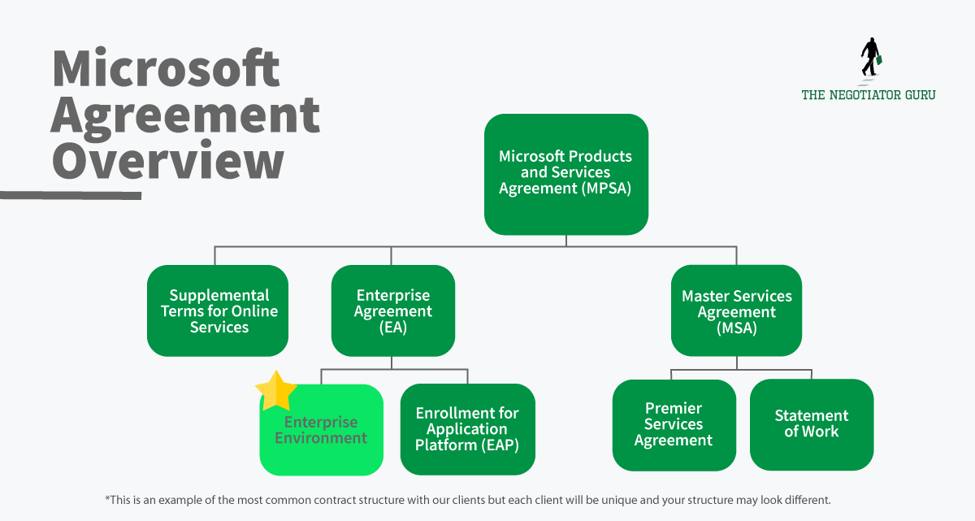
During your renewal you should take an inventory of your multiple agreements (servers, office products, etc.) and explore the benefits and risks of combining under one agreement called the Microsoft Products and Services Agreement (MPSA). The MPSA acts as a parent to the child agreements for your individual products and services and makes for an easier and more streamlined contracting experience down the road for all involved.
Historically, your Office products are on an Enterprise Agreement while the infrastructure products are on a Server & Cloud Enrollment (SCE) Agreement.
The more you can consolidate and co-term your agreements, the more leverage you’ll have. You’ll be able to negotiate the entire consolidated contract with the “business desk” versus two or more separate, and distinct contracts.
What you need to know about converting from a perpetual license to a subscription based license (Office 365)
If you’re converting from a perpetual license to an Office 365 contract, you have a huge opportunity to capture the lowest price point you’re ever going to get from Microsoft.
This conversion is its own license - it has its own SKU. The reason for this is that you’ve already paid for a part of that license through your original perpetual license purchase. If properly negotiated, the cost for this conversion license should only be the difference between the upgrade cost (current version to new) and your original cost.
Most Microsoft customers don’t know about this opportunity and let this massive cost avoidance opportunity slip through the cracks never to be seen again.
For context, the price difference is about 50% and it will be realized year-over-year. If properly negotiated, you'll reap continuous benefits from this opportunity.
FAQ's
What is the difference between Microsoft E1, E3, E5 licenses?
The difference between a Microsoft E1, E3, E5, and K1 license is in capability. The primary differences are:
- The number of Microsoft apps you can access;
- If you have download rights; and,
- If you can download the application (desktop version) versus online only (web browser access).
Microsoft Office 365 E1 is your “lowest” level license for the Microsoft Office Suite via web browser access.
Microsoft 365 E3 is your basic mid-level license which includes additional applications and allows users to download desktop applications. This by far the most common license for all enterprises. Microsoft 365 E5 is your highest level license which includes your core apps, download rights, and specialized apps like Advanced Threat Protection (ATP), etc. There are several other core licenses (suck K1, F1, Desktop Only, etc.) which can, and should, be used to lower your Microsoft spend. For most organizations, an E1 or E3 license will satisfy most of your end-users requirements. Can I mix E1, E3, and E5 licenses within a Microsoft contract?
Microsoft 365 E5 is your highest level license which includes your core apps, download rights, and specialized apps like Advanced Threat Protection (ATP), etc. There are several other core licenses (suck K1, F1, Desktop Only, etc.) which can, and should, be used to lower your Microsoft spend. For most organizations, an E1 or E3 license will satisfy most of your end-users requirements.
Can I mix E1, E3, and E5 licenses within a Microsoft contract?
While most companies who are longtime Microsoft users understand that you can mix several different products and services within an Enterprise Agreement, many aren’t aware of the fact that you can mix and match different license types for your core licenses as well.
In a well negotiated (and proactively managed) Microsoft contract, it’s very common for different persona groups to leverage different core licenses in the interest of Right Sizing™ your environment.
For example, a persona group in your company may use an E1 license, and then a different persona group (such as your IT department) may use an E5 license, depending on their use case.
If you are not mixing licenses at the moment, then you are likely paying for capability you don’t need for a subset of users who do not need the fully upgraded licenses.
How do you know what Microsoft license you need?
The easiest way to figure out what you need from a Microsoft license perspective is to hire an outside advisor to help you with that analysis.
It is much faster to hire someone who looks at licenses all day and can match up your needed capabilities with the ideal license type.
If you are going to do this yourself, the best way is to dive deep into the spec sheets on the license pages for each license on Microsoft’s website.
It is also very important to conduct a persona analysis inside of your organization if you have not already done so. This is a simple process.
- Identify 1-5 personas within your organization who use Microsoft products. These would be different individuals who use Microsoft in different ways.
- Identify the specific needs and wants of each persona group as it relates to Microsoft.
- Match each persona’s needs and wants to the best fitting license type for that persona group.
This is part of our Right Size™ secret sauce at The Negotiator Guru and how we help our clients reduce their spend with Microsoft.
What does the Microsoft contract structure look like?
The Microsoft contract structure is a constantly changing evolution. Historically, Microsoft has had Enterprise Agreements, Master Service Agreements, and supplemental terms and conditions that are unique to a specific product set. Historically, these have all acted as individual contracts. What Microsoft has done over the last 3-5 years is rolled all of their contracts into the Microsoft Products and Service Agreement (MPSA). It is a contractual container for these existing MSA’s, EA’s, and supplemental terms and conditions.What you want to do is be very careful when Microsoft is asking you to sign brand new agreements. More often than not, you are actually in a better contractual position by using your existing MSA’s, EA’s, and Supplemental Terms and then attaching that to the MPSA.
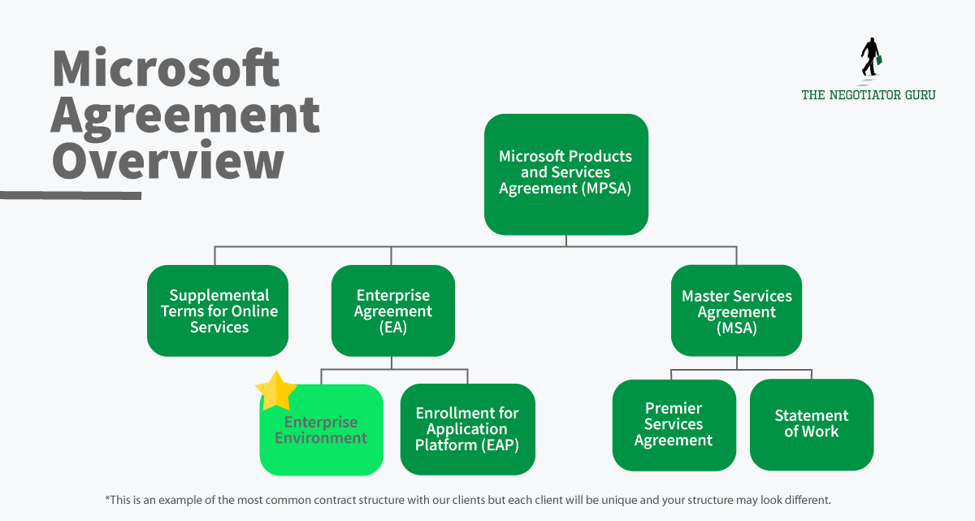
This is especially important because Microsoft is trying to move users to accepting online terms and conditions. While that may seem like a convenient aspect to contract management, with almost all of these online terms and conditions, there is a clause that allows them to change those terms and conditions at their will.
If this is not actively managed, changes within online terms and conditions can lead to unknown legal and/or commercial risk. We have many clients that engage us after they discover (either voluntarily or involuntarily) that they are out of compliance with their contract. The result can come in the form of an unbudgeted expense, lawsuit, and/or customer loss.
This is why it is extremely important to memorialize your specific contracts with Microsoft as much as possible...you can still do so within the new MPSA structure.
As you can see, contracts with Microsoft can quickly become complex which is why it is helpful to hire an outside advisor like The Negotiator Guru. Contact us today to discuss your Microsoft agreement.
What Microsoft products give me leverage in my negotiation?
There are certain Microsoft products that give you leverage in a negotiation with Microsoft. The short answer is that any product or service they have recently introduced to the marketplace (generally within the last 6 months) will provide amazing leverage for you.
The Microsoft sales team is highly incentivized to sell new products into existing accounts at renewals.
What is the typical term of a Microsoft contract?
A typical term of a Microsoft contract ranges anywhere from 3-7 years. The most common is 5 years with multinational enterprise customers.
For companies ranging from $5B-$15B in annual revenue, Microsoft will often do a lot of 1-3 year agreements.
For companies under $1B, Microsoft will often structure annual or month-to-month contracts.
Can you renegotiate a Microsoft contract early?
Yes. When you renegotiate early it is called an “early commit.” That being said, it’s important to note that not every early commit contract will provide value for the end customer. It’s very important that you hire an advisor like The Negotiator Guru to help you analyze the cost/benefit analysis of a new deal.
What are key risks of a Microsoft contract?
There are numerous risks that Microsoft customers can experience depending on what their environment looks like both in size, scope, and geographic footprint. One of the most common risks for all customers is the ability for Microsoft to audit customers. This is very similar to other software providers such as Oracle, SAP, Salesforce, etc. For a specific assessment of your contractual and/or technical architecture risk you’ll need to leverage an advisory firm like The Negotiator Guru.
To be clear, The Negotiator Guru does not provide 3rd party maintenance services like that of a Rimini Street but rather senior expert negotiation services. The two capabilities are very different and distinct.
Understanding Microsoft Audit Rights
Microsoft Audit rights typically emerge when you have any sort of restricted use license or on-premise architectural limitations. Related to the restricted use license, this is generally a custom made license for your company to serve a specific internal use case. These are negotiated licenses with Microsoft and can drive significant cost savings if used, and managed, correctly.
If you as the client don’t have a software asset management team, or the equivalent responsibilities assigned internally, then there is an increased risk that you’ll be audited and fined.
This audit risk typically comes up 6-8 months before your contract renewal. This is done by design by Microsoft to gather leverage for the upcoming renewal negotiation. In general, Microsoft will sometimes let audit compliance fees slip in exchange for new products and/or services within the customer’s renewing contract. Remember, this is largely driven by your account team who are highly incentivized to drive new product/service additions to the existing customer base.
Another typical resolution for compliance risk will be a required license upgrade which in turn satisfies your account team’s desire to increase their revenue of your account as well.
Are payment terms on a Microsoft contract negotiable?
Yes. Payment terms are negotiable.
Several years ago, Microsoft made a partnership with the banking sector to provide bridge financing. This makes it quite easy for a client to leverage payment terms of 180 days instead of the standard 30 days via their value added reseller (VAR).
You have the flexibility on payment terms. Simply ask Microsoft for the flexibility, and they will put you in touch with one of their payment partners like PNC Bank. The Negotiator Guru also has finance partners that allow our clients to extend their payment terms for any software contract including, but not limited to, Microsoft.
Can you change payment terms on a Microsoft contract from annual to quarterly?
Sometimes is the appropriate answer here. Depending on your specific situation, you may be able to change your payment terms from annual to quarterly or monthly.
Who has decision making authority inside of Microsoft and why?
There are multiple levels of decision making authority inside of Microsoft. That is purely by design. The decision making largely depends on the annual contract value of your new and/or prospect contract with Microsoft. Subsequently, the decision making rights change depending on if you are a new customer or a renewal customer.
For the purposes of a renewal, the primary decision maker is the business desk. This is a specific group inside of Microsoft that is meant to handle your renewal from end-to-end.
The business desk is incentivized to keep your revenue flat as their worst case scenario. Your account team is presented with a 10% revenue growth target for each of their accounts. If they are unable to satisfy this target, they will refocus their energy on those accounts where there is growth opportunity. At such time, they will hand off the deal to their renewal team at the “business desk.”
The business desk is essentially a sales enablement team in the background supporting your account team and driving the deal from behind the scenes.
To bypass this, you should aim to incorporate the business desk as part of your negotiation. This helps eliminate the extra step of the business desk being separate from your deals and improves the outcome of your negotiation.
The other thing you can do to improve your negotiation, and achieve better decision making authority, is to require a sales executive sponsor from Microsoft to join in on your negotiation. For example, if you spend $5M+ per year with Microsoft, you should require an SVP from the sales organization within Microsoft to be part of your negotiations.
With that type of connection, you can pass through a lot of back and forth and get to the bottom line much quicker.
When you have a high level sponsor involved in the deal, this enables you to exchange value in different ways with Microsoft such as collaborating on white papers, case studies, or structuring deals to work with Microsoft's innovation team, or test new products. Having a high level sponsor enables all of these additional leverage points to be brought into a negotiation.
The Bottom Line
Microsoft has a deliberately designed sales process and most companies are so entwined in their products that they readily accept new subscription charges and upgrades without digging deeper into their specific needs.
Our goal here is to help educate you on the best practices for negotiating with Microsoft. If you have additional questions or want to see more articles like this - whether for Microsoft or other SaaS companies - let us know so we know where to prioritize our focus for future articles.
More resources
From Fortune 500 giants to fast-growing innovators, TNG has helped clients save 20% – 40%+ on enterprise software contracts — even when they thought it was impossible

How Much Does a Salesforce Implementation Cost?
The Salesforce implementation phase can make or break a SaaS platform’s adoption rate and effective use for months and years to come.
Resistance to change is to be expected, but companies need their employees to go all-in on understanding the tech, establishing new processes, and eliminating workarounds and legacy behaviors.
Salesforce implementation costs vary widely depending on the size of the implementation partner (if you choose one), your total Salesforce spend, and how many custom features and processes are required. Implementation costs also vary based on whether you are migrating from an existing platform(s) or starting fresh. If you plan to implement an off-the-shelf instance with few customizations, average costs range from 10-30% of your total annual spend. On the other hand, a large company with extensive customization could pay as much as 50% of their annual spend. Integrating multiple disparate systems after a merger or acquisition can drive the price even higher.
Start with Your Salesforce Roadmap
We recommend our clients begin building out a Salesforce roadmap six to nine months before negotiations. This process helps document necessary functionality, gain buy-in from internal stakeholders, and control the direction of negotiations from the beginning.
The Salesforce roadmap can also serve as a guide during the implementation process. It represents the project’s top priorities in terms of users, functionalities, and expectations; it sets the stage for a successful rollout.
What if we are an existing company migrating to Salesforce from one or more platforms?
If you are implementing Salesforce to replace existing technology (“lift-and-shift”), the roadmap is more defined at the outset. Many processes are already in place, users have certain expectations about how their work should be done, and stakeholders know what outcomes to expect from these efforts.
A successful implementation should do more than replicate existing processes. Users should expect to adapt processes and habits to fit the new platform and achieve the desired outcomes more efficiently. (If not, why did we switch platforms at all?)
“Lift-and-shift” implementations almost always cost the most, take the longest, and have the most risks involved. Implementation partners must be experts on Salesforce and any legacy platforms.
What if we are a new company or startup with no CRM?
New companies are challenged to build a roadmap with more limited information. Depending on the age and history of the company, it can take weeks or months to really understand what it needs from a technological standpoint. Strategies fluctuate; in many startups, marketing and IT departments do not exist as standalone functions yet.
These companies must define critical needs quickly, but they have one cost-saving advantage—they can build out business processes based on existing Salesforce functionality. There are no “bad habits” to accommodate that require custom development.
Regardless of whether you are implementing Salesforce for the first time or as a replacement, there are five important ways to keep implementation costs down.
5 Steps to Reducing Salesforce Implementation Costs
1. Build your Salesforce Roadmap
Your Salesforce roadmap contains two basic pieces of information: what you plan to buy and when you plan to buy it. It is your guide for negotiating and will become your guide for implementation as well.
In many organizations, one individual serves as the Salesforce “project manager” leading this effort. This person could have any role in the organization, from Salesforce admin to CIO, but is the primary point of contact for the Salesforce rep. This does not stop the rep from reaching out to the C-Suite and VP-level leaders to build better relationships.
The roadmap helps project managers achieve the internal alignment necessary to fend off Salesforce reps who contact multiple organizational stakeholders in hopes of influencing buying decisions. It empowers the Salesforce project manager and stakeholders to present a united front regarding what to buy right now, keeping negotiations focused on costs and business value rather than product.
2. Your Introductory Rates Matter
Your initial negotiations with Salesforce will determine your rates forever. The rate you start with will be the benchmark for all future negotiations, a boon for sales reps who will jump at the chance to sell seats and modules you do not need yet.
Without a clear roadmap that identifies the types of platforms your company needs (Sales Cloud, Marketing Cloud, industry-specific clouds, etc.), the sales rep will take the opportunity to build a roadmap for you that best serves their sales and revenue objectives. To drive first-year revenue as high as possible, it will likely include many features and benefits you need, along with quite a few that you do not.
Features and benefits that are not business-critical as defined in the roadmap inflate your base price, affecting future negotiations. They will also inflate third-party implementation costs, regardless of whether you plan to use all the functionality at the time of implementation or not. Unnecessary features still take time and resources to implement, potentially deterring those resources from more important projects. Many Salesforce implementation firms bill by the hour, so every hour they spend on non-critical functionality is money wasted.
3. Avoid Buying “Shelfware”
“Shelfware” is a term that describes software or licenses a company purchases but never uses. Software becomes shelfware in several ways. Perhaps someone saw a “cool” platform at a trade show, bought it, but never adopted or used it. Some companies buy software licenses at a volume discount rather than for an actual number of users. It is an outcome of classic price psychology—if you buy one, you get one more at 50% off. If you do not need two, is the half-off price as valuable as it looks? Rarely.
Salesforce account reps know how appealing a discount is, especially when they know their points of contact must get buy-in from multiple stakeholders. As mentioned above, Salesforce reps are highly motivated to maximize first-year revenue from new clients. They may drive the conversation by offering a bundled selection of platforms at some discounted rate. There is no rhyme or reason behind these discounts. They can be invented on the spot.
New companies are especially susceptible to paying for shelfware. When business processes are still evolving and companies are still working out best practices, it might make sense to license another platform or add a few more user seats in anticipation of future growth. It is certainly easier to do so in a room with an account rep; project managers must be proactive in sticking to the roadmap and focusing on immediate, defined technological needs. Companies must be intentional and specific when negotiating quantities, types of licenses, and the associated costs to keep initial spends reasonable, weed out upselling, and avoid wasting resources implementing unnecessary technologies. At the same time, Salesforce customers should take advantage of free trials, proofs of concept, and demonstrations to explore new technologies before buying.
4. Require Clarity on Pricing Structures
Bundled pricing leads to shelfware which leads to wasted time and money. Salesforce has several tricks up its sleeve to create highly variable pricing structures across industries and company sizes. Your company’s annual revenue and annual Salesforce spend also influence pricing, but there is no way of knowing to what degree. There are no “best in class” rates; sales reps are trained to rebut these inquiries.
To avoid unnecessary costs, companies must require itemized pricing. Recently, we are seeing more and more deals that boil down to Salesforce offering X, Y, and Z for one discounted fee. This number does not necessarily represent anything; Salesforce uses a value-based pricing model where prices are set based on your perceived value of the solution.
Third-party rate data can help you better understand whether your rates are comparable to similar companies. Some Salesforce consulting firms have price calculators on their websites, but they are generally built on base rates as listed on the Salesforce website. Firms like TNG compile this data based on years of experience negotiating contracts.
5. Keep it Simple
All SaaS implementation efforts have one thing in common—customizations equal cost.
This simple fact requires stakeholders to think carefully and critically about existing business processes and expected outcomes. The more your business can align processes with Salesforce capabilities out of the box, the lower implementation costs will be.
In many cases, companies fall into the trap of extensive customization. They create technical debt; more custom features require more internal and external resources to support Customization is not necessarily a bad thing, but many small- to mid-sized organizations do not need as much custom development as they believe. A thorough business process analysis in the beginning stages can help avoid costly customizations in the future.
Stakeholders and project managers must also take into consideration the employees working with these systems daily, how changes might impact the workflow, and how human elements of change management factor in. End users must be on board with the change; stakeholders must be sure that customization requests solve a business problem rather than accommodating a user’s (or department’s) preferences.
Do I need a third-party Salesforce implementation consultant?
Organizations must decide whether they want to launch the platform themselves, add Salesforce’s implementation and customer success services to their deal, or hire a third-party consultancy. All have pros and cons.
A typical Salesforce implementation process includes business process analysis, data transfer from previous systems, custom development (if applicable), user testing and quality assurance, deployment, and ongoing user training and support. It is a heavy lift, even for large organizations.
If you choose to partner with a vendor, it is critical to find the right vendor for your needs. Large vendors may not provide small companies with the level of service or talent necessary to get the job done. While it makes sense for large companies to evaluate the big-name firms, they should prepare for higher costs with no relative increase in quality.
If you already have a consulting partner like Accenture or Deloitte working with your organization, they are strong choices for Salesforce implementation as well—they understand your business and already have strong relationships with stakeholders. Levering these existing relationships can ease the change management process.
Beyond technical proficiency, third-party firms help you manage the human element. They can help secure buy-in, speed up adoption rates and time to proficiency, and help you design workflows that optimize the use of the platform. They also optimize the use of human resources, allowing internal employees to engage with the process as needed without affecting day-to-day responsibilities.
For those who want to partner with a third party, we advocate for mid-sized implementation firms. They are large enough to provide the critical talent necessary for a successful deployment but small enough to prioritize the client-partner relationship and drive mutual success.
You can search Salesforce’s database of implementation specialists here. Brief pricing information is available below.
Conclusion
Numerous variables affect Salesforce implementation costs. At TNG, we believe companies need a clearly defined roadmap that aligns stakeholder needs and expectations before ever opening discussions with a Salesforce rep. The roadmap drives the negotiation process which ultimately drives implementation costs and time frames.

Negotiating with Salesforce - Seven things you need to know about how Salesforce looks at a deal
Salesforce is good at negotiating. So your chances of getting a good deal are enhanced by understanding how they look at a deal and their goals. Your Salesforce Account Executive will lead the team you are negotiating with, in close coordination with his or her manager. This team is your path to getting the best overall deal. And while they are trained to maximize Salesforce revenue, they won’t get paid unless you make a purchase. So if you ask the right questions, and provide information that can help them get to a discount level you are comfortable with, this is the win-win situation all are striving for.
The remainder of this article provides some guidelines and background that will help you to get there.
1. Salesforce sales teams earn commissions on incremental revenue
Account Executives (also called “reps”) and their management are paid based on incremental revenue, not total revenue. If you don't buy additional licenses (or spend additional money), they don't earn commissions. More specifically, if your total spend this year is not more than last year’s, they don’t earn commissions this year. They are indifferent to whether you purchase licenses for more users, add-ons licenses for existing users, or you swap out one type of license for another, as long as the total spend is more. This is actually a good thing for the customer because it gives you more leverage and allows you to adjust your purchasing to your needs.
2. Salesforce AE’s are paid when the deal is signed
SF reps and management are paid in advance for the 12-month value of whatever you are deploying now. While they will ask for a longer contract such as three or five years, they are open to a shorter term, since most, if not all of their commissions are based on first-year revenue only. This varies from year to year, but the first year is always more important.
3. Timing matters
Salesforce's fiscal year ends in January. While this may seem strange, it is actually quite intentional. They can work with a customer the entire year to justify a new purchase, and wait until that customer's new fiscal year starts in January when the budget becomes available. And since the sales team gets paid on an annual quota they are quite happy with January deals. This often leads to very large February commission checks!
But it's not only the end of the year that matters, as management and reps are often encouraged through bonus payments to close deals at the end of a quarter.
Customers can take advantage of this quarter and year-end effect by asking for and often getting discounts that would otherwise not be available.
4. Discount authority is distributed
There are many articles in the public realm indicating that the rep has no power, and all of the decision-making lies with a special team that has the authority. This is not quite correct. Your rep has access to a discount/approval matrix indicating what level of discount is available, by license and quantity, and what organizational level is needed to approve it. They know how much of a discount they can get approval for, and whom they need to get that approval from.
In general, each level of management has a specific level of discount they can approve. So for example, for a given size deal, your rep may be able to offer you a 10% discount without additional approval. His manager may be able to approve an additional 5%, and each level of management above can offer some additional discounting. The special approvals team is involved only when a deal requires additional discounting, beyond what a given size of deal and management level can approve. A good rep knows how to work this structure, and will do so to get you the best deal they believe they need to have to get your signature.
So while the rep doesn't necessarily have the authority to grant you the discount you might want, they are your advocate and absolutely control the path to get you a better deal. So keep pushing and asking for more - as you get closer to year-end or quarter-end, more of the management will be interested in helping your rep get you a bigger discount. And it is highly likely that your rep’s manager (Salesforce calls the first-line sales manager a “Regional Vice President”, or “RVP”) is fully knowledgeable about every deal, so going above the rep does not necessarily get you better discounts.
5. Discounts depend on both deal size and customer size
Larger deals and larger customers generally get larger discounts. The combination of order size and customer spend leads to the discount they might offer you for a particular purchase. For example, a $100k purchase from a customer spending $2M annually will likely get a larger discount than that same $100k purchase from a customer spending $500k annually.
Conversely, a $2M customer making a $10k purchase may get a larger discount than a $100K purchase made by a new customer.
While deal size determines the discount level, customer size determines where the discount level for the deal starts.
6. Consolidating purchases increase your discount
Salesforce loves it when you make lots of little purchases. Each one is considered as if it were the only purchase you are making, and thus separate individual purchases lead to higher overall spend (see #5). When you are about to make a purchase, be sure to consider if any other groups in your organization are doing the same, as well as purchases you might be making in the short term future. If you can consolidate the orders into a single request, your deal size goes up, and your discount level will likely improve.
7. Consider near term future demand in your current purchase
As an extension to the previous point to consolidate your purchases, this can be extended to include purchases that will likely be made in the next few months or even the next year. Providing this to the account team will allow them to provide several options to you, and you will be able to see larger discount levels that might be available to you. This will likely include making the full year’s purchase upfront, which will lower your cost per license, but potentially increase your short-term spend.
The downside of advancing purchases before you need them is that there will be licenses that are unused for part of the contract term. You can then compare which is better for you, both in the short term and the long term, since your renewals will start from a lower price per user. You may find that even though some licenses are unused for a time, your overall cost is lower, especially when you consider the cost of several years in the future. Most good account teams will be able to provide you sufficiently better deals to make this worthwhile for you to make the purchase up front. And since you have already paid for the licenses, the faster you can deploy them, the more you will benefit, without incurring additional costs.
Bonus - Not all licenses need to be activated concurrently
Let's say you are planning on deploying 900 licenses in the next 12 months, with a schedule of 300 in month 1, 300 in month 4, and 300 in month 7.
You will almost always get a better price if you purchase all 900 at once, rather than 3 purchases of 300, but you will end up with licenses that you are paying for and not using for some of this time. Conversely, if you make three purchases, you are not paying for anything prior to actually deploying them, but the cost per license will be higher.
A better option is often available that combines the best of both. You can agree to purchase the 900 licenses in a single order but delay the activation dates for the licenses you will not be activating in the next few months. Your order form will have three line items, one for each activation date. But since your discount will be based on the full 900 license purchase, they will all be less expensive, and you are not paying prior to when you need them! Salesforce calls this a “staggered deal” structure.
Ready to explore joining the TNG family? Contact us today to set-up a client intake assessment where we identify your cost savings opportunity for free!
.jpg)
Guide to Salesforce Pricing: How Much should Salesforce Cost in 2021?
Yes, you can negotiate your contract with Salesforce.
Much like other large IT and SaaS vendors, Salesforce expects you to negotiate. Most customers do not know they can negotiate IT contracts or are hesitant to do so out of fear of compromising the business relationship. Some customers do attempt to negotiate but are largely unsuccessful because they do not know how to navigate the complicated process.
It is possible to achieve a margin of reduction anywhere from 15% to 50% in your Salesforce contracts. In our experience, the most successful negotiations focus on mutual value rather than a lower price.
Salesforce, by design, has developed its sales organization so that the customer-facing account representatives do not fully understand where rates should be per client. These individuals are the clients’ day-to-day contacts and have some local knowledge from their book of business, but they do not always have the full picture.
The sales system runs through a “business desk” or “deal desk.” The business desk is Salesforce’s decision-maker, with the account representative serving as something of a middle-man on your behalf. Read more about the business desk system.
How does Salesforce determine pricing?
First, it is important to clear up misconceptions about seasonal pricing. Many of our clients have been conditioned to believe that you must negotiate with software vendors at the end of the vendor’s fiscal year. They are operating under the assumption that the vendor is hustling to meet its annual or quarterly sales goals and is highly motivated to offer deals. This is an expensive and erroneous assumption. Salesforce, for example, has monthly targets as well; they change depending on how well certain sales verticals are performing and which products are selling.
In general, Salesforce pricing is consistent with most SaaS organizations in that the more volume you have, the lower your price will be. However, there is no standard pricing for Salesforce. There is no “best in class” rate across industries; if another company is paying less than you, that means nothing at face value. In fact, sales teams at Salesforce are trained to rebut those concerns.
In addition to the number of users, Salesforce pricing varies wildly based on three primary variables: industry, annual contract value (the amount of money you pay to Salesforce each year), and the customer’s (your) annual revenue.
Other factors that can lead to additional fees is the number of custom objects, permissions, profiles, developer support, integrations with Outlook or Gmail, dashboard creation, customizable reports, custom objects, external apps, lead scoring, and other additional features.
Consider this example: Two companies, one in manufacturing and one in life sciences, have roughly the same annual revenue and roughly the same annual contract value. The main differentiator is the industry; this could mean price points vary as much as 30% to 40%. Why? Salesforce operates using a type of value-based pricing model, where prices are set based on a customer’s perceived value of the solution. Industries like manufacturing and consumer goods with relatively small profit margins tend to see lower Salesforce costs. It is unlikely an individual sales rep would see this, being siloed into his or her own industry vertical.
What are Salesforce’s prices?
For the most part, Salesforce products are priced on a per user/per month or per digital capability /per month basis, billed annually. Customers who need additional Sandboxes, Shield, Platform Encryption, etc. will also experience variable pricing which is calculated on a percentage basis against a set of core SF products (like Sales/Service Cloud licenses). Salesforce calls this “derived pricing” and, contrary to what your account team will tell you, it’s highly negotiable as it delivers a high commission incentive. Publicly, Salesforce will tell you these products are 30% of net contract value. The “should cost” percentage of these derived products are reliant on the 3 variables described above with a specific emphasis on your product mix and annual contract value with Salesforce.
Below you will find the “list pricing” for Salesforce. On average, through proper negotiation you can save 15-75% off of these list prices.
Salesforce CRM Pricing (See also: add-ons)
Work.com
- Workplace Command Center: $5/user/month. Manage the complex process of opening your business and getting employees back to work safely in the COVID-19 environment
- Emergency Response Management for Public Sector: $300/user/month. Prioritize and mobilize emergency resources
- Emergency Response Management for Public Health: $450/user/month. Protect communities and provide personalized patient care at scale
- Contact Tracing: $200/user/month. Protect your employees and customers from the risk of infection
Small Business Solutions
- Essentials: $25/user/month. All-in-one sales and support app
- Sales/Service Professional: $75/user/month. Complete sales/service solution for any size team
- Pardot Growth: $1,250/org/month. Suite of marketing automation tools for any size team
Salesforce Sales Cloud Pricing
- Salesforce Essentials: $25/user/month billed annually. All-in-one sales and support app
- Lightning Professional Edition: $75/user/month. Complete CRM for any team size
- Lightning Enterprise: $150/user/month. Deeply customizable sales CRM
- Lightning Unlimited: $300/user/month. Unlimited CRM power and support
Salesforce Service Cloud Pricing
- Essentials Edition: $25/user/month billed annually. All-in-one sales and support app
- Professional: $75/user/month. Complete service CRM for any team size
- Enterprise: $150/user/month. Customizable CRM for comprehensive service
- Unlimited: $300/user/month. Unlimited CRM power
Marketing Cloud
- Customer 360 Audiences
- Corporate: $12,500/org/month. Give mid-sized businesses tools to unify and grow data assets
- Enterprise: $50,000/org/month. Help large-scale organizations unify, segment, and activate all data
- Enterprise Plus: $65,000/org/month. Enterprise edition plus Premier Support
- Loyalty Management
- B2B: $30,000/org/month. Incentivize channel partners and distributors with a B2B loyalty program
- B2C: $35,000/org/month. Launch and manage more dynamic and personalized B2C loyalty experiences
- B2C Loyalty Plus: $45,000/org/month. Run multiple loyalty programs on a single platform
- Pardot (up to 10,000 contacts)
- Growth: $1,250/org/month. Fuel growth with marketing automation
- Plus: $2,500/org/month. Dive deeper with marketing automation and analytics
- Advanced: $4,000/org/month. Power innovation with advanced marketing automation and analytics
- Premium: $15,000/org/month. Enterprise-ready features with predictive analytics and support
Email, Mobile, Web Marketing
- Basic: $400+/org/month. Personalized promotional email marketing
- Pro: $1,250+/org/month. Personalized marketing automation with email solutions
- Corporate: $3,750+/org/month. Personalized cross-channel strategic marketing solutions
- Enterprise: Ask for a quote. Sophisticated journeys across channels, brands, and geographies
Social Studio
- Basic: $1,000/org/month. Start your social media marketing journey with listening and engagement
- Pro: $4,000/org/month. Listen, publish, and engage across social networks
- Corporate: $12,000/org/month. Social marketing and social customer service for companies with multiple brands or products
- Enterprise: $40,000/org/month. Maximize results at scale across teams, brands, and geographies
Advertising Studio
- Professional: $2,000+/mo. Power audiences across digital advertising with CRM
Datorama
- Starter: $3,000+/org/month. Begin your marketing intelligence journey and unify, visualize, and activate your marketing data
- Growth: $10,000+/org/month. Grow your marketing intelligence platform across all campaigns, channels, and platforms
- Plus: Ask for a quote. Complete marketing intelligence across regions, brands, and business units
Google Marketing Platform
- Google Analytics 360: $12,500+/org/month. Turn insights into action with Google Analytics 360
- Google Analytics 360 + Optimize 360: $17,500+/month. Test, adapt, and personalize with Optimize 360
Salesforce CMS: $10,000/org/month. Build connected content and digital experiences at scale
Commerce Cloud
- B2B Commerce: Quote request
- B2C Commerce: Quote request
Platform
- Starter: $25/user/month. Build custom apps that fuel sales, service, and marketing productivity
- Platform Plus: $100/user/month. Extend Salesforce to every employee, every department, and transform app dev for your entire organization
How much does a Salesforce implementation cost?
A Salesforce implementation will cost on average 10-30% of your annual spend with Salesforce for a standard implementation. The primary factors that will cause the cost of your Salesforce implementation fees to vary is the amount of custom integrations, configuration services, and custom objects required by your organization.
To learn more read our article about How much does a Salesforce implementation cost?
How do we get a Salesforce discount?
Discounts through organizational growth:
Organizational growth is the greatest leverage a company can have when negotiating discounts. Whether a company grows organically by adding more employees or capabilities, or inorganically through mergers or acquisitions, the need for more user licenses is an excellent starting point for negotiations. When company growth leads to both new users and new products, the opportunity for more extensive discounts increases.
Discounts through product expansion:
Companies that do not have planned organic or inorganic growth can build leverage by opting for some new or trending products.
If you are just purchasing a basic CRM platform for lead, contact, & opportunity management, then you will likely struggle to receive a large discount. Although Salesforce routinely offers discounts on cross-industry platforms such as Einstein for analytics. It is discounted because it has not been widely adopted and few implementations have been successful. When Salesforce is actively pushing Einstein or another specific product, there are massive sales incentives and greater discounts. These discounts can be leveraged to negotiate further discounts in core licenses.
While Einstein is promoted across industries regularly, other industry-specific platforms may be incentivized at different times of the year. Without inside knowledge, it is impossible to predict or know what products will be incentivized at what time. Because we work with Salesforce constantly, The Negotiator Guru has a much clearer picture of the Salesforce landscape. Our active client engagements and professional relationships with former Salesforce employees allow us to work on your behalf to move through the negotiation process.
How do we manage Salesforce cost over time?
Once you have successfully worked with TNG to negotiate your first contract, what happens when renewal time comes around? Clear, established ownership of Salesforce within an organization plays a critical role in managing costs moving forward.
Salesforce’s ideal customer is one with multiple business units where needs and goals are not aligned across functions. No one is leveraging spend or standardizing rates/terms. Salesforce sales reps plan for an annual 10% increase in revenue from every customer, so customers should expect to be presented with the latest and greatest tool or app when sales conversations begin. When each business unit works independently with Salesforce, it is far more likely a company will pay for more software than it needs.
TNG recommends a centralized authority that manages the overall relationship with Salesforce but particularly the tactical management of licenses. An internal Center of Excellence that can manage the entire Salesforce instance from an enterprise perspective, move licenses around as necessary, ensure products are being used appropriately, and continue refining and adjusting the Salesforce roadmap along the way.
Conclusion
Our negotiation process is driven by a simple concept: right size, right price. Similar clients should pay the same price for the same product, know what rates they should be paying in comparison to their peers, and know what to look for in software contracts to eliminate potential issues before they arise. Salesforce has hidden much of this process in the shadows, making it challenging for companies to make informed investments in technologies.
Start with a CIA.
That’s a Client Intake Assessment.
Upload your contract data or schedule a discovery call. If we can’t identify at least a 10%+ from a TNG Right Pricing™ opportunity, we won’t take your money (but we will offer you some free advice!)
