

My 3 Guiding Principles for The Negotiator Guru


Imagine you are a C-Suite executive and your business is built on a franchise model.
Each franchise branch is owned and managed by a different person but they all use the same ERP and the big corporate umbrella entity that you own pays for all the services.
The individual owners dictate which software and services they use, how many licenses they need, etc.
Your annual bill for all the different contracts comes to $2.5 million.
How would you feel if I looked through your contracts and told you that, based on the prices your peers pay, you should actually be billed closer to $900,000 - a more than 60% savings - for the same host of services?
You’d probably want to flip the table we’re sitting at.
I started The Negotiator Guru because I believe in 3 things:
- Clients should all pay the same price for the same product*
- Clients have the right to know what rates they should be paying in comparison to their peers.
- Clients should know what to look for in software contracts to eliminate potential issues before they arise.
I want to go into each of these beliefs in more detail and give some case study examples to further demonstrate why I think these points are so important.
Clients should all pay the same price for the same product.
It’s common for people to believe the price they’re paying is equal to what their neighbor paid for the same product.
Due to both Master Service and Non-Disclosure Agreements between most software vendors and their customers, companies are not allowed to publicly share what rates they’re paying for their different products/services. Subsequently, software suppliers will almost never advertise a specific price point for enterprise customers but rather indicate “call for details” in the interest of driving the most revenue from the potential relationship.
In other words, in the art of enterprise SaaS sales, you won’t find any published rate information for you to benchmark your contract against. The only way for you to identify whether or not your rates are competitive is to engage a firm that holds that market intelligence as a result of analyzing contracts on a daily basis.
The fact of the matter is: Prices always vary.
No one pays retail as an enterprise customer but some companies achieve significant discounts compared to other similarly-sized operations.
In some cases, you’re getting ripped off if you’re not getting an 80-90% discount off published prices.
It wouldn’t be logical to expect a huge company like Coca-Cola and a small startup to be paying the same price purely based on volume alone. But brands of the same size with similarly-sized contracts (based on annual revenue & annual spend for their contract) should be paying the same price.
I have great respect for wonderful sales executives who sell value to customers, but my company believes the market should dictate a fair price for all IT goods & services (Services, Software, Hardware, etc).
The enterprise sales executive is arguably the greatest asset these IT companies have within their organizations. The good ones truly know how to sell “perceived” value.
Regardless of how personable a sales executive is, we believe the market should dictate what a fair price is - much like buying or selling a home. In order for this work, we believe that rate information should be readily available to customers. In order for this information to be shared legally, we need to enter into a commercial agreement with your company and charge for these advisory services.
Clients have the right to know what rates they should be paying in comparison to their peers.
On a daily basis we see similar-sized clients with similar-sized contracts have a 30 – 60% price variance.
Now, whether this is because some companies didn’t have strong negotiating skills or perhaps they just didn’t know how their contracts compared to the market doesn’t matter. What does matter is that clients know how their contract prices compare so they can make future decisions accordingly.
Ideally, through access to more information regarding IT contract pricing, you’ll be able to secure the best rates for your company. Leveraging this information can significantly impact a company’s bottom line.
But even if you aren’t able to achieve best-in-class pricing, we believe you should know what those rates are to empower decisions on how to work that supplier moving forward.
Often, relationships with IT suppliers run into the roots of your business and once you’re in that deep, it can be hard to break loose to find another vendor.
Even if you can’t get off of a big platform like Salesforce, Oracle or another ERP, you can make better-informed decisions about how you’re going to increase or decrease your use of that platform in the future.
There are a few market intelligence firms out there that supply basic and watered-down pricing information to clients but require a $30,000 per year subscription fee (per seat). This cost to have access to this benchmark data isn’t a feasible or justifiable expense for many companies.
We don’t feel that only Fortune 500 companies should have access to market intelligence firms and benchmark data.
The existing methods used to decide what the best price really is for any given enterprise could be improved. Most market intelligence firms take a general approach to setting correct pricing rather than looking at the specifics of each contract and the unique needs of each company.
For example, these firms will recommend that you should be getting a 60% discount if you’re spending $1 million with a particular IT company as a blanket rule.
Instead, we take into consideration the specific needs of our clients and use a Right Size, Right Price approach within every contract negotiation.
Clients should know what to look for in software contracts to eliminate potential issues before they arise.
Having a deep understanding of the terms of your most expensive contracts will help you save hundreds of thousands of dollars.
Here I want to briefly outline a few common contract issues that I see my clients face:
Price Protection (and not just by SKU)
Price protection generally comes up when you’re signing your first contract with a software provider. IT companies will compete for your business by offering you the lowest prices for their services with the expectation that they’ll be able to raise the rates once you’ve completely adopted the product.
Companies will always try to find ways to increase your annual expense. This is largely due to sales incentive plans in place with their sales development organization. Common tactics used by software companies include random internal audits to monitor usage (overage fees), product lift and shift changes (new SKUs), and service fees (for enhanced customer support).
More often than not our clients are very astute individuals that use their best efforts to price protect their organization’s contract for future years. That being said, it’s unrealistic to think anyone knows how to mitigate all the potential risks unless you do this everyday.
For example, to mitigate against the software companies from simply changing product names (SKUs) to bypass any preexisting price protection you may have on a specific product, we suggest you introduce contract language that protects your company using your total spend (vs a product-specific SKU) as the common denominator.
M&A Language
Make sure you have specific language in your contract about what happens in the case of a merger or acquisition.
Be sure to include language about a Termination for Convenience. This is a provision allowing you to get out of the contract if you acquire, or are acquired by, another company within a certain time frame - usually 90 days to 6 months.
Termination for Convenience eliminates the risk of having duplicate service providers for the same service after the transaction is closed. Without this stipulation, companies can find themselves with millions of dollars in expenses that are avoidable.
Note: In the interest of this article’s brevity we aren’t going to stipulate all the protections you need in an M&A transaction as this will be further explored in a future article. While the guiding principles of what to include within your contracts will remain consistent, client-specific protections will always require advisory services.
Termination for Breach
Termination for Breach language is important information to include in your contracts. In these cases, attorneys have to be involved and mal intent has to be proven by the accusing party.
This rarely ever happens and having the language laid out in the contract incentivizes IT companies to behave their best throughout the contract term.
License Limitations
It’s common to have language surrounding license limitations in your contracts. This basically says that you can use a specific license at a specific site for a specific reason.
These stipulations probably make sense on the surface and won’t alarm the person reading the contract but in most companies, with thousands of employees, not everyone is reading the contract. This could lead employees to inadvertently infringe on how the license may be used.
The best way for most companies to avoid this is to have seat-based pricing attached to specific personas (usage rights) rather than volume-based pricing.
Audit Rights
We’ll go into this further in a future article but I want to point it out here that you should be in control of the audit capabilities - don’t leave that in the hands of the supplier.
When IT companies retain audit rights, they have a Trojan Horse to get inside your company and find more ways to increase your pricing. They already know more about your company than you do - don’t give them the reigns to take over completely.
Roles & Responsibilities (when working with multiple parties)
Establishing clear lines of accountability is incredibly important when you’re working with multiple third parties.
As the owner of Company ABC, you’ve got Supplier X and Supplier Y. In each contract where there are dependencies for another supplier to take action, you will want to include a Roles & Responsibilities Matrix so that all parties are contractually agreeing to the same responsibilities/accountabilities. Conducting this exercise is not only a good way to align parties prior to the start of any project but also contractually protects you from any finger pointing across these same parties which will ultimately cost you time and money.
This Roles and Responsibilities matrix is oftentimes called a “RACI” Matrix - Responsible, Accountable, Consulting, Inform. The example below shows how it is used to clearly define roles and responsibilities across and within parties.
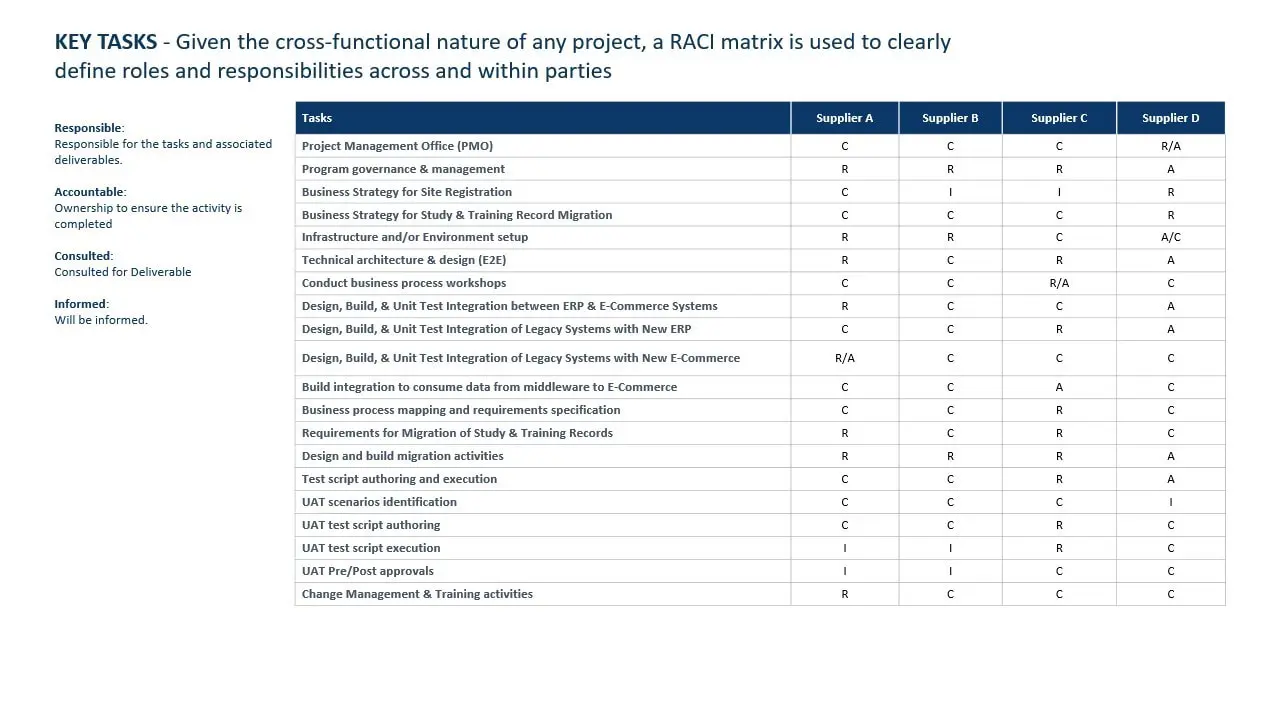
You can clearly see the task at hand, who is responsible for it, who is accountable for it, who needs to be consulted for it, and who is informed by it. Where appropriate we suggest including your internal resources as well as more often than not your suppliers will require your team to take action as well. Our clients use the RACI matrix process within their internal organizations as well to drive alignment and avoid potential issues before they arise.
From a tactical perspective, it’s important that the same RACI matrix is included within each supplier’s contract so that everyone is operating from the same table, terms, and conditions. This often takes some negotiation but with the proper foundation and alignment, you shouldn’t have any pushback from your suppliers. In fact, if you do have a supplier that is heavily pushing back against this exercise we recommend our clients view this as a potential leading indicator for what’s to come with that particular relationship.
With these 3 guiding principles, we ensure our clients are negotiating the best contracts for their needs.
Whether you’re in the process of negotiating your first IT contract or are looking to save big on your next renewal process, we’re here to share our experience and expertise with you.
We want to ensure that you’re paying the right price for the right products.
We want to make sure you have benchmark data to help you make decisions about the future of those contracts.
We want you to avoid contractual pitfalls by including key language around important, often overlooked points.
More resources
From Fortune 500 giants to fast-growing innovators, TNG has helped clients save 20% – 40%+ on enterprise software contracts — even when they thought it was impossible

The Negotiator Guru Names Chrissy Hudson as New Director of Operations and Corporate Affairs
MINNEAPOLIS, MN. — The Negotiator Guru, a global technology consulting firm specializing in SaaS contract negotiation advisory services, today announced the appointment of Chrissy Hudson as their new Director of Operations and Corporate Affairs.
“Chrissy is a strong communicator who is client focused with deep leadership and business operations capabilities,” says TNG Founder and Senior Partner Dan Kelly.
“She has been a tremendous asset to our organization over the past year, and we're confident that she'll continue to guide us to even greater success in this expanded role. TNG has become a worldwide niche consulting firm due to outstanding talent like her.”
Although women currently account for around 47% of the overall workforce, they remain largely underrepresented in the technology field, making up only 26% of all job roles and less than 10% of tech leadership positions.
“With its deep pool of talent and global client base, TNG is positioned for growth,” said Hudson. “I am excited for the opportunity to help guide the firm into the next stage of its strategic development.”
Hudson brings over 17 years of leadership and business operations experience from both the public and private sectors. She will be responsible for developing new business relationships, promoting products and services, and overseeing the firm’s internal operations to ensure overall client satisfaction. Hudson holds a Bachelor of Arts degree from the University of Louisville and a Master of Arts degree from Concordia University.
About The Negotiator Guru
The Negotiator Guru (TNG) is a global technology consulting firm that provides industry leading IT contract negotiation services to clients around the world. Founded in 2015, TNG is recognized as the world leader in Salesforce contract negotiation services. In 2020, The Negotiator Guru ranked No. 15 on the Inc. 5000: Midwest Series and was recognized as the 2nd fastest-growing private company in the state of Minnesota. TNG is also ranked as one of the largest IT consulting firms in the Twin Cities by the Minneapolis/St. Paul Business Journal. For more information, visit www.thenegotiator.guru.

The truth about Salesforce Enterprise License Agreements (SELA)...is it right for you?
We’ve found that the average savings potential for a company switching from a Salesforce Enterprise License Agreement (SELA) to a standard Salesforce Subscription Agreement is 41.3%.
Yet many large enterprises still honor their SELA agreements simply “because we’ve always had one.” Subsequently, these companies have a difficult time benchmarking the value they’re extracting from a SELA vs any other contracting method.
While Salesforce will present these agreements in a way that may seem extremely advantageous to the customer, the truth is they’re rarely a good fit.In this article we are going to explain:
- What is a SELA Agreement?
- How SELA’s looked in the early days of Salesforce
- How present day SELA’s have changed
- Why SELA Agreements are a bad idea for most companies
- Problem 1: SELA caps are built off of your current needs
- Problem 2: SELA agreements are manipulated by Salesforce’s changing product line
- Problem 3: You are paying 41.3% more than you should be with a SELA Agreement
- When SELA’s work
- When SELA’s don’t work
- Why “you don’t have to manage it” rarely justifies a SELA
- What to do if you have a SELA
What is a SELA Agreement?
A SELA Agreement is a Salesforce Enterprise License Agreement.
What is the difference between a Salesforce Enterprise License Agreement (SELA) and a Salesforce Subscription agreement?
A Salesforce Enterprise License Agreement (SELA) agreement is different from a Salesforce Subscription Agreement in one key way. A SELA is meant to provide “Unlimited Access” to the platform, while a standard Salesforce Subscription Agreement includes set prices for a set number of products.
Yet while SELA began as an “Unlimited Access” promise, that is not quite what SELA agreements look like today.
To understand SELA’s and why your company probably doesn’t need one, it’s helpful to understand the history of SELA’s and how they may have looked when your company originally signed one.
How SELA’s looked in the early days of Salesforce
In the early days of Salesforce, there was a massive focus on market penetration. Like any typical SaaS company, all they cared about was volume.
In the early days of Salesforce, the CRM market was extremely fragmented with small players and disparate homegrown solutions. Arguably, at the beginning, the largest competitor to Salesforce was Microsoft Excel. As a result, Salesforce hit the market precisely at the right time and acquired new customers relatively easily.
But given that Salesforce was in such a high-growth mode, they wanted to leverage their existing client base to grow organically both internally and externally at the client organization. In other words, they wanted to pursue any strategy that enabled new endpoints whenever, and wherever, possible.
Under this premise, they created the first SELA which conceptually provided unlimited access to the platform. This would ensure that Salesforce could land and expand as fast as possible within a new account without any barriers, paperwork, governance, or red tape.
The MO of an early SELA deal summarized would be:
Your contract with Salesforce is $10M per year over a 5 year contract term. It is a $50M relationship, and you can use the entire Salesforce platform however you see fit, no restrictions. Use our support as you need it. Our goal is to help you grow.
This unlimited access approach was the foundation for Salesforce’s growth by 100x in the early years. By signing one of these deals, and then expanding into a large enterprise organization, they were able to show massive growth rates on all of the SaaS growth metrics such as users, retention, growth rate, turnover rate, etc.
Because they were signing customers onto SELA’s, their growth metrics went through the roof which gave all of the signals for additional funding, press, and market share.
The goal of SELA in the early days was simple. Achieve as much penetration as possible into the corporate world.
How present day SELA’s have changed
While SELA’s once provided “Unlimited Access” to the platform, that isn’t always the case today. Present day SELA agreements look quite different.
Today’s SELA Agreements are full of floors and caps on the quantity of specific product sets that you can use. While old agreements were “Unlimited”, the new agreements come with added restrictions, usage ceilings, and massive financial growth commitments.
When your organization grows/declines past the commercially allowed threshold within your specific SELA, there will be significant financial consequences. Subsequently, without the proper legal terms and conditions protecting you from changes within your business, you are setting yourself up for significant financial and legal risk.
Why a SELA is a bad idea for most companies
A floor/cap on your product usage initially may not sound like a large risk for your company, especially if you are comfortably within the allowed threshold at the time of contract execution. That being said, there are 3 major problems that commonly arise from this scenario. Here we are going to dive into the three fundamental problems:
Problem 1: SELA caps are built based on your current needs
A SELA agreement will often be on a 3-5 year term, and the caps are negotiated based on the needs of your organization at the signing of the contract. This may not sound like a major risk, but for high volatility (growth and/or decline) companies, or anyone in an active M&A industry, this can be a major issue.
When you break the caps of your SELA Agreement, it’s not as simple as “buying extra licenses” to make up the gap. Instead, it will trigger an entire sales event with Salesforce that is going to have them coming back to you for more money.
Additionally, you may only trigger your cap in one single product category (Ex. Pardot), but if you break your SELA caps in that space, they can use that as grounds to raise prices across the board.
These caps are dangerous because as soon as you break one, it puts the power of the contract back into Salesforce’s hands.
Problem 2: SELA Agreements are manipulated by Salesforce’s changing product line
The second problem with a modern day SELA is the ever-changing product line from Salesforce.
Salesforce is a master of releasing and repackaging products. They are constantly rolling out new products into the market, as well as repackaging existing products, while retiring old products.
While innovation at Salesforce is great, the new products and services that are organically (or inorganically) created are rarely contemplated as part of your organization’s SELA. If your organization wants to use those new products and/or services, they will likely need to be paid for separately as an additional expense.
Additionally, some products may “retire” or become a “carveout” of an existing product. Continued usage of these products may actually trigger a contractual breach of your SELA.
This sounds ridiculous, but Salesforce does it all of the time, and it’s very expensive for the client. Naturally, most Salesforce clients are not aware of these inherent risks until they’re sent an invoice for this incremental out of compliance usage.
Here is a recent practical example of how they pull this off...
Repackaging Example: Sales & Service Cloud
Up until recently, Sales Cloud & Service Cloud were two separate products from Salesforce.
Sales Cloud was for Sales Reps while Service Cloud was for service department technicians. These two products came at two different price points. Sales Cloud was cheaper, and Service Cloud was more expensive.
Eventually, Salesforce decided to roll these into “Sales and Service Cloud” as a single commercial product even though they technically operate as separate infrastructures (clouds). This provided Salesforce a commercial opportunity to financially uplift those existing clients that had both products (Sales and Service Cloud), historically with two different price points, now as a single price point that matched the more expensive line item as part of Customer 360. The logic being that both clouds are integrated harmoniously whereas the entire client organization is able to review all of its omnichannel touchpoints with their customers. This “additional value” was largely the basis for this product and price convergence.
The targeted outcome is typically around a 30% revenue boost within the existing customer base. This revenue boost was predicated by a simple repackaging of services.
Problem 3: You are likely paying 41.3% more than you should be with SELA
We renegotiate a lot of SELA deals at The Negotiator Guru (TNG), and on average, we identify a 41.3% cost reduction opportunity when switching to a standard Salesforce Subscription Agreement.
The reason behind this is that most SELA’s are priced extremely high (on a price per unit, per month basis) and commit the client to much higher usage (products & quantities) than is actually being used, creating conceptual shelfware.
At TNG, we leverage a proprietary Right Size, Right Price approach to drive efficient and long lasting savings for our clients.
We first understand what your organization actually needs and build a roadmap to support you based on your specific global business. Instead of buying everything through a SELA Agreement, we leverage our Right Size framework to ensure you’re leveraging the appropriate products and services at the Right Price.
We are able to easily identify Right Price information based on our industry leading price benchmarking database that is minimally rationalized based on your Annual Contract Value, Industry, and Company Size. We say “minimally” because there are other factors that determine product pricing such as product mix, your roadmap, Salesforce quarterly interests, etc.
Then, we leverage our unmatched expertise negotiating with Salesforce either as a covert silent advisor, or an overt legal agent, to extract maximum value for you at the lowest possible cost.
Those two simple components alone have generated our SELA Agreement customers 41.3% in savings.
We’ve worked with Fortune 100 companies paying $25M+ per year to Salesforce whose actual contract value should have only been $10M.
The savings potential is real and worth the time to renegotiate.
When a SELA is a good idea
Most of this article is spent sharing why SELA’s are a bad idea for most clients. That being said, there are a few select cases where they may be temporarily beneficial to a client.
Every year, we speak with hundreds of Salesforce Customers. Since the inception of TNG in 2015, we have only had one customer where a SELA was actually a good fit for their needs.
While we always keep our clients confidential, this specific company was a high-growth IT firm with rapid-growth aspirations (500x), large amounts of equity funding, minimal IT resources, and a technical architecture that required Salesforce to act as the backbone for their outreach strategy. They were in a very unique situation.
Here are the required conditions to even consider a SELA:
- High-Growth Environment of 10x-500x per year;
- High-amounts of capital investment;
- A large volume of customers with varying interaction levels across multiple channels; or,
- A clear architectural roadmap from a digital capability and functionality perspective.
When a SELA is a bad idea
99% of the time, a modern day SELA Agreement is a bad idea. In almost all cases, it just doesn’t make sense.
Here are (only some of) the conditions where a SELA does not work:
- You signed a SELA 4+ years ago;
- Your company has predictable needs in both products and quantities;
- Your company is spending less than $10.75M/year on Salesforce;
- You have less than 5,000 API connections per day;
- Your IT department’s strategy is to leverage native (vs. custom) functionality wherever possible;
- You have less than 3,500 Sales and/or Service Cloud licenses; or,
- You’re not sure where your business is going in the next 3-5 years.
Why “you don’t have to manage it” rarely justifies a SELA
Yet, even with everything we shared, many companies still sign up for new, or keep renewing their existing, SELAs. Perhaps that’s because they haven’t read this article!
The most common reason we hear from our clients on why they have a SELA is that “We don’t have to manage it. There are no order forms, compliance, or governance. We just signed the deal and originally, didn’t have to worry about it.”
While that is great in theory, you can achieve nearly the same benefits with a standard Salesforce Subscription Agreement by negotiating specific terms and conditions into your Order Forms. We will share two of these terms below for your awareness and utilization:
M&A Language
Request language be added to your Order Forms that protects you in the event of an extraordinary corporate event like Merger and Acquisition (M&A) Activity. Adding in the appropriate language for M&A activity can provide huge benefits to your organization. Specifically, ensuring that an acquisition or divestiture can be brought in or taken out of your environment without commercial recourse will proactively avoid painful legal headaches and financial synergy slippage.
Product Swap Language
As we discussed, Salesforce likes to change up their product line to create disruption in the marketplace and in your contract. Introducing product swap language that enables you to swap products and services freely as long as you maintain the same annual contract value provides a huge value that is similar to that of a SELA.
FAQ’s
What happens if I exceed the caps on a product in my SELA Agreement?
Salesforce will use this overage as leverage against you in your upcoming negotiation. They will either charge you an overage fee or push a net new product on you in exchange for waving your overage fee. This net new product helps them achieve additional revenue, new products, and a larger footprint inside of your organization.
When you exceed the caps on a product in your SELA Agreement you are naturally placing yourself in a vulnerable position with Salesforce.
Many organizations who have an active SELA Agreement with Salesforce don’t have an internal software asset management (SAM) team. As such, these organizations won’t know they have exceeded their cap limit until Salesforce informs them. Even with an active SAM team inside multinational organizations it can be very easy to exceed your caps.
In general, 6 months prior to your contract renewal, Salesforce will conduct an audit on your account to look for any overages. If your organization is not already aware of these overages you’re naturally going to be on your heels trying to fact check information internally. Either way, Salesforce will use these overages as leverage against you in the upcoming renewal negotiation.
There are two scenarios that commonly play out within this situation:
First, if you notice you have exceeded the cap limit, you can take corrective action to decrease your quantities of specific products so that you are back in compliance. Your organization will technically be obligated to pay overage fees for the time those overages were occurring within your environment. The standard language within Salesforce agreements indicates you will be liable to pay the “published retail rate.” In other words, the rate that Salesforce publicly publishes on their website without your organization’s discount.
Second, if Salesforce notices that you have exceeded the cap limit, then you will be hit with a heavy overage fee in a similar manner as discussed above. However, Salesforce will likely use this opportunity to push new products within your environment in exchange for some of the overage fee. The net outcome, if not properly negotiated, will be a higher total cost of ownership over the term of your new contract than paying the overage fee by itself.
It’s important we state this again: Standard Salesforce MSA and SELA Agreements (aka all agreements) include a standard clause that any license overage will be charged at the then current retail price. That means instead of paying for additional seats at your discounted rate, they will charge you the retail price for the product that is currently listed on their website.
This is a very dangerous situation as the retail price can often be 2 -3x your standard rate.
We recommend negotiating specific contractual language that limits your financial liability to that of your organization’s reduced rate vs. retail.
How do you approach negotiating an existing SELA Agreement?
When renegotiating a SELA Agreement, we leverage our best-in-class and proprietary approach that we always use when Negotiating with Salesforce.
Mastering Your Salesforce Spend: Why Ditching the SELA Can Save You Millions
Create a Salesforce Roadmap
The first step in controlling your Salesforce spend is to build a roadmap of specific products and services you will need from Salesforce over the next 5 years. Create a list of both your needs and your wants.
With a Salesforce Enterprise License Agreement (SELA), it is very important that you build a 5-year game plan instead of a 1-3 year plan. The reason is that the 5-year roadmap will help you decide if a SELA agreement is right for you. If you are forecasting rapid growth or large M&A activity, then a SELA may make sense, assuming the proper legal terms and conditions are in place. But without either of those two components, a SELA rarely provides the differentiated and intrinsic value one would expect from its large price tag.
In most situations, a SELA Agreement will not make sense for most organizations. Putting together a Salesforce Roadmap will help you see this clearly. When you have a clear roadmap of what products you need, in what quantities, then you can use that as a benchmark on price.
Benchmark Your SELA Spend with Right Price Data
Once you have your roadmap, the next step is to gather Right Price Data for what rates you should be paying for each product on your roadmap.
At The Negotiator Guru, we have the largest database of Salesforce rates as a result of reviewing hundreds of Salesforce contracts for organizations that span literally every industry. We can tell you what you should be paying for each product or service.
While firms out there like Gartner can provide directionally correct information, they are not able to provide prescriptive insights for your specific situation. To access our Right Price Data for your account, contact us at info@thenegotiator.guru.
When you take this Right Price Data and line it up against your roadmap, you can see an estimation of what your Salesforce spend should be in a total cost of ownership view. Now simply take that total number and compare it to the annual spend of your SELA Agreement to see just how much of a savings potential is available for your organization.
Based on our real client data, we find there is typically a 41.3% opportunity available when switching from a SELA to a standard MSA & Order Form contract and pricing structure.
Examples of SELA Negotiation Success
Through our work at The Negotiator Guru, we have helped hundreds of organizations reduce their Salesforce expenses. Our firm is the industry-leading expert in negotiating with Salesforce.
Here are two recent examples of SELA negotiations we have completed with, and for, our clients. All company information has been redacted for client confidentiality.
Negotiating a $75M SELA Agreement down to $32M (57% savings)
One of our clients came to us with a 3-year term on a SELA Agreement valued at $25M per year. This was a total contract value of $75M over a 3-year period.
We worked with the client to create a Salesforce Roadmap and shift the organization over to an MSA & Order form contract and pricing structure. This simple shift produced a material reduction of their annual spend down to $10.7M per year for a 3-year term.
That is over 57% in savings and $43M in cost savings over a 3-year period. This example shows just how much SELA Agreements can be overpriced.
$30.5M in savings by negotiating a SELA Agreement that no longer made sense post-M&A
This particular organization was on a 5-year SELA Agreement. The SELA was designed based on the company footprint at the execution of the SELA Agreement.
There was one major problem—this specific organization was in the telecommunication industry which was experiencing heavy disruption. As a result of this disruption, the company divested several business units for financial and regulatory reasons. When these business units were divested, everyone assumed that their Salesforce contract would adjust accordingly… but that was not the case.
The response that came back from Salesforce was essentially, “It won’t be possible to reduce your spend because you have committed to this agreement for a total of 5 years.”
This meant that the telecom organization was now paying for products and services that were used by companies they divested, and they were committed to continuing to pay for those products for an additional 3.5 years. In total, this would be $36M in wasted expense over a 3.5-year period.
Through negotiations with Salesforce, we were able to reduce that down to a $5.5M breakup fee for a total savings of $30.5M over a 3-year period. This example shows just how important it is to structure in proper M&A language into your SELA and all Salesforce Agreements.
SELA Agreement Logistics and Strategy
What is the typical SELA annual spend?
The typical customer on a SELA agreement is a multinational organization doing over $10B in annual revenue with a total spend of $15M+ per year with Salesforce.
How long does the process take to renegotiate a SELA Agreement?
The process to renegotiate a SELA Agreement typically takes 2.5 months. That being said, to properly prepare for the negotiation, we engage our clients a minimum of 6 months prior to your natural renewal date. Remember, 80% of negotiation is done through thoughtful and intentional planning. In a best-case scenario, you want to plan for your SELA renewal 1 year in advance.
Who is involved in a SELA Agreement negotiation?
On your organization’s side, the following individuals should be involved in your core negotiation team:
- Head of IT Sourcing
- IT Leadership in charge of the Salesforce Platform
- IT Finance Representative
- CIO (Optional)
From The Negotiator Guru, the following individuals are involved:
- Lead Negotiator
- IT Architect
- Legal Representative
Do I need to switch off a SELA or just negotiate a lower price?
In most cases, it will make sense for you to switch from a SELA Agreement to a standard MSA & Order form agreement with Salesforce. While you do not have to switch, it is often the most advantageous for you as a customer of Salesforce.
There are several material reasons for this, however, the most prominent being that it’s very difficult to proactively measure the value you’re receiving from Salesforce when everything is bundled into an annual fee. This lack of transparency is by design from Salesforce, allowing your account team to do some creative accounting.
When you convert to an MSA & Order Form contract structure, you can compare your specific needs with Salesforce directly with our Right Price Data to understand exactly what you should be paying.
My company’s workflow is seasonal, and a SELA allows us to adjust licenses as needed. How do we accomplish this with a Salesforce Subscription Agreement?
You can achieve the same flexibility of a SELA by adding in Seasonal Worker Licenses within your subscription agreement. These licenses largely produce the same flexibility as they are intended to be used for seasonal contingent workers that increase and decrease throughout the year. Another common use for these licenses would be for college interns or factory workers.
In some cases, Salesforce will tell their customers that this product option does not exist. This is simply not the truth.
Recently, one of our customers did not believe that a “seasonal worker license” actually existed. Through multiple conversations with Salesforce, he was told this simply was not an option. We pulled up a screenshot of another client’s invoice, redacted all of the confidential information, and shared the invoice with “Seasonal Worker License” as a line item. The client was blown away. You can achieve a Seasonal Worker License... you just have to ask... perhaps more than once.

How to Create a Salesforce Roadmap
In previous articles, we shared with you how the Salesforce machine operates. We shared with you how it structures its organization and the tactics it uses to maximize its revenue from your company.In this article, we are going to dive into your single most important weapon against Salesforce in your negotiation . . . Your Salesforce Roadmap.
What is a Salesforce Roadmap?
Simply put, a Salesforce Roadmap is nothing more than a table outlining:
- What you are going to buy
- When you are going to buy it
This sounds simple, yet most companies don’t go into a negotiation with Salesforce clear on these two points. As a result, Salesforce hijacks the conversation and creates a roadmap for them.
What you are going to buy
This question isn’t always as simple as it sounds.
Do you need Enterprise or Unlimited?
Do you even need premium support? Or would that money be better spent on a 3rd party consulting firm?
Have you run a utilization report to see how many of your licenses are actually being used?
Is marketing actually using that instance of Pardot you purchased three years ago?
The “what you are going to buy” conversation isn’t always easy. One company we worked with ran a utilization report to find that only 63% of their licenses had even been logged into in the past year. This means they were paying for 37% more licenses than they actually needed!
Another customer realized that a large portion of his organization could get by through downgrading to a lower license level. They were only using basic features that didn’t require them to be at the Unlimited License.
It’s easy to think you know exactly what you need going into a negotiation, but sometimes you need to do a bit more digging into understanding how each department actually utilizes the tool.
When you are going to buy it
Another common tactic Salesforce uses is to tell you that you cannot roll out licenses over the course of a three-year contract. Your rep will tell you that you need to buy them all up front now if you want to get a discount.
This ironically always works out in Salesforce’s favor as the added revenue from those dormant licenses makes up for the discount one rates. The truth is you can negotiate to roll out licenses at set periods of time throughout your negotiation.
In order to do this though, you need a clear roadmap and to create confidence with Salesforce that this is what you actually need and when you need it.
Why Is Building a Salesforce Roadmap So Important?
Before we dive into how to create this roadmap, let’s first dive into explaining why this roadmap is so important.
A roadmap is your best defense against divide and conquer
Remember the divide and conquer tactics we described in our guide on negotiating with Salesforce? We shared with you how Salesforce will make contact with multiple individuals and decision-makers throughout your organization.
Its goal with divide and conquer is to create conflicting stories which develop chaos in terms of what you actually need.
Creating your own Salesforce Roadmap helps you prevent against that.
When you create a roadmap and get buy-in from all your key stakeholders on that same roadmap, you create alignment within your organization. In addition to the roadmap, we are also going to give your internal stakeholders key talking points on what to say if Salesforce approaches them. It’s also important to know that timing is everything with regards to these key messages.
As a result of being aligned on talking points and what your organization actually needs, your organization begins to speak from one voice. Instead of having Salesforce gather conflicting stories from each department, they suddenly are left dumbfounded when they receive the same story from all contacts within the organization.
Flip-flopping your wants in the negotiation focuses the discussion on the wrong things
Whenever you don’t have your roadmap aligned, you spend your time in the negotiation with your rep going back and forth on how many licenses you need or what add-ons you do or don’t want.
Every time you go to your rep with a revision on your renewal because you and your team changed your mind, you are wasting a valuable chance to negotiate a key term or reduce your rates.
Without a roadmap, you will end up flip-flopping on what you want during the negotiation and spend your time focused on what licenses you are even going to buy instead of the price point or the terms. The entire negotiation gets focused on just figuring out what you need instead of getting you the best rates.
Your roadmap creates that clarity and alignment and lets you spend your time focused on getting you the best deal.
A lack of alignment undermines the key contact of the negotiation
Imagine for a moment that you are a Salesforce rep. You go into conversation with the Salesforce Admin who is your main point of contact in the negotiation. The Salesforce Admin request a 20% license count increase but is not interested in adding any new products or expanding their Salesforce footprint into any new departments.
Then two days later, your sales management team comes back from a basketball game with the CEO of your client organization. They tell you “we just met with the CEO, he wants to roll Salesforce out to his entire marketing department as well.”
As a Sales rep, you immediately jump to the conclusion that your Salesforce Admin is not the authority or decision-maker on this account. All respect you had for this Salesforce Admin’s decision-making ability has gone out the window.
As a result, that Sales rep treats the Salesforce Admin differently in the negotiation. He starts going around them and maximizing his divide and conquer tactics because he knows the Salesforce Admin is not in charge.
This is what happens when your organization is not aligned.
It undermines the individual who is the face of the negotiation. It doesn’t matter if it is a Salesforce Admin, CIO, or CFO.
Alignment and a roadmap gives power to the negotiator
Let us imagine another scenario for a moment here. Imagine that you are a Salesforce rep. You go into a conversation with your Salesforce Admin who is your main point of contact. The Salesforce Admin tells you they want to increase sales cloud licenses by 20% and consider a demo of Pardot in their marketing department.
Then two days later, your sales management team comes back from a basketball game with the client CEO. They tell you “we just met with the CEO, he wants to grow his licenses by 20% and is considering expanding Pardot into their marketing department.”
As a Sales Rep, you just heard consistency.
You heard that your Salesforce Admin is aligned with the CEO.
You heard that your Salesforce Admin is actually in charge of this negotiation.
When you have organizational alignment on your roadmap, it gives power to whoever is running your Salesforce Negotiation. It doesn’t matter of it is the Director of IT, CIO, or CFO. Whenever you have that alignment of stories, it gives that person in the negotiating seat power to drive the negotiation on their own.
When to Create your Salesforce Roadmap
We typically recommend companies start building their roadmap six to nine months prior to their negotiation. You are going to want at least three months to handle the actual negotiation with Salesforce so a six month runway gives you an additional three months to get that internal alignment.
Each organization is different, but that internal alignment won’t happen overnight. Give yourself some time to meet with all key stakeholders and achieve that internal alignment.
Three Steps to Creating your Salesforce Roadmap
A Salesforce Roadmap is not complicated. It is a simple table of “what you need” and “when you need it” over the next three to five years.
Even though most Salesforce renewals are only three years, it is helpful to plan five years in advance so you can think of a bigger picture of what may be coming down the line. This helps you in creating an aligned story for Salesforce at your renewal.
Step 1) Create a rough draft alone
If you are reading this, chances are you are the one who is driving the Salesforce negotiation. You have extensive knowledge of Salesforce and can probably fill out 80% of the roadmap on your own.
The key in this step is to document all of your ideas for the roadmap on paper.
You don’t want to go to your key stakeholders with a blank slate and build the roadmap from scratch together. That is not a good use of their time, and it is going to create too much debate.
By crystallizing your thoughts about Salesforce into a rough draft of the roadmap, you can share that document with others. It becomes a starting point for the entire roadmap discussion.
Step 2) Take the rough draft to key stakeholders for feedback
This rough draft of the roadmap is purely for internal use. Once you have this rough draft complete you are going to present this document, typically in the form of a PowerPoint presentation, to your key stakeholders within the organization.
This may be your CEO, CFO, CIO, COO, VP of Sales, Director of IT, Salesforce Admin, Sales Management Team, etc.
You are going to take this roadmap to them and say “This is what I believe our 3-5 year Salesforce roadmap looks like...what feedback do you have?”
As you go into these meetings you may find yourself saying, “I have an idea here but I don’t know exactly what X department needs.” This roadmap and these conversations are meant to help you refine the roadmap and clarify those needs with each department in the organization.
What is great about this step of the process is that this allows your team to have internal dialogues about what you need with Salesforce. Without doing this internal roadmap, these contacts would not be brought into the conversation until a contact from Salesforce had reached out to them.
Instead of letting Salesforce guide these conversations, you are getting in front of them and taking charge. This helps you own and drive the conversation.
Step 3) Gather all feedback and refine your roadmap
Once you have gathered alignment from each of your key stakeholders on the roadmap, you are going to want to take some time to sit down and refine that roadmap into a final polished version.
At this point, you are almost ready for entering the negotiation. But before that we need to build a communication strategy and negotiation plan.
Lastly, it's also important to realize that a Salesforce Roadmap is essential for SELA Agreements (Salesforce Enterprise License agreements). Read our guide for more details on how to renegotiate your SELA Agreement.
Start with a CIA.
That’s a Client Intake Assessment.
Upload your contract data or schedule a discovery call. If we can’t identify at least a 10%+ from a TNG Right Pricing™ opportunity, we won’t take your money (but we will offer you some free advice!)
